
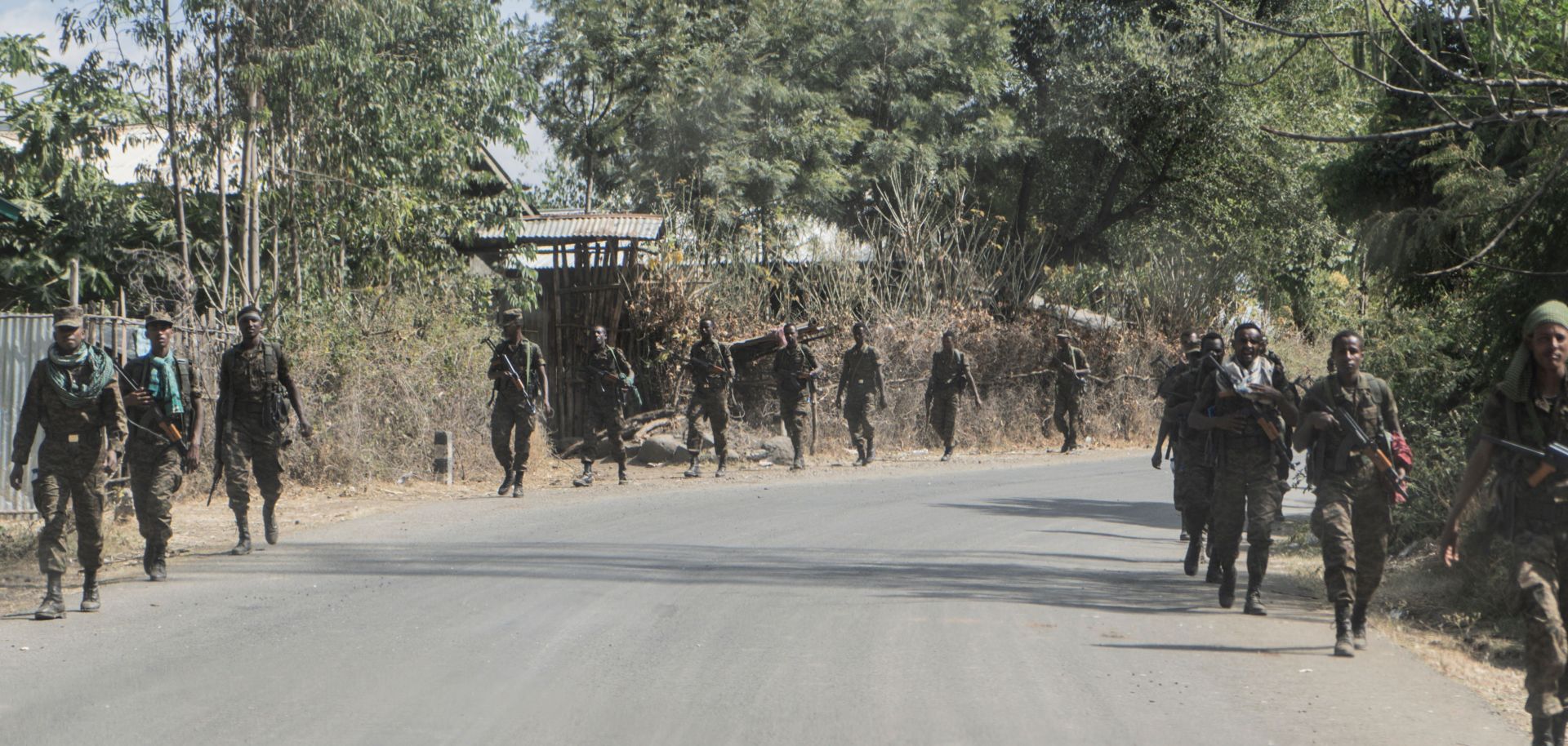
Soldiers from the Ethiopian National Defense Force (ENDF) walk in line in Wichale, Ethiopia, on Dec. 13, 2021.
Tigray fighters’ retreat and apparent willingness to negotiate with the Ethiopian government signals a sharp change in the direction of the civil conflict. However, a standoff remains the most likely result due to enduring constraints on both sides. The head of the Tigray People’s Liberation Forces (TPLF), Debretsion Gebremichael, wrote a letter to the United Nations on Dec. 19 announcing that he had ordered his forces to withdraw from Ethiopia’s Afar and Amhara regions in an abrupt change in the northern rebel group’s strategy. Debretsion claimed that the TPLF’s retreat was driven by a desire to negotiate with Ethiopian Prime Minister Abiy Ahmed’s government, which launched the offensive against Tigray in November 2020. But the recent loss of key locations and strained supply chains suggest that the TPLF was losing ground ahead of the announced withdrawal.
- On Dec. 19, the Ethiopian military announced it had regained control of the town of Lalibela, a UNESCO world heritage site in eastern Amhara, and Weldiya, a town approximately 65 kilometers (40 miles) south of Tigray along the strategic A2 highway connecting the northern region to the Ethiopian capital of Addis Ababa.
- Debretsion’s letter positioned the TPLF withdrawal as “an opening for peace,” and asked that the United Nations, African Union and other international representatives facilitate TPLF negotiations with the central government. The letter also called for a no-fly zone for hostile aircraft over Tigray, arms embargoes on Eritrea and Ethiopia, and a U.N. body to affirm that external armed forces had withdrawn from Tigray.
Ethiopian Prime Minister Abiy Ahmed has little incentive to engage with the weakened TPLF, while resistance from ethnic Amhara elite and continued Amhara militia occupation of western Tigray will collectively limit the negotiation progress. While the TPLF claims that its retreat is intended to open the door to negotiations, its occupation of key towns and cities increasingly close to the Ethiopian capital of Addis Ababa provided the group significant leverage against Abiy’s government. The group’s withdrawal from Afar and Amhara has removed Abiy’s greatest incentive to engage in talks with the TPLF by relieving the prime minister from having to retake those regions outside Tigray. Additionally, ethnic Amhara political and business elites generally favor a zero-sum outcome to the conflict, meaning that elites are exerting continuous pressure on Abiy to bring the Tigray region under the control of the central government. Negotiations are not part of this calculus. Finally, Amhara militias, commonly known as Fano, occupy parts of western Tigray and have carried out raids, arrests and executions of ethnic Tigrayans. As long as government-affiliated Amharan groups have success with low-grade conflict in western Tigray, Abiy can claim ignorance of human rights abuses while militias continue to encroach on Tigrayan territory.
- The TPLF captured Dessie and Kombolcha, two key strategic towns along the A2 highway, in November, causing widespread concern that the TPLF would launch an offensive against Addis Ababa. The Ethiopian government re-took both towns in early December.
- The international organization Human Rights Watch alleges that Fano has systematically rounded up ethnic Tigrayans in Abdebai, Humera and Rawyan in western Tigray and separated families, arrested young men and boys, looted homes and killed people who tried to escape. The U.N. Human Rights Council also alleges that TPLF soldiers are responsible for widespread war crimes in Amhara and Afar, including arbitrary killings and widespread rape.
Addis Ababa is no longer at immediate risk of conflict, but the numerous political and military constraints facing negotiations means the Ethiopian government is unlikely to immediately engage in meaningful dialogue with the TPLF and a standoff remains the most likely outcome. Abiy may announce a willingness to negotiate in order to alleviate international pressure to end the war. However, the prime minister still faces significant domestic pressure to establish central control over Tigray, which will impede the negotiation process. Abiy’s Ethiopian National Defense Forces (ENDF) could launch a full-scale ENDF invasion of Mekelle, the regional capital of Tigray, although the Ethiopian government would face international condemnation for what Tigrayan advocates would call a genocide. The TPLF will almost certainly not accept centralized government control over the region, meaning that any attempt by the Ethiopian military to assert control would be met with fierce military opposition. More likely, a protracted standoff between TPLF forces relegated to the Tigray region and ENDF forces and allied militias will emerge, thus prolonging an end to the conflict. The low-grade conflict in western Tigray in which Amhara militias occupy swaths of land will likely persist, although flare-ups may become more common as the TPLF has more resources to devote to defending territory.
