
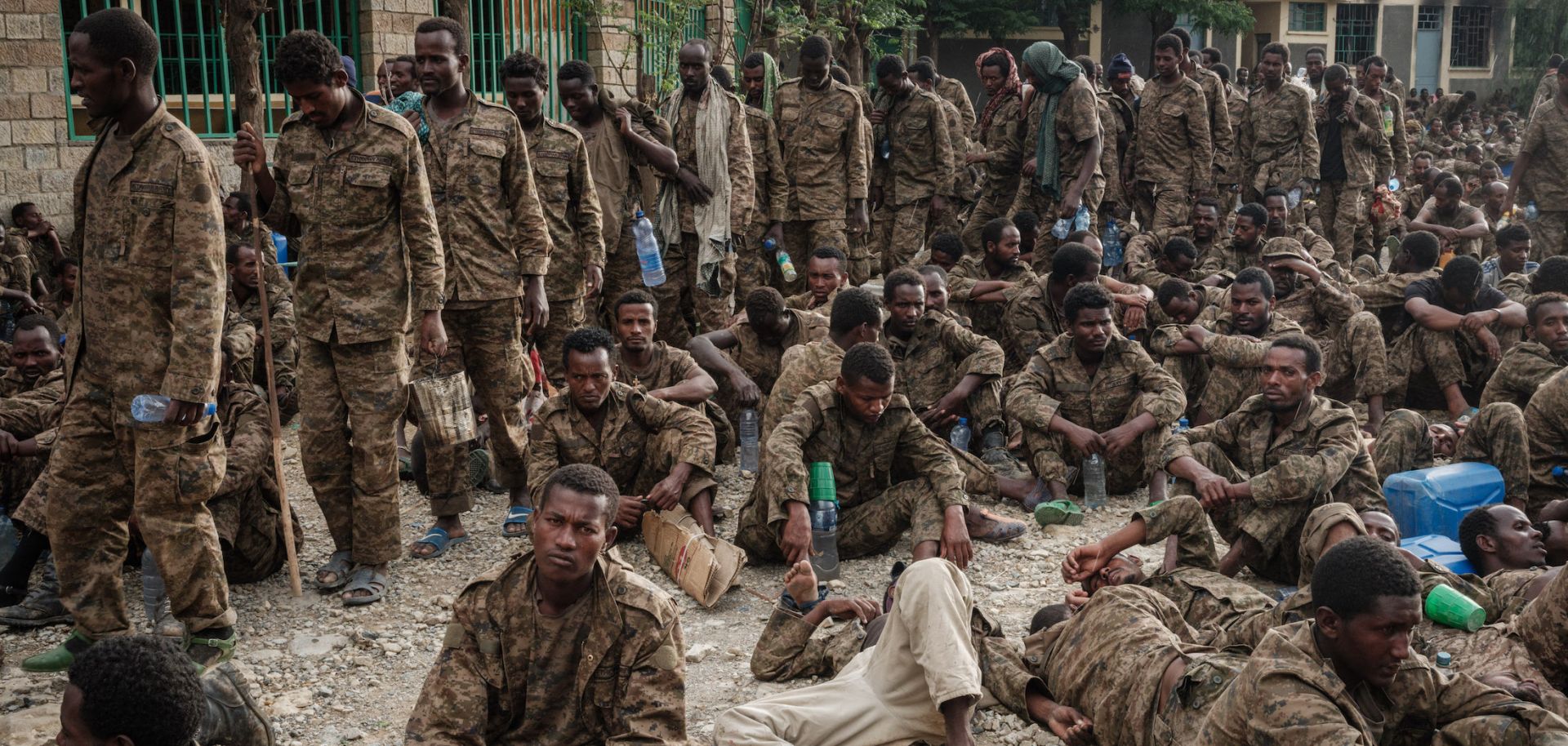
Captive Ethiopian soldiers arrive in Tigray’s regional capital of Mekele on July 2, 2021.
Ethiopian Prime Minister Abiy Ahmed appears on the verge of ending a unilateral cease-fire with Tigray forces, raising the risk for even more humanitarian strife and ethnic violence in the country. On Aug. 10, Abiy’s office issued a statement saying that it was the “right time” for all “capable Ethiopians” to join Ethiopia’s military, special forces and militias. The statement comes after Ethiopia’s foreign ministry warned Aug. 6 it could deploy its “entire defensive capability” against the Tigray People’s Liberation Front (TPLF) following TPLF incursions into neighboring Ethiopian regions Afar and Amhara.
- Such a deployment against the TPLF’s forces would end the unilateral cease-fire that Ethiopia declared on June 28 in response to the TPLF overrunning Tigray’s regional capital of Mekele.
- Amhara’s regional government has been backing the federal government in its strategy against the TPLF, with an Amhara official saying on Aug. 6 that the region would launch an offensive against Tigray forces.
The expansion of TPLF territory to create a buffer zone will drive Addis Ababa to respond militarily. After the TPLF seized the Amhara town of Lalibela on Aug. 5, TPLF spokesman Getachew Reda said that the group would not leave areas it had expanded into until “the blockade [against Tigray was] lifted.” The TPLF claims that despite its cease-fire, which Ethiopia has framed as “humanitarian,” the Ethiopian government is carrying out a siege against the region and limiting the flow of essential supplies, including food. The TPLF’s offensive in Afar and Amhara has focused heavily on securing the main A2 highway (and other roads) connecting Mekele to Addis Ababa by establishing a buffer zone to keep Ethiopia and its allies from attacking the TPLF’s roads, as well as spreading into Afar and Tigray. This will give the TPLF much-needed leverage when and if negotiations with the central government begin.
- Samantha Power, the administrator of the U.S. Agency for International Development, said on Aug. 5 that only 10% of the trucks that the United Nations estimated needed to enter the Tigray region with aid to meet current assessed needs were allowed to enter since mid-July.
Negotiations between Ethiopia and the TPLF do not appear to be imminent as both sides continue to dig in, making further conflict and more violence likely. Many of the same disagreements that led to the conflict remain in place and both sides of the conflict seem to be far apart on negotiations. Addis Ababa, which continues to appear completely uninterested in talks at this time, will face increasing pressure from Amhara — a region that represents a significant base of support for Abiy’s government — to respond militarily. Sudan offered to mediate the dispute but recalled its ambassador to Ethiopia on Aug. 8 following the Ethiopian government’s rejection of the offer. The TPLF’s successes on the battleground, meanwhile, also give the group little incentive to negotiate unless Ethiopia caves into some of its demands. Those demands, however — which include international oversight of any cease-fire and a full withdrawal of Ethiopian and Amhara forces from all of Tigray — are almost sure to prove too politically difficult for Abiy to accept, leaving the two sides locked in an impasse.
Without a clear path to de-escalation, the Tigray conflict risks evolving into a more widespread civil war, exacerbating Ethiopia’s humanitarian and economic crises. Even prior to the TPLF regaining control of Mekele, an estimated 2 million people were internally displaced in the Tigray region. The conflict’s widening has since forced another 250,000 people to flee from Afar and Amhara. Moreover, the United Nations has warned that over 100,000 children in Tigray are at risk of death from malnutrition. The situation is only going to worsen, with the U.N. World Food Programme estimating that only 25% to 50% of Tigray’s normal crop planting occurred this year amid the unrest. Inflation has also already become a crucial issue for Ethiopians throughout the country. At the end of June, Ethiopia officially reported that the country’s annualized inflation level hit 24.5%, with rising food prices driving much of that increase. The high level of fighting also risks harming Ethiopia’s image as a potential investment destination. Its long-awaited bidding round for two telecom licenses failed to garner the amount of interest that Addis Ababa had hoped for, leading it to award just one license in May.
Further expansion of the conflict will cause more ethnic strife in the country as well, particularly against ethnic Tigrayans, making a permanent solution to Ethiopia’s notorious fractious ethnic divisions more difficult. Western organizations have already accused Ethiopia of ethnic profiling and Abiy’s calls for Ethiopians to help the government “track down and expose spies and agents” working with the TPLF are only going to augment those fears.
- An Aug. 5 incident involving artillery shelling in Ethiopia’s Afar region may have killed more than 200 civilians, including more than 100 children, according to a regional official cited in a recent AFP report. The exact death toll has not been verified, but the incident nonetheless underscores the escalating scope of the violence in the country.
