
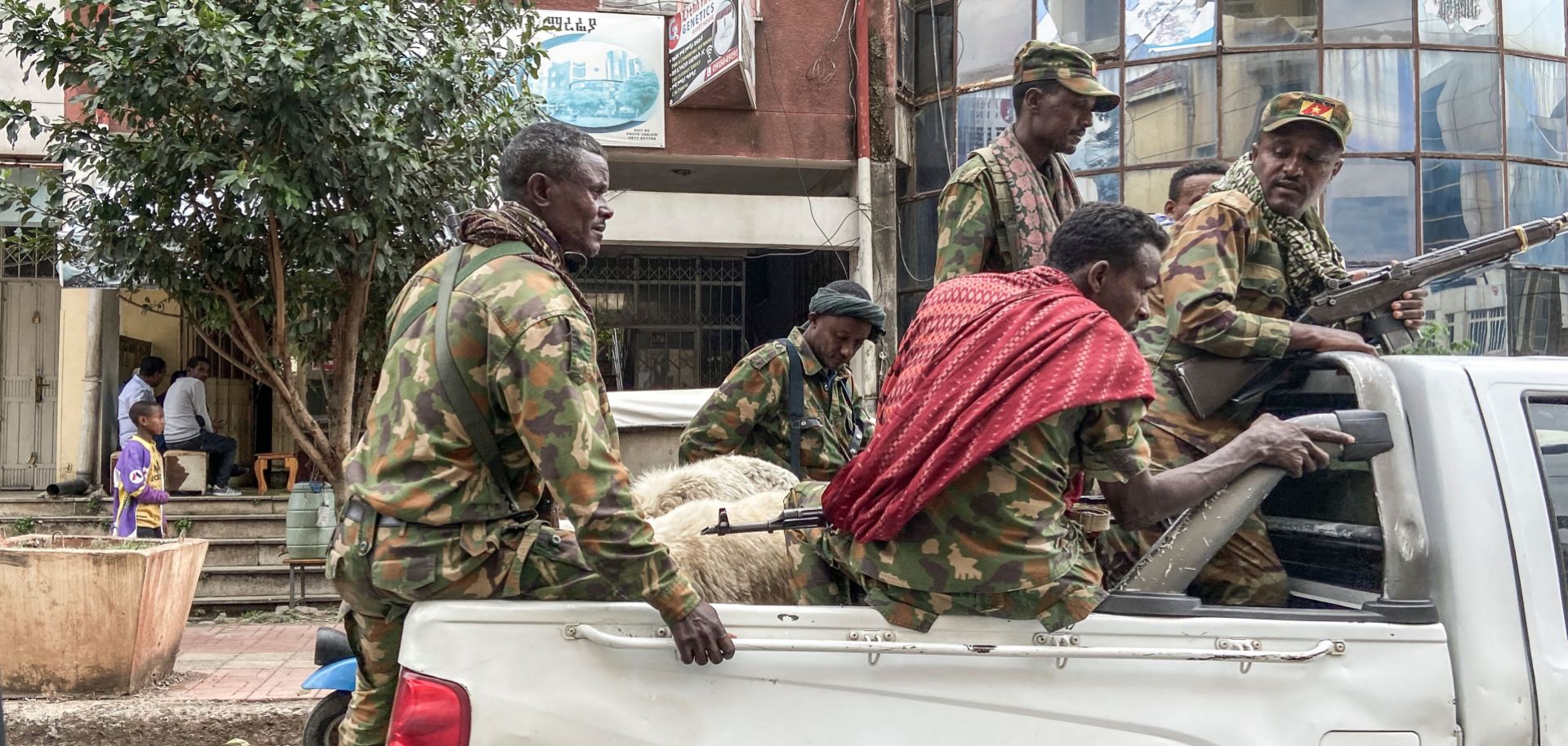
Members of the Amhara militia fighting alongside Ethiopian forces in Tigray ride on the back of a truck in Gondar, Ethiopia, on Nov. 8, 2020.
Ethiopian Prime Minister Abiy Ahmed appears unwilling to abandon his offensive against the Tigray People’s Liberation Front (TPLF) without fully exhausting a military response. As the conflict enters its third week with no end in sight, the offensive risks both damaging Ethiopia’s attractiveness as an investment destination and escalating into a significant regional conflict. A protracted and deadly conflict with human rights violations risks undermining Abiy’s reputation as a liberal-minded and reform-oriented leader following his historic peace agreement with neighboring Eritrea in September 2018, which has since boosted Ethiopia’s attractiveness to foreign investors.
After rejecting mediation efforts, Abiy announced Nov. 17 that the Ethiopian National Defense Force (ENDF) would launch a “final and crucial” offensive against the TPLF. Abiy’s announcement comes two days after the military claimed that it had taken control of Alamata, a town in southeastern Tigray on the main highway to Mekelle, the regional capital. On Nov. 18, Ethiopia’s military chief Berhanu Jula said that his forces were advancing on the Tigray capital. In a Nov. 16 meeting, Ugandan President Yoweri Museveni urged Ethiopian Foreign Minister Demeke Mekonnen to launch peace negotiations with Tigray, as did former Nigerian President Olusegun Obasanjo during his trip to Addis Ababa that same day. But as things stand, neither side of the ongoing conflict appears willing to negotiate.
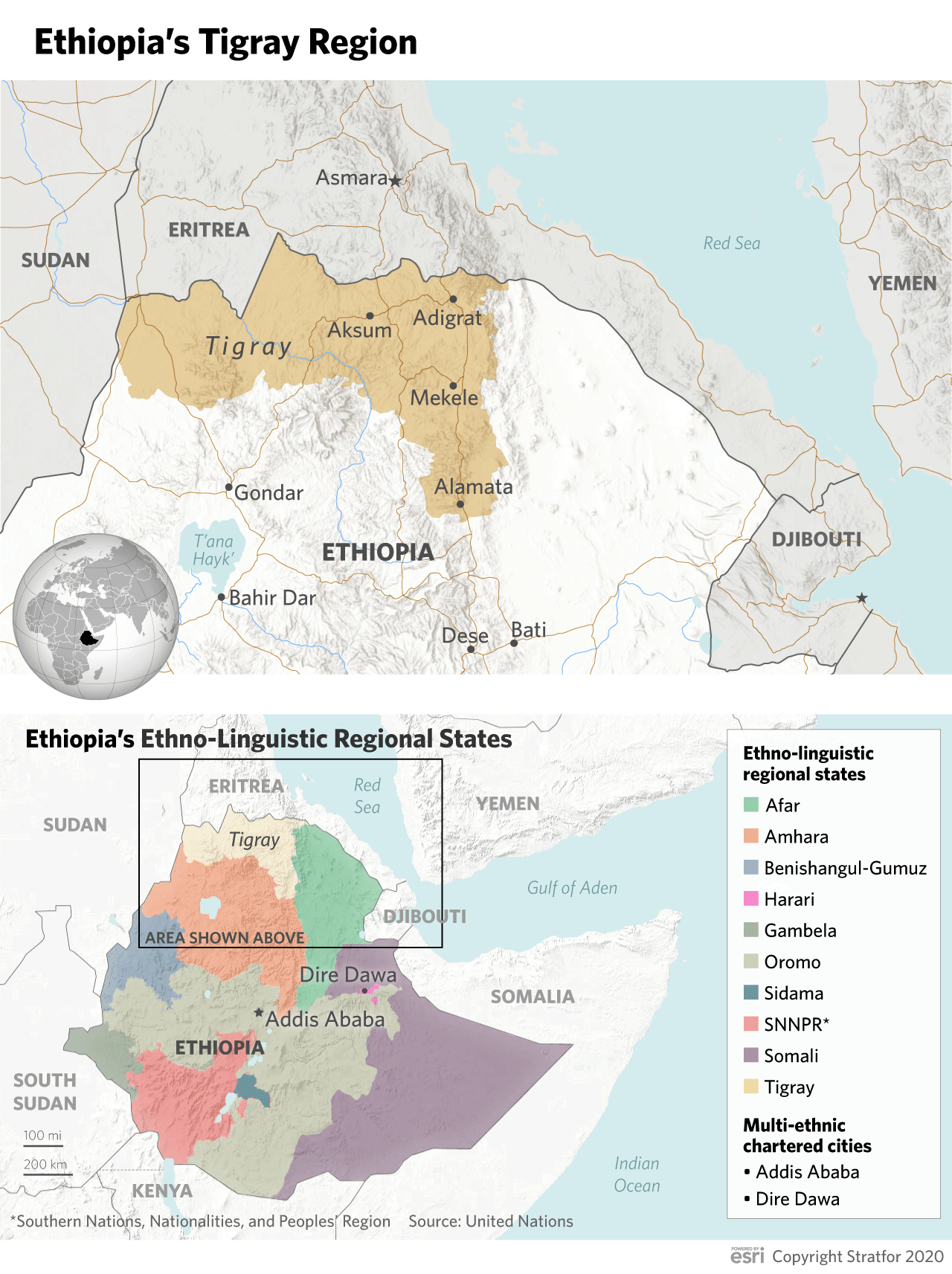
It does not appear that the Ethiopian military has the ability to quickly defeat the TPLF and its aligned forces, resulting in a protracted conflict that could exact a significant toll on civilians living in Tigray. The TPLF will be able to muster more capable firepower and more fighters as the battle moves into the more difficult mountainous terrain near Mekelle. Tigray’s regional leader has also claimed that TPLF forces and their allies have inflicted significant damage on those of the federal government. Ethiopia, meanwhile, is likely overstating the pace of its military advances to fend off criticism. But with a near-complete media blackout, it is difficult to verify either side’s claims.
- The Tigrayan leadership claims to have an estimated 200,000 to 250,000 fighters that they can draw on. Many of the region’s military leaders are former ENDF military commanders that had been pushed out since Abiy took office, giving them a high degree of experience and capability.
- Tigrayan officials have also claimed that a large proportion of the heavily armed ENDF Northern Command, based in Mekelle, has backed the regional Tigray government, and that a significant proportion of the armament and equipment had been seized.
- In recent weeks, the TPLF has launched rocket attacks at two airports in Bahir Dar and Gondar in response to government airstrikes on Mekelle. The TPLF has also launched rocket attacks against Asmara in response to alleged Eritrean support of the Ethiopian offensive.
The TPLF and its allies have withstood the initial offensive, but their ability to fight will become more difficult if the prolonged conflict becomes a war of attrition or devolves into an insurgency. In such a scenario, finding external support, such as from Egypt or especially Sudan, could prove instrumental in the long run. Tigray has limited options to continue supplying itself, both with resources related to the military conflict and humanitarian goods. Most of its logistical connections go through Ethiopia proper or Eritrea, and during a protracted conflict, those supply chains will be largely unavailable. The only other land border that Tigray possesses is with Sudan, placing the new Sudanese government in a key position. Egypt does not have a land border, but Cairo has a strategic interest in gaining leverage over Ethiopia and could find supporting the TPLF beneficial to that end.
When it comes to resolving the conflict, Abiy has effectively backed himself into a corner. Abiy has continued to reject talks, which reflects his overall strategy of trying to centralize political power in Addis Ababa and reduce the level of power that Ethiopia’s regional states have. This strategy, however, leaves little room for an offramp to de-escalation in the short-term, as engaging in negotiations without the Ethiopian military first displaying a decisive show of force against Tigray would expose Addis Ababa’s limited ability to control the region and the TPLF. This could then lead to other regions that reject his centralization strategy to demand similar concessions. It may also lead to the end of Abiy’s personal political career in 2021 planned elections.
Neither the TPLF nor Addis Ababa will likely be open to entering negotiations as long as they have enough political support to continue the fight. Abiy’s offensive is backed by leaders in Ethiopia’s Amhara region who support his political agenda. The Amhara Special Force has also been a critical component of the initial offensive. Abiy’s Amhara allies have also been supportive of marginalizing the TPLF and ethnic Tigrayans. The more the fighting becomes ethnically-motivated, however, the more it will embolden Tigrayans to back the TPLF. That support could dissipate in the event of a lengthy conflict, as stockpiled food supplies in Tigray decline and water becomes more scarce. But right now, the famine-prone region is coming out of its rainy season (July to August) and has just harvested crops.
- On Nov. 13, Ethiopian police reportedly visited a U.N. World Food Programme (WFP) office in the Amhara region to request a list of their ethnic Tigrayan staff, indicating ethnic profiling by the Ethiopian government.
- Ethiopia has also allegedly disarmed several hundred Tigrayan soldiers deployed in
- On Nov. 4, the Ethiopian parliament voted to label the TPLF a terrorist organization.
- Ethiopia also froze the bank accounts of TPLF-linked companies on Nov. 17.
Any bogging down of the conflict would worsen Ethiopia’s humanitarian crisis, with a high number of civilian deaths and displaced peoples. Already there have been widespread accusations that Tigrayans have been the target of harassment, summary executions and arbitrary imprisonments throughout the country. Equally, there are accusations that the TPLF has also been the instigator of ethnically-motivated violence and killings of civilians.
- There have so far been significant accusations of human rights violations on both sides of the conflict.
- In Tigray, non-governmental organizations and other aid groups have been trying to evacuate staff, but this has been difficult due to the internet and communications blackout.
- As of Nov. 18, Sudan had reported 36,000 refugees crossing into its territory. The United Nations also expects Sudan to receive up to 200,000 more refugees over the next six months.
The Tigray conflict will also damage Addis Ababa’s ability to play a role in stabilizing the broader Horn of Africa region, further eroding its attractiveness for foreign investment. After decades of animosity and violence, Eritrea and Ethiopia signed a historic peace deal in 2018, which has since led to a surge in regional investment in infrastructure aimed at unlocking Ethiopia’s landlocked market. In 2019, the African Development Fund agreed to finance the first phase of the Ethiopia–Djibouti Road Transport Corridor Project. Ethiopia has also signed port agreements with Somalia (and Somaliland) and Eritrea. But there’s a good chance that the Tigray conflict and likely degradation of the security situation in other areas of the country will prompt investors to reconsider funding such projects — particularly given the already poor global investment climate amid the COVID-19 pandemic.
Upstream Nile countries Sudan and Egypt will likely try to take advantage of the Tigray conflict to extract concessions from Addis Ababa on its Grand Ethiopian Renaissance Dam (GERD). Egypt, which fears the continuous refilling of the $4 billion hydroelectric dam along the Blue Nile could further limit its water flows from the Nile, will attempt to use the unrest in Ethiopia to gain leverage against the Ethiopian government. But Tigray’s potential dependence on Sudan for access to supplies in the case of a prolonged conflict has the potential to offer Khartoum much more leverage over the Ethiopian government in the ongoing dam on the dam’s initial filing and annual operation.
- Ethiopia plans to fill the GERD’s reservoir significantly next summer.
- U.S.-brokered talks between Ethiopia, Sudan and Egypt earlier this year failed to reach an agreement on how to sustainably refill the dam's reservoir and the amount of water that should be released back into the Nile.
Somalia could bear the brunt of the regional fallout from the Tigray conflict by prompting Ethiopia and the United States to withdraw their peacekeeping soldiers. The ENDF has already reportedly begun pulling troops from Somalia that are not directly involved with the African Union Mission to Somalia (AMISOM) peacekeeping operation. It’s possible Ethiopia could further reduce or suspend its participation in ANISOM as Addis Ababa focuses its resources on the conflict in Tigray. U.S. President Donald Trump, meanwhile, is also considering removing the 700 troops in the country involved in counterterrorism and training operations. Such withdrawals would occur ahead of an expected period of social and political unrest in Somalia in the likely lead-up and aftermath of the tense elections in early 2021. Any reduction in U.S. and/or Ethiopian support will also increase the space for al Shabaab and other militant groups to conduct attacks, which may extend beyond their border to Kenya and other East African countries.
