
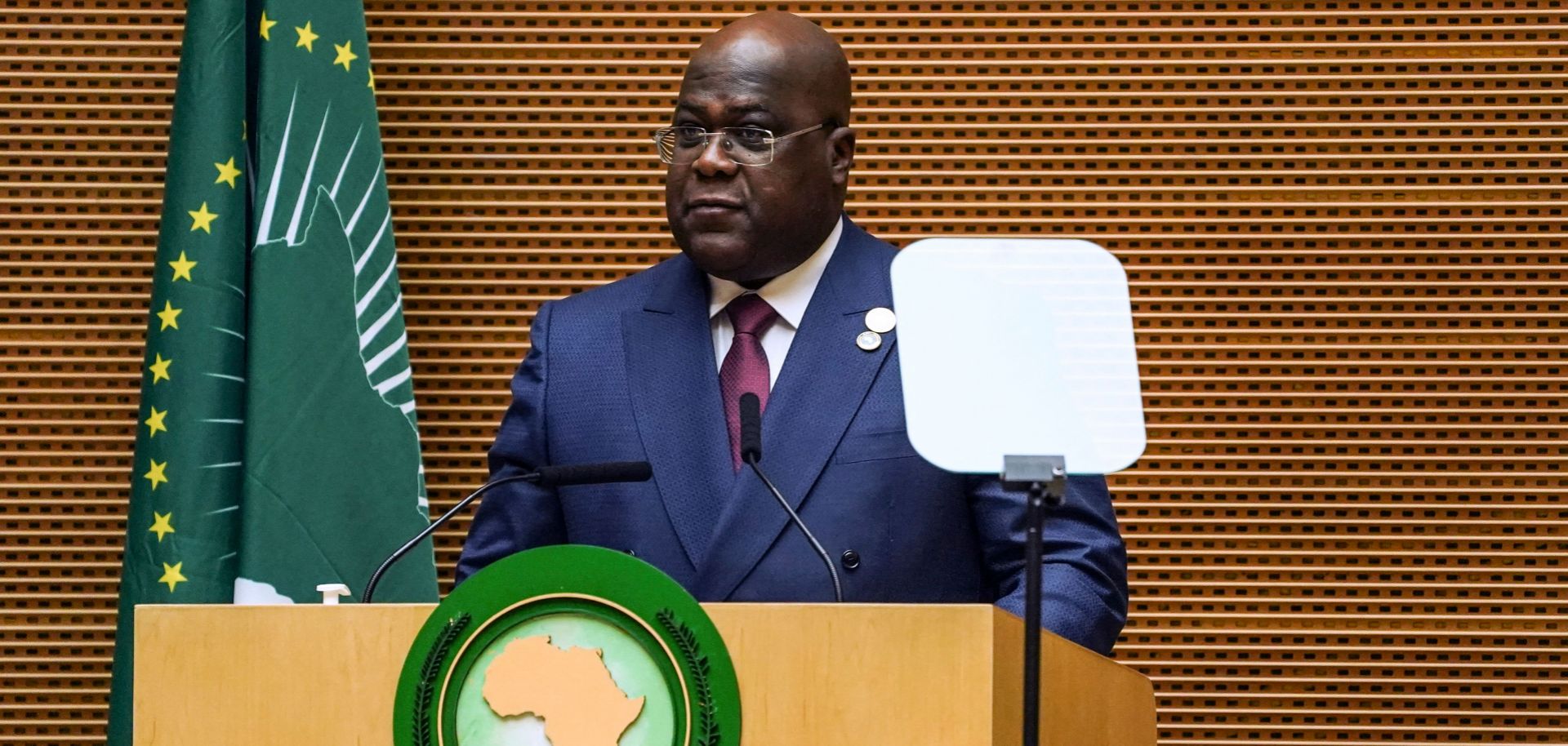
The president of the Democratic Republic of Congo, Felix Tshisekedi, speaks during the African Union (AU) Summit in Addis Ababa, Ethiopia, on Feb. 5, 2022.
Congo's entry into the East African Community (EAC) will lead to minor improvements to border crossing bureaucracy and reduced tariffs, though it's unlikely to result in significant short-term economic benefits for the bloc due to economic, political and security constraints. The EAC admitted the Democratic Republic of the Congo to the regional bloc on March 29, increasing the EAC market by 90 million people. Kenyan President Uruhu Kenyatta said on March 29 that adding Congo to the community will boost the common market's annual economic output by 25%. Additionally, the presidents of Uganda and Rwanda remarked that the bloc would now have access to the Atlantic Ocean for the first time through Congo's Matadi and Boma ports.
- The EAC promotes the free movement of goods, people, labor, services and capital between member states through its pillars of integration, including the eventual establishment of a customs union, common market, monetary union and political federation. Progress on establishing each pillar is mixed, as members frequently run up against issues of sovereignty and an unwillingness to cede power to supranational institutions when attempting to establish a political federation.
- Congo applied for EAC membership in 2019, citing its desire to benefit from the freer movement of its citizens across borders, removed or greatly reduced import taxes (which would make transporting goods cheaper), greater investment, and easier access to ports at Dar es Salaam and Mombasa.
- Congolese lawmakers still have to ratify EAC laws and regulations before they take effect, which could take several months to a full year.
Despite the optimism surrounding Congo's entry into the common market, the economic benefits of integration will be muted due to the country's poor infrastructure, weak security and limited areas of complementary economic activity. The primary economic benefit to Congo and its new EAC partners will be lower or eliminated tariffs and customs taxes at border crossings, as well as reduced time that goods are stuck at border crossings pending inspections by tax authorities and health inspectors. However, the volume of trade between Congo and its East African partners will be limited by Congo's poor (and in some places nonexistent) road and rail infrastructure. Further, Congo does not have a railway that connects its western ports along the Atlantic coast with the northern or eastern parts of the country that border South Sudan, Uganda, Rwanda, Burundi and Tanzania. This means that the only way to transport exports from East Africa to western Congo remains via air, which is more costly. Insecurity in the eastern Congo will also continue to limit the flow of goods, people and services, as the ongoing insurgencies regularly block roads and result in civilian and security force casualties. The high security risk contributes to extreme poverty, which means that while Congo's entry will add 90 million consumers to the EAC market, the purchasing power of those consumers will be very low. Additionally, even if roads and security permitted open movement of goods, East African economies do not have the industrial bases necessary to support regional exports. For example, Uganda does not have industrial use for Congo's copper, nor does Kenya for Congo's cobalt.
- In December, Uganda started a project to connect Uganda to the Congolese cities of Beni, Butembo and Goma in eastern Congo via a 223-kilometer road in anticipation of the Congo joining the bloc. Many more of these projects are necessary before there are enough networks of well-maintained roads to serve as supply corridors.
- There is a large presence of armed groups in eastern Congo following years of intermittent civil wars. The Kivu Security Tracker, a U.S.-based monitor of violence in the region, estimates that 80 rebel groups are active in the eastern Congolese provinces of Ituri, North Kivu and South Kivu.
- More than 70% of the Congolese population lives on less than $1.90 a day.
Congo's involvement in regional rivalries will limit the political integration of EAC members. Historical disputes between Congo, Rwanda, Uganda and Burundi resulting from state sponsorship of rebel groups operating in Congo's two civil wars and intermittent conflict in the east is one such division that will very likely manifest in EAC dynamics. Congo has accused Rwanda of sponsoring the M23 rebel group, Rwanda has accused Uganda and Burundi of supporting the Democratic Forces for the Liberation of Rwanda, and Uganda has accused Rwanda of backing the Allied Democratic Forces. While each of these rebel groups has its own locally motivated goals, regional powers have repeatedly relied on such groups to address social, economic, political and ethnic grievances. From an economic perspective, the addition of Congo will likely deepen the rivalry between Kenya and Tanzania. Kenya has historically dominated the transport of goods from landlocked Uganda, Rwanda and Burundi to the Kenyan port of Mombasa. The entrance of Congolese copper and cobalt to the EAC market offers greater opportunities to ship the minerals from ports in East Africa, rather than South Africa via the long and expensive route south. Due to Tanzania's shared border with southeastern Congo, Tanzania will likely court investors to upgrade rail infrastructure so that it can provide an alternative to Kenya's Mombasa Port with the port in Dar es Salaam, thus diluting Kenya's influence. Finally, Congo (like Tanzania) is also a member of the Southern African Development Community (SADC), which will further support Tanzania's positioning as a political and economic alternative to Kenya by increasing the SADC's presence within the EAC.
- On March 29, the same day that the EAC admitted Congo to its membership, the Congolese-Rwandan rebel group M23 seized several towns in the eastern Congolese province of North Kivu. The Congolese military promptly accused Rwanda of supporting the rebels after they captured two Rwandan soldiers. Rwandan officials have repeatedly denied any affiliation with M23.
- The Kenyan port of Mombasa is the largest in East Africa. Kenya's landlocked neighbors have historically relied on the port for access to shipping.
- The East Africa Crude Oil Pipeline, which is currently in development, will run crude oil from Ugandan oil fields to the Port of Tanga in Tanzania. Upon completion, the pipeline will upset Kenya's historical dominance of Ugandan exports, fueling the rivalry between the two largest economies in the EAC.
