
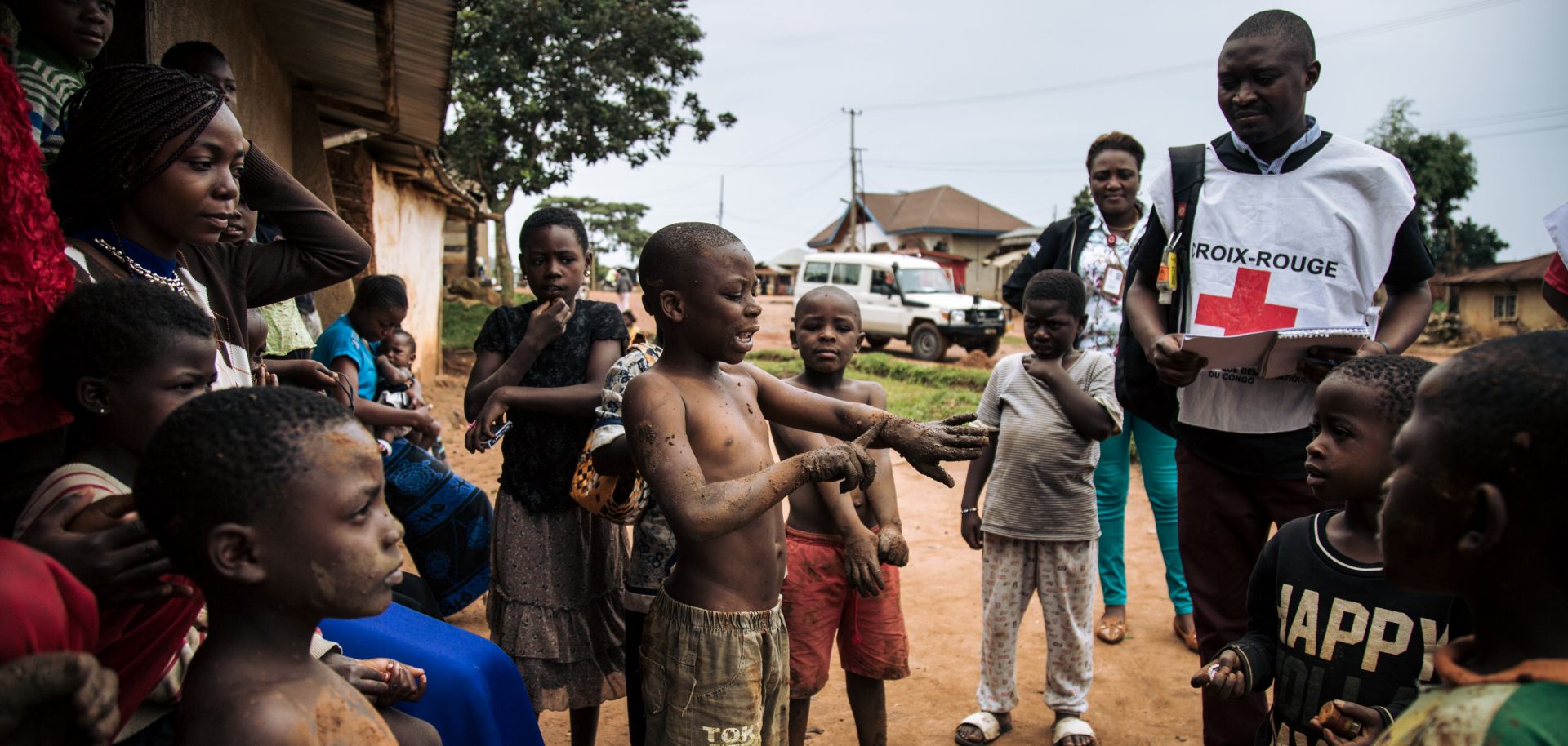
Red Cross members visit families in northeastern Democratic Republic of Congo to listen to their fear of the Ebola virus on Aug. 31. The Congo's inability to establish control over its easternmost territories has exacerbated the country's current Ebola outbreak.
Editor's Note: This assessment is part of a series of analyses supporting Stratfor's 2019 Fourth-Quarter Forecast. These assessments are designed to provide more context and in-depth analysis of key developments over the next quarter.
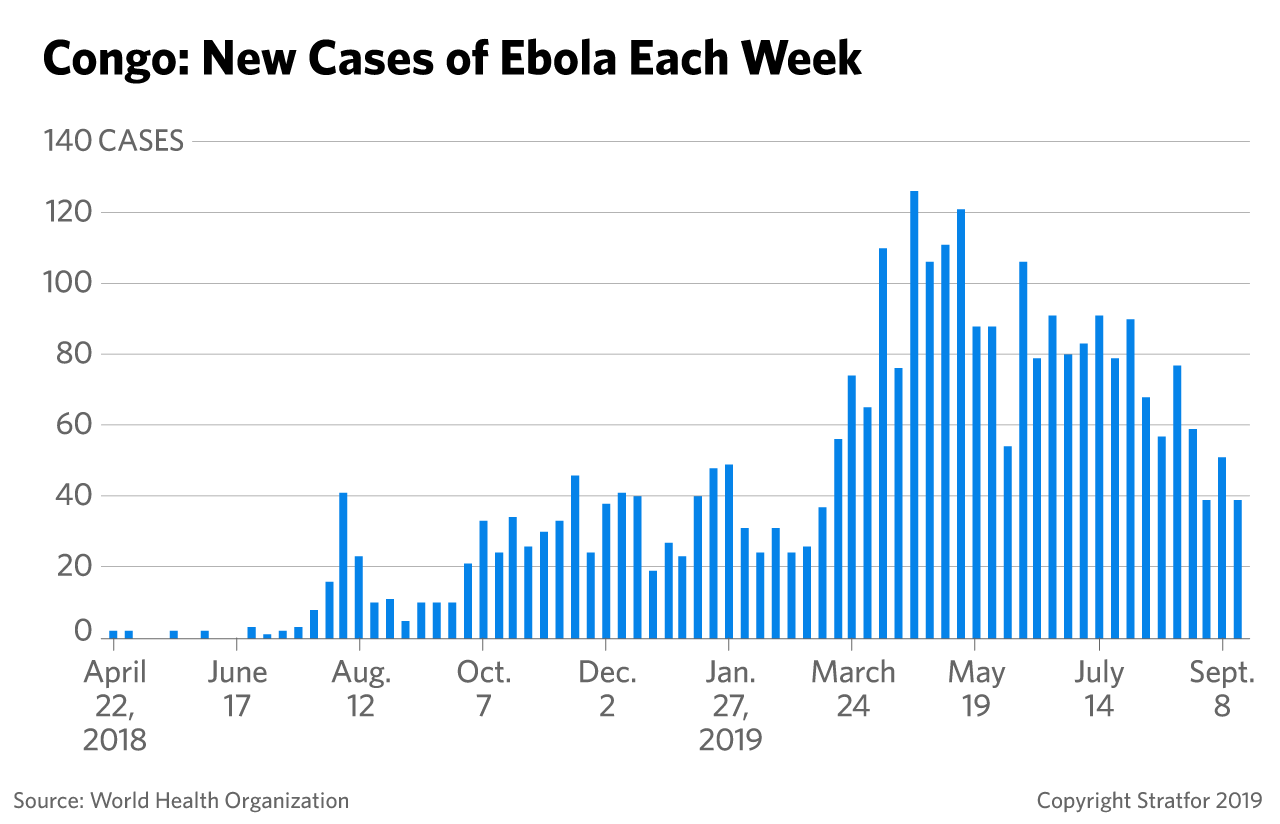
In July, the World Health Organization declared the Ebola outbreak in eastern regions of the Democratic Republic of the Congo an international emergency. Of the more than 3,000 confirmed cases to date, the virus has taken the lives of more than 2,000 people — making it the second-largest Ebola outbreak in history. And while the spread of the disease has weakened in recent months, the crisis is far from over, as new cases continue to emerge and fuel the threat of contagion.
A number of international and nongovernmental organizations (NGOs) have attempted to contain the virus through an ambitious preventive campaign, which has so far helped vaccinate 225,000 people in the country. But experts have argued this number is still insufficient to fully stamp out the virus, since it represents only a small portion of the approximately 10 million people who inhabit the affected Congolese provinces of Ituri and North Kivu. Plans to roll out a new vaccine are expected to mitigate shortages that had stemmed the vaccination campaign's reach. But more medication won't remove the violence and geographic barriers that continue to limit both international and Congolese efforts to identify and access the populations that need it.
A Constellation of Conflict
The specific area affected by the Ebola epidemic, which sits along the border with Uganda and stretches from Lake Albert to Lake Edward, is home to a large variety of armed groups. Some of these groups, including the jihadist Allied Democratic Forces and several local Mai-Mai groups, have attacked NGOs and clinics focused on the anti-Ebola effort. In addition to these direct attacks, the overall presence of armed militias has significantly limited broader preventive measures in the affected Ituri and Kivu provinces.
A significant number of Ebola cases have been reported in remote places where the Congolese government has had no presence for years, with local rebels operating in quasi-autonomous fiefdoms in these rural areas. The effects of these offensives by rebel forces also typically trigger refugee flows. Such an influx of displaced people from these affected areas not only risks adding to already stretched humanitarian and health efforts in the region, but also bringing Ebola into other areas of the Democratic Republic of the Congo's east — or even across the border into Uganda or Rwanda.
There's no one easy fix to the complex constellation of conflict in the Congolese east, which is the result of decades of devolving security. While these groups operate under a wide variety of different names, such as Raia Mutomboki Nduma Defense of Congo and Mai-Mai, their origins all largely hail from localized auto-defense groups against ethnic and foreign-supported militia. As a result, the remote eastern regions of the Democratic Republic of the Congo have long been a victim to ethnic violence at varying scales of scope or intensity — the presence of rebels originating from the former Hutu regime that enacted the Rwanda genocide being just one of the many instigating factors. In the absence of the Congolese government's ability (or intent) to secure the region, local communities have formed their own various self-defense groups that have gradually developed into their own active rebellions.
Even the common names of rebel groups in the region don't necessarily reflect unity. Over 100 smaller groups associated with Mai-Mai, Raia Mutomboki and Nduma Defense of Congo operate independently across the east — each fighting their own wars for survival or resources on a localized scale. Without overarching leadership, or even political agendas beyond localized control, it is almost impossible for the Congolese government to pacify the region through a diplomatic process. The Congolese military's attempts to crack down on violence has mostly focused on the larger rebel formations, such as the Allied Democratic Forces. But even those efforts have been met with little success on the ground.
Barriers to the East
There are a number of reasons why the Democratic Republic of the Congo has faced such difficulties in trying to establish control over its easternmost territories. Vast rainforests, for one, effectively separate the region from other parts of the country. With limited transport infrastructure, this dense landscape complicates movement to and from the east, limiting the government's ability to rapidly shift security forces. And when it comes to allocating the government's limited security resources, other areas of the country usually rank higher in priority. Separate rebellions in southern Katanga province (where the country's important mining industry is located) or security concerns near the country's capital of Kinshasa (where political power sits) are often seen as more pressing than securing the fairly remote and economically less important eastern edge of the country.
In addition to this geographic divide, the persistence of corruption in the Congolese government, as well as its military, has limited its effectiveness in the east. With only marginal political relevance, funds earmarked for efforts to secure or improve the provinces within the region are an easy target for corrupt officials — which, subsequently, has directly affected anti-Ebola efforts in the country.
This has occurred not only through limiting the capabilities of the military forces deployed to this particular area, but also through direct misappropriation of public funds and foreign aid intended to help stem the epidemic. Anti-corruption efforts recently led to the resignation and arrest of the country's former health minister, though such actions won't provide a long-term fix to the rampant culture of corruption in the Congolese political establishment. The overall marginalization of the region has also limited access to education and information, which has proved to be a major source of resistance against the anti-Ebola effort as people refuse vaccinations or even attack aid workers.
Left with the existing security and health emergencies, and little resources to truly affect sustainable change, the fight against the current Ebola outbreak in the Democratic Republic of the Congo continues to be an uphill battle. If the Ebola crisis were to flare up again and truly risk expansion into highly populated areas of central Africa, a case could probably be made for a foreign peacekeeping intervention to provide cover for an effective anti-Ebola campaign. But the threshold to trigger such a takeover would be high, due to the area's tangled web of conflict and the vast resources required to effectively — and safely — maneuver it. But even beyond the current ongoing effort to fully stamp out the Ebola epidemic, vulnerability to future humanitarian emergencies in this region will persist because of its treacherous geography and security situation.
