
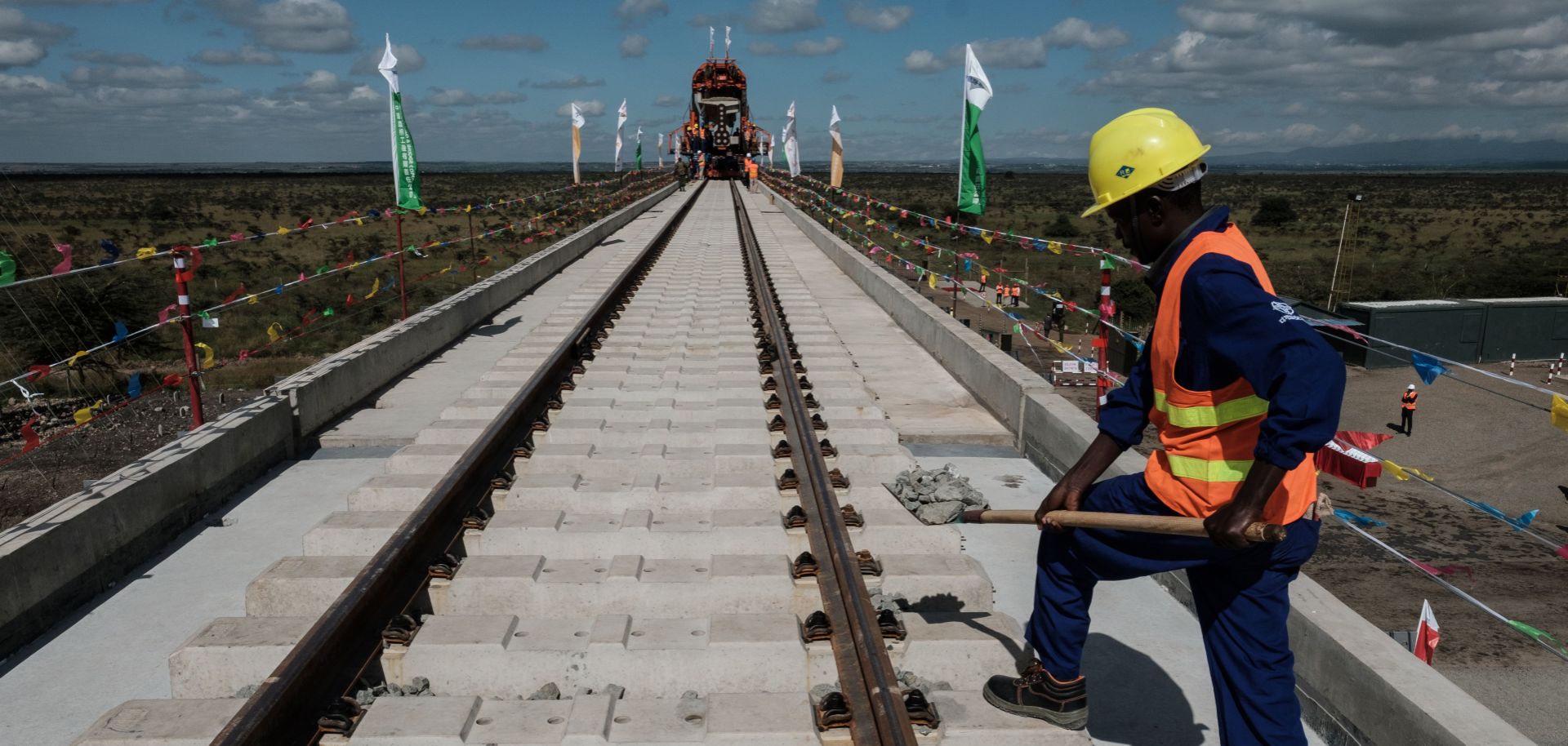
A construction worker adds gravel to the tracks of a section of the new Standard Gauge Railway (SGR) in Nairobi, Kenya, in June 2018.
The winner of Kenya's upcoming presidential election will inherit an increasingly unsustainable debt burden, with repayments slated to overtake the national government's recurrent spending programs beginning in July. Kenya will hold general elections on Aug. 9 in which voters will cast ballots for the country's president and national legislature, along with various regional positions. The presidential race, in particular, is expected to be highly contentious and could hold significant repercussions for Kenya's financial outlook, as massive infrastructure projects continue to drive the government deeper into debt (which now totals an estimated $71 billion, or 70.2% of Kenya's GDP). Kenyan President Uhuru Kenyatta's government has increased borrowing to build his ambitious ''legacy projects,'' which include the Standard Gauge Railway, the Nairobi Expressway and the Lamu port. In funding these infrastructure projects, which are estimated to cost a total of $47.8 billion, Kenyatta's government has relied on Eurobond offerings, a package of Chinese loans and syndicated commercial loans. Kenyatta is not up for reelection this summer, but his chosen predecessor Raila Odinga has committed to negotiating ''better'' debt repayment deals, as has opposition candidate William Ruto.
- During an April 7 budget speech, Kenya's cabinet secretary for the treasury predicted that the country's economy would grow by 6% in the 2022-23 fiscal year. But in its supplementary budget, the treasury also projected that Kenya will spend $11.6 billion annually for debt repayments starting in July, up from $9.9 billion in the current fiscal period. In addition, the treasury expects the government's interest payments as a percentage of total revenue to hit 28% by the end of the 2023 fiscal year, up from 12% in the 2013-14 fiscal year.
- The International Monetary Fund (IMF) warned in December that Kenya faces a high risk of debt distress. In March, the world's leading banks, think tanks and consultancies also downgraded their consensus growth outlook for Kenya from 5.4% to 5.1%, citing the country's reliance on foreign capital for infrastructure and a rise in external debt.
- Kenya borrowed $3.24 billion from China Export-Import Bank to finance the Standard Gauge Railway that would connect Mombasa to Kampala. While the second stage of the railway connecting Mombasa to Naivasha is nearing completion, revenue from the first year of operations came to half of the expected amount, and only covered half of expected operating expenses. This prompted the Chinese firm developing the project, China Road and Bridge Corporation, to pull funding for the third stage due to concerns over financial viability and political stability.
Kenya's main presidential candidates have called for renegotiations of debt payment plans in the lead-up to the election. Public anger at the government's accelerated borrowing has grown in step with the increased debt burden. This stems in part from the fact that, at $11.6 billion, debt repayments will consume about 65% of taxes beginning in July, which will curb spending on popular projects to address poverty and youth unemployment. Against this backdrop, presidential frontrunners Raila Odinga and William Ruto have both promised to renegotiate what they call unfair deals in pursuit of reduced interest rates and longer repayment periods. But Chinese creditors — to whom much of Kenya's high interest, short-term debt is owed — are unlikely to agree to such renegotiated terms.
- Opposition candidate and current deputy president Ruto stressed ''debt must be the last resort'' and that Kenya ''must not be slaves of debt from any place or any country'' in his speech after receiving his party's nomination for president. Odinga — a four-time presidential hopeful and close ally of current President Kenyatta — has used less inflammatory rhetoric in discussing the country's debt woes, though like Ruto, he has also pledged to sweeten the terms of the government's debt deals if elected.
- Bilateral debt to China makes up only 9% of Kenya's total debt. But high-interest rates and short loan terms have still made Chinese debt one of the largest strains on the Kenyan government's revenue. On March 21, the Kenyan Auditor General said the country risks incurring additional costs and penalties after delaying more than KSh3.6 billion ($31.2 million) worth of payments to China Road and Bridges Corporation.
The next Kenyan government will probably fail to renegotiate the country's debt while also failing to reduce public spending, which will increase the probability of a debt default. Kenya's finance minister, the IMF and the World Bank have on separate occasions acknowledged that one of the primary obstacles to debt sustainability is consistent overspending relative to revenue collection. And political constraints portend a continuation of this trend. While Ruto and Odinga have both promised to address the debt problem, they have also promised development projects requiring large public expenditures, meaning the next president will have less fiscal space to balance the budget if they are to implement pre-election development promises. With youth unemployment still above pre-pandemic levels, Kenya's future president is likely to face strong political and social pressure to deliver on promises of building new roads, affordable housing and revamping the health sector, which have the added benefit of creating jobs in the country. The IMF has also been pushing for a restructuring of what it calls ''inefficient state corporations,'' which could lead to job loss as departments merge or shut down. The rising public sector wage bill is another point of contention, as the IMF has asked Kenya's treasury to freeze some existing collective bargaining agreements, remove ghost workers from payrolls and require civil servants to begin contributing to their pensions. While each of these issues already has the potential to spark political backlash, ethnic tensions and violence that typically surround elections in Kenya mean that tensions will likely already be high, further deterring an unpopular reduction in public spending in the near term.
- To raise revenue, the Kenyan government's 2022-23 draft budget includes a proposal that would expand the range of assets the Kenya Revenue Service can freeze in tax disputes, as well as a proposal that would force individuals involved in tax disputes to deposit 50% of the disputed tax sum at the country's central bank. But even if these two proposals are ratified by parliament, their implementation would likely get held up in legal disputes due to both reforms' potentially severe impact on taxpayers' cash flows.
- Both Ruto and Odinga have said that they will propose supplementary budgets to fulfill campaign promises if they win the election. Ruto says that one way he will divert money from large infrastructure projects to a $1.7 million fund for small businesses. Odinga, meanwhile, has announced plans to introduce a $52 monthly stipend for 8 million low-income Kenyans, which would cost the Kenyan government a total of $1.2 billion per year.
Without massive spending cuts, Kenya is headed toward a debt crisis in the medium to long term. In December, Finance Minister Ukur Yatani told the IMF that the Kenyan government plans to raise its debt ceiling to $105 billion, with a long-term limit of $130 billion (up from the current debt limit of $79 billion). This would maintain spending programs needed for government operations to continue uninterrupted, limiting severe repercussions for public sector wages and debt servicing capacity in the immediate term. The IMF has also recently noted some progress toward Kenya's debt consolidation priorities. But in the long term, the unlikelihood of significant spending cuts will raise the risk of the Kenyan government defaulting or restructuring its debt. Should Kenya continue on this path, currency devaluation, austerity measures including spending cuts and tax increases, foreign investor flight, declines in credit ratings and increases in borrowing costs are probable. Given Kenya's strong history of unrest resulting from economic woes, social discontent in the forms of strikes and demonstrations are also likely, which would exacerbate ethnic tensions. The upcoming election means politicians will be resistant to enact economic reforms, but without them, the long-term costs will likely be much greater.
