
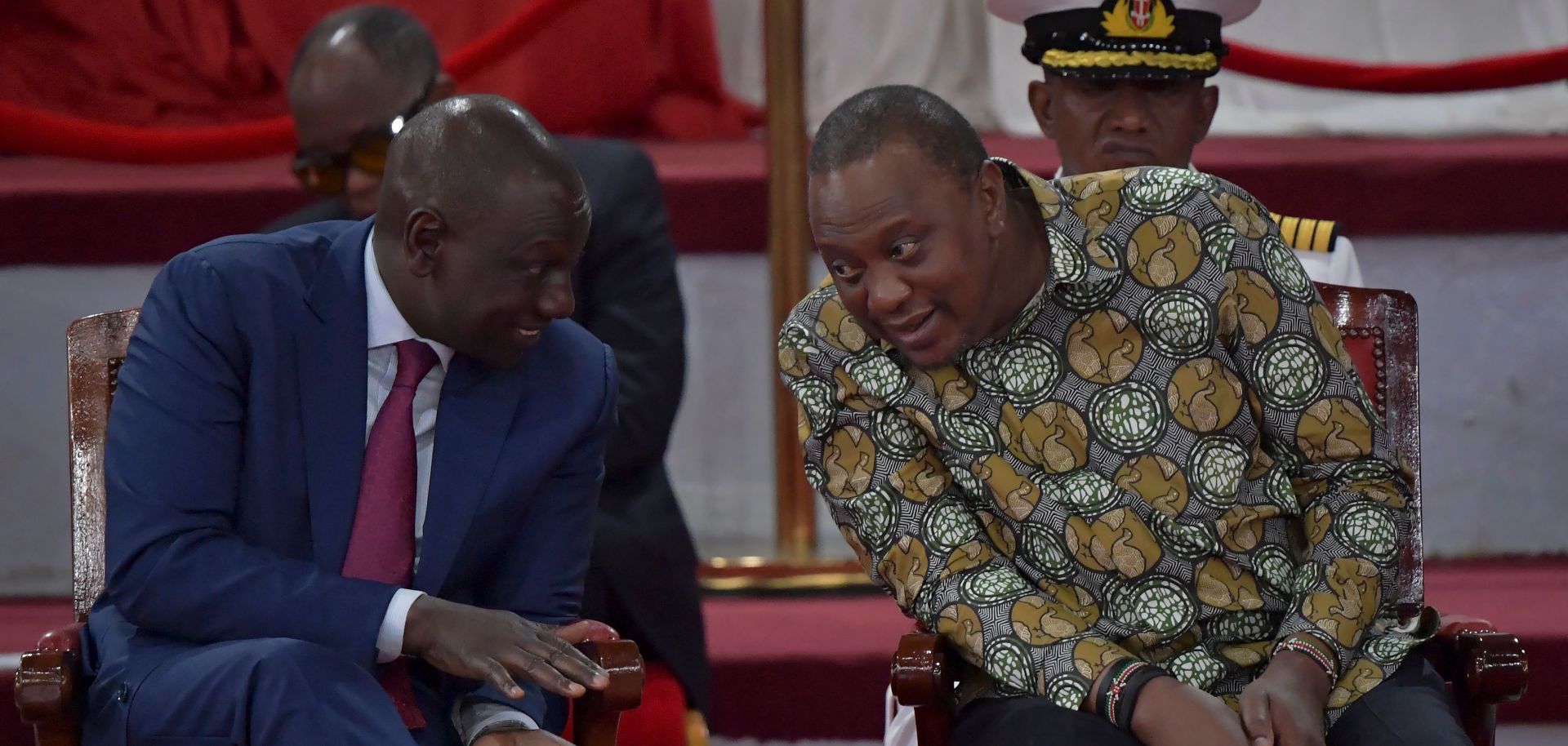
Kenyan President Uhuru Kenyatta (right) leans in to listen to Deputy President William Ruto during a launch event for the government’s Building Bridges Initiative (BBI) bill on Nov. 27, 2019.
A court ruling against Kenyan President Uhuru Kenyatta’s plan to restructure the government ahead of 2022 elections will heighten political unrest, raise the risk of violence ahead of the polls and potentially upend the government’s fiscal consolidation efforts. In a four-hour televised address on May 13, five High Court judges declared the Constitution of Kenya Amendment Bill, 2020 — better known as the Building Bridges Initiative (BBI) bill — unconstitutional. The decision stops the BBI process in its tracks as Kenyatta and the bill's proponents had hoped to hold a referendum by the end of July in order to make the necessary changes to the government ahead of August 2022 elections. Kenya’s solicitor general said the government would appeal the decision.
- The BBI reforms would restructure the Kenyan state by creating a prime minister position with two deputies and boosting the size of the National Assembly. The changes are aimed at shifting Kenya’s political system further away from a winner-take-all system where power is concentrated in the hands of the president.
- Opponents argue that the bill would bloat the size of the government and be used as a way to retain Kenyatta’s influence after his second and final term ends next year by empowering the president’s political allies.
- The judges argued that because the BBI process was triggered by the president, it violated Kenya’s constitution, which mandates the amendment process must be led by ordinary citizens. Since the reforms were proposed by the government, the court also ruled the 5 million signatures that the BBI task force secured did not constitute a popular initiative. The court ruled the task force itself was unconstitutional as well.
The government has limited options to challenge the ruling, meaning most (if not all) of the BBI’s proposals are unlikely to be implemented ahead of the 2022 election. The government will likely appeal the High Court ruling to the Court of Appeals, and if that fails, file an appeal with Kenya’s Supreme Court. Even if the ruling is reversed, the court decision will still delay the BBI process, which could complicate efforts to implement all of the changes before elections by pushing the referendum into late 2021 or into 2022. Should the legal challenges fail, Kenyatta could ignore the court orders and try to hold the referendum regardless. He could also try to implement some of the BBI through legislative action, which is something that the government had discussed previously. Either option, however, would risk triggering more legal challenges that only further draw out the process.
The lack of BBI implementation means Kenya’s current political system and the rivalries within it will remain in place for at least the 2022 ballot, keeping the risk of election violence high. Kenyatta will have to go through an appeals process and potentially implement the bill in other ways, which will divert more attention and government resources while exacerbating political fault lines in the country. Given that he cannot run for a third term, Kenyatta’s efforts ahead of the election will likely focus on throwing his powerful political support behind on a successor he deems most likely to protect his interests — whether that be Odinga, Deputy President William Ruto or a third candidate. The BBI court ruling, however, will likely only worsen Kenyatta’s relationship with Ruto, who opposed the bill and argued that it was a vehicle for Kenyatta and opposition leader Raila Odinga to marginalize him. This could, in turn, lead to more turmoil in the ruling Jubilee Party, raising the probability of the party fracturing ahead of elections. If the bill fails, the BBI initiative would also no longer exist to hold together the shaky political alliance between Odinga and Kenyatta, whose rivalry triggered Kenya’s post-election crisis in 2017.
- One of the stated goals of the BBI bill was breaking Kenya’s cycle of election violence and disputes by diffusing power between the president, deputy president, and the prime minister and his deputies — thus reducing the country’s focus on a single election outcome.
- Under the Kenyan government’s current structure, power is heavily concentrated in the president’s hands, which makes for “winner-take-all” electoral outcomes. This has led to a history of bloody election cycles: Odinga-Kenyatta fault lines triggered the political crisis after 2017 elections, while Kenyatta’s rivalry with Ruto sharpened as a result of the violence after 2007 elections, which led to both being indicted by the International Criminal Court.
The Kenyatta administration’s increased focus on political reforms and negotiations ahead of the election will also further delay action on addressing the country’s economic issues. Kenya’s rising debt levels and the COVID-19 pandemic need significant government attention. Amid the political turmoil, Nairobi risks falling behind on fiscal consolidation and other economic reforms that it needs to make to receive the three-year $2.34 billion bailout package agreed to with the International Monetary Fund (IMF) in February. The IMF has said that Kenya’s debt levels are currently sustainable, but the country is still at high risk of debt distress. And a violent election cycle could push it even further in that direction, as would a politically motivated increase in debt-fueled economic stimulus measures ahead of elections.
