
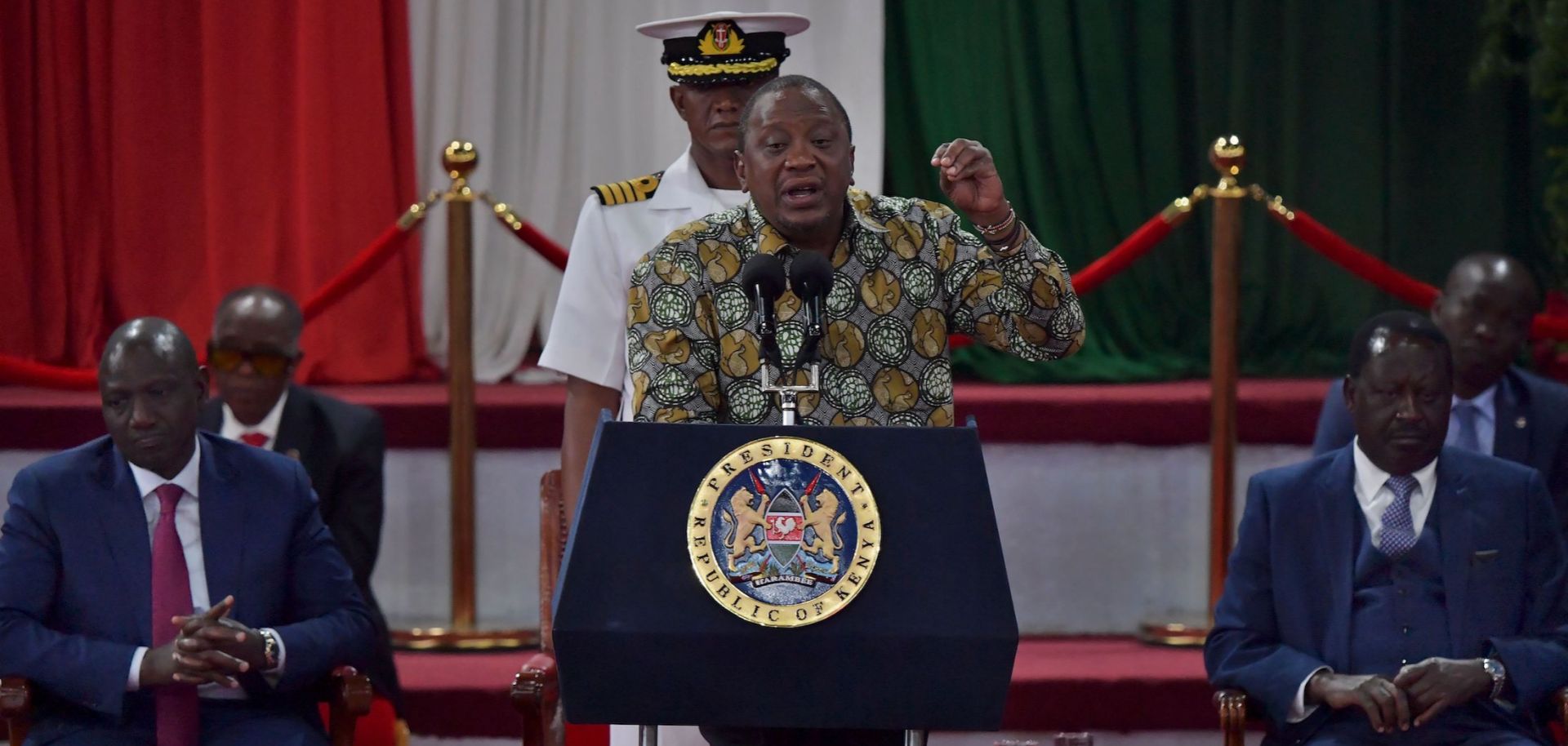
Kenyan Deputy President William Ruto (left) and opposition leader Raila Odinga (right) listen to President Uhuru Kenyatta (center) give a speech in Nairobi, Kenya, on Nov. 27, 2019.
A growing rift between Kenyan President Uhuru Kenyatta and Deputy President William Ruto could break up the ruling Jubilee Party ahead of 2022 elections, raising the risk of ethnic violence that could damage investor confidence in one of Africa’s leading economies. On Oct. 2, the Jubilee Party’s National Management Committee recommended that Ruto be removed from his post after he and his allies stormed the party’s headquarters to try to hold a meeting.
Kenyatta’s close collaboration with opposition leader Raila Odinga on reform efforts has quickly unraveled his alliance with Ruto, which helped to stabilize Kenyan politics in recent years. Kenyatta and Ruto formed a political alliance ahead of 2013 presidential elections under a tacit understanding that the former would support the latter at the end of Kenyatta’s second term. Kenyatta and Ruto’s alliance was always a marriage of convenience between the rival Kikuyu and Kalenjin ethnic groups. Its formation was a way for both leaders to unify and challenge the International Criminal Court (ICC) investigations against them for their actions in fueling violence following 2007 elections. But Kenyatta appears to have assessed that this marriage is no longer needed, now that his two terms are nearing an end and his ICC charges have been dropped. Over the past year, Kenyatta has sidelined Ruto to work more closely with Odinga on reform efforts. His warming ties with Odinga, however, will also likely be temporary, given the long-standing animosity between Odinga’s Luo ethnic group and Kenyatta’s Kikuyu ethnic group, which has long dominated Kenyan society.
- Kenyatta and Odinga do not have a formal alliance, but their closer working relationship is fueling speculation that Kenyatta, who is ineligible to run in 2022, may endorse a ticket that includes Odinga.
- Under Kenyatta, the Jubilee Party has reached election pacts with several opposition parties over the past year, all of which have leaders with their own presidential aspirations.
- In June, Ruto formed his own rival faction, the Jubilee Asili Party, which has its own separate headquarters. The splinter faction is likely to be used as a vehicle for Ruto’s eventual presidential run.
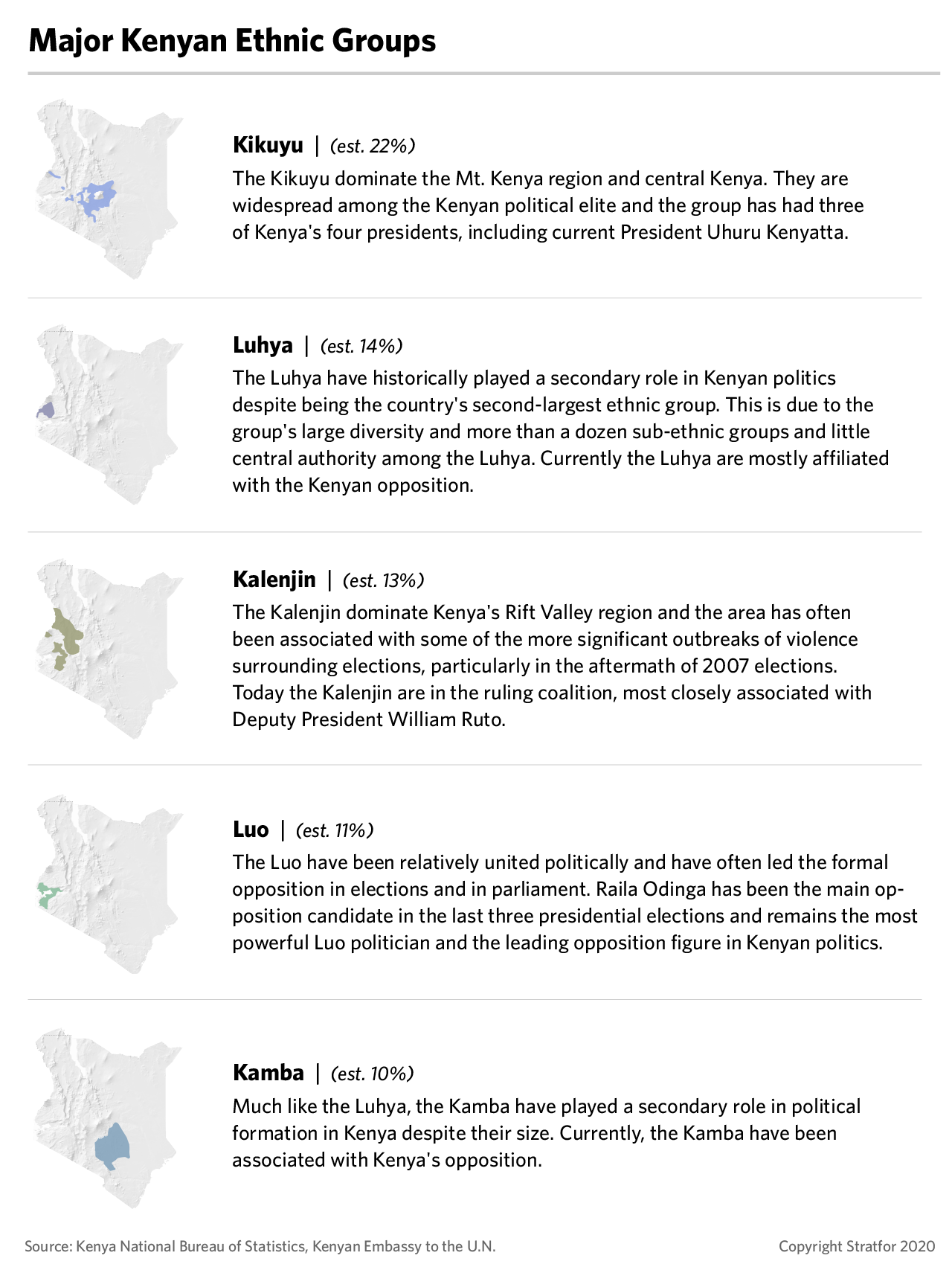
Disagreements over how to reform Kenya’s ethnically-based political system has set the stage for another turbulent transition of power. The most violent episode in recent years occurred after the 2007 elections, which resulted in a new constitution that has only partially fulfilled its goal of devolving power. The 2017 election exposed the 2010 constitution's limitations after Odinga disputed the first election results over irregularities and then boycotted the re-run. The political crisis ended in 2018 when Odinga and Kenyatta launched a new task force, called the Building Bridges Initiative (BBI), to address the fundamental issues plaguing Kenya’s political system, including ethnic antagonism, corruption and devolution. The task force issued its recommendations in 2019, but there is significant disagreement on how to prioritize, interpret and implement them. These disputes have stalled the BBI process over the last year, meaning the recommendations are unlikely to be implemented in their entirety before the next election.
- The BBI’s recommendations included creating a prime minister’s position, increasing financial resources to Kenya’s counties, equitably sharing resources across Kenya’s ethnic groups and allocating government revenue on the basis of population.
- Odinga and Kenyatta have both backed many of the proposals, and have discussed passing some through legislative action. The leaders have also jointly backed the proposed “One Man, One Shilling, One Vote” structure to implement the BBI’s revenue-sharing recommendation, which would see government revenue split based on an ethnic group’s population size only without considering a group’s current level of inequality. This proposal has proven particularly controversial, given that Kenyatta’s Kikuyu and Odinga’s Luo are two of the three most populous ethnic groups in Kenya.
A scenario where Kenyatta backs an opposition leader and Ruto is removed from office would likely result in localized levels of violence in the lead-up and aftermath of the 2022 elections. Following elections in 2007, Ruto’s Kalenjin ethnic group started attacking Kikuyu businesses and travelers in their home region, the then-Rift Valley Province, angered by Kikuyu’s dominance in Kenya’s economy and perceived theft of the vote. Violence surrounding the 2022 election would likely also remain ethnically motivated and concentrated in the former Rift Valley Province and other ethnically-dominated rural areas. But demonstrations and attacks in cities such as Nairobi and Mombasa that result in short-term shutdowns of ports, roads and rail travel cannot be ruled out, as metropolitan areas are also home to all major Kenyan ethnic groups. It’s unlikely such violence would evolve into direct attacks against foreign companies or their operations in Kenya as well, though their Kenyan employees could get caught in the crossfire.
But even if not widespread, any violent unrest surrounding the 2022 elections would risk damaging investor confidence in Kenya at a time when the country’s financial situation is fragile. Already difficult due to the COVID-19 crisis, Kenya’s ability to consolidate its finances, however, will be further complicated, should another violent political crisis spook investors. But if it does figure out a way to bring its financial house in order, the country will risk facing a debt crisis in the second half of the 2020s.
- Kenya has been home to one of Africa’s leading economies for more than a decade, with an average growth rate of 5.8 percent between 2010 and 2019. But those years of debt-fueled economic growth has also significantly expanded the country’s debt-to-GDP ratio, which increased from 38.2 percent in 2012 to 60.8 percent at the end of 2019.
