
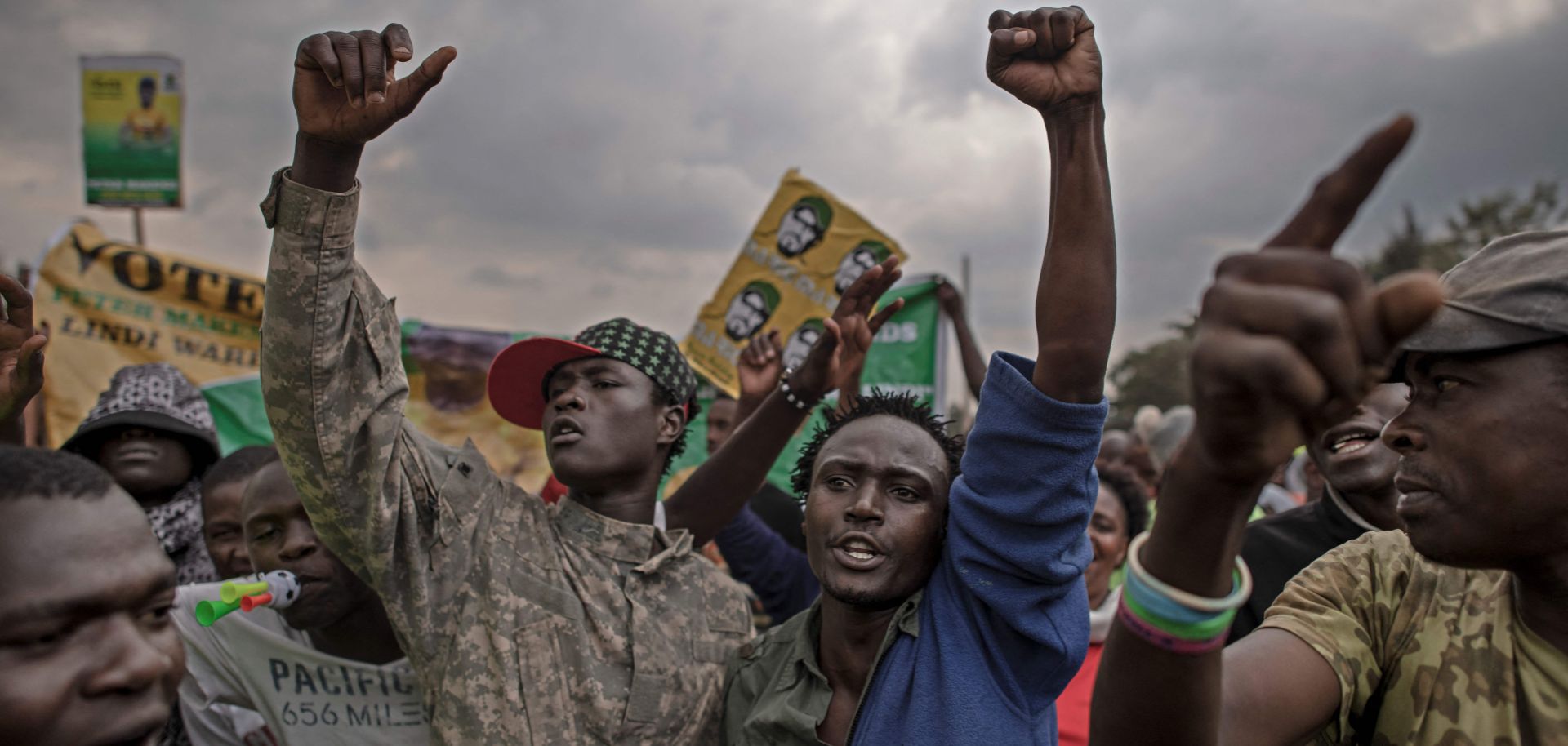
Supporters react to Kenyan Deputy President William Ruto’s speech during a presidential campaign rally in Kibera, the largest slum in Nairobi, on Jan. 18, 2022.
Kenya is barreling toward a highly contentious and likely tumultuous presidential election that could alter the future of the country’s political system. Kenya will hold general elections on Aug. 9, where voters will elect the president, members of the National Assembly and Senate, and various county positions. But the presidential ballot, in particular, is shaping up to be a highly contested race, with two political insiders as the frontrunners: Kenyan Deputy President William Ruto (the former ally and now adversary of Kenyan President Uhuru Kenyatta) and former Prime Minister Raila Odinga (who has become one of Kenyatta’s closest allies in recent years). Ruto is running under the slogan “hustler nation” in an attempt to paint himself as an average Kenyan who achieved great success by working his way up the political ladder. Odinga, meanwhile, is running on decades of political experience and a social welfare platform that he says will benefit Kenya’s poor and unemployed. In terms of general policy, the two candidates are virtually indistinguishable other than their positions on the controversial Building Bridges Initiative (BBI) bill, which is currently before the Kenyan Supreme Court. The proposed reforms in the BBI would boost the size of Kenya’s National Assembly and create a prime minister position with two deputies. Odinga and Kenyatta say these changes are aimed at mitigating the risk of violence that has plagued past Keynan elections by ending the country’s current “winner-take-all” system, where political power is concentrated in the hands of the president. But Ruto and his supporters argue the BBI is a thinly veiled attempt to extend Kenyatta’s political influence after the formal end of his tenure by potentially enabling the president to install allies in the newly expanded executive.
- Following accusations of fraud and widespread unrest during the 2017 elections, Kenyatta and opposition leader Odinga dispelled tensions with the 2018 “Handshake” agreement, which launched the BBI and a series of proposed institutional reforms. This close collaboration with Odinga on reform efforts quickly unraveled Kenyatta’s former political alliance with Ruto.
- Unlike Ruto, Kenyatta and Odinga both hail from political dynasties. Kenyatta’s father served as Kenya’s first president from 1963 to 1978, while Odinga’s father served as Kenya’s first vice president from 1964 to 1966 before going on to become a prominent opposition leader.
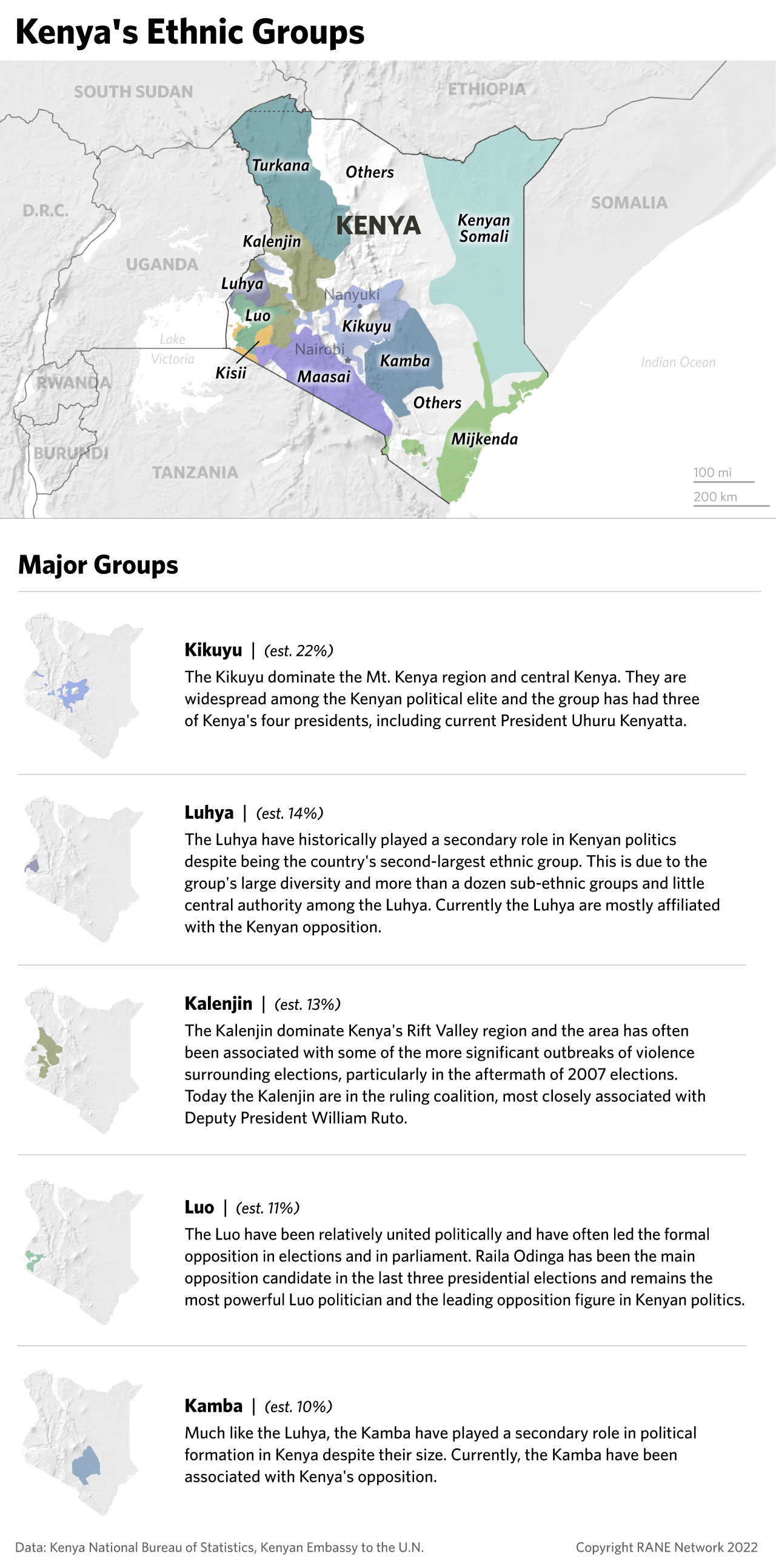
Support from key ethnic groups will be the most salient indicator of which presidential candidate has broader support. The Kikuyu and Kalenjin are two of five major ethnic groups that have had an outsized influence on Kenyan politics. In the two most recent general elections, Ruto’s Kalenjin ethnic group teamed up with Kenyatta’s Kikuyu ethnic group to defeat Odinga, who is an ethnic Luo. Many ethnic Kalenjins voted for Kenyatta with the understanding that ethnic Kikuyus would support Ruto in 2022. But Kenyatta and Odinga’s alliance in 2018 has since made that reciprocal vote less certain. However, there’s a chance that the alliance could collapse if the Supreme Court rejects the BBI, which is the cornerstone of Kenyatta and Odinga’s partnership. This would significantly reduce Odinga’s odds of winning the presidency, due to the strength of the Kikuyu vote that has historically supported Kenyatta.
- Kenyatta’s Kikuyu ethnic group comprises an estimated 22% of the population. Since Kenya gained independence in 1963, Kikuyus have dominated Kenyan politics and directed resources to community and coalition partners.
- Gideon Moi (son of former President Daniel Moi) or another third-party candidate could pull votes away from one or both front runners, which could potentially lead to a runoff.
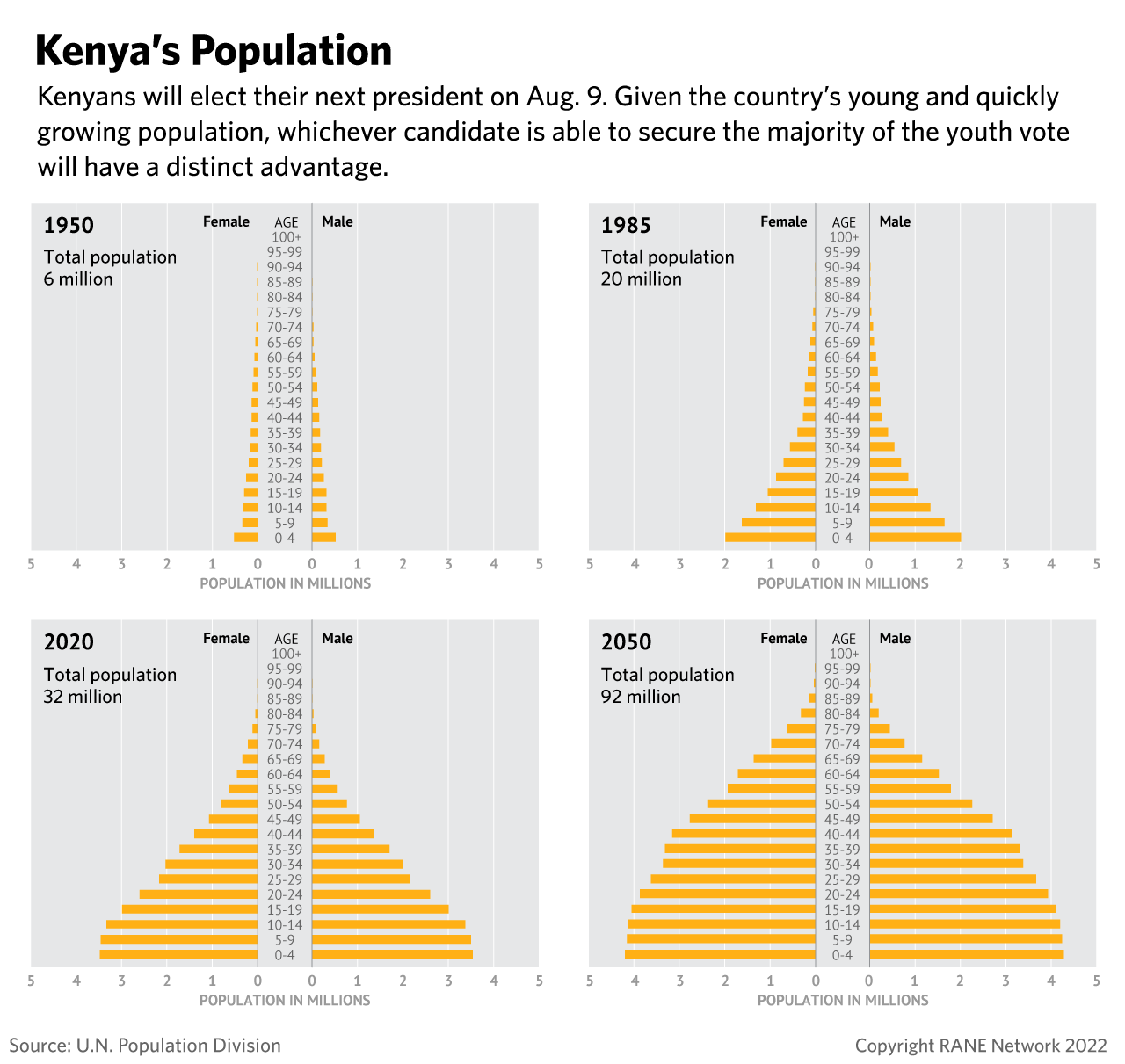
In Kenya, where 42% of the population is under 25 years old, the youth vote will also be key in deciphering the outcome of the Aug. 9 presidential race. The candidate who receives the majority of support from Kenyans between 18-24 years old will have a distinct advantage due to the sheer size of this voting bloc. The Kenyan electoral commission also recently launched a renewed push to register 4.5 million new voters by Feb. 9, which will likely further increase the number of young adults who are eligible to cast ballots in August.
- In addition to painting themselves as advocates for Kenya’s underclass, both leading presidential candidates have sought to win over younger voters by promising to enact welfare measures for unemployed youth upon taking office. Ruto has promised to set aside nearly $900,000 for each of the 290 constituencies to support small- and medium-sized businesses managed by youth and women, while Odinga has said he will implement a program for poor youth by donating $54 every month to 2 million households.
The outcome of the presidential race will risk spurring unrest among non-ruling ethnic groups in Kenya, especially if there are widespread allegations of fraud. An Odinga presidency would be largely seen as an extension of Kenyatta’s term and, thereby, an extension of ethnic Kikuyus’ long-standing political dominance over Kenya’s political system and economy. Should Odigna maintain his alliance with Kenyatta and win the election, there would be a high risk of ethnic Kalenjins inflicting violence on Kikuyus in the Greater Rift Valley, largely due to the Kalenjin perception of Kikuyus’ failing to fulfill their promise of supporting Ruto. It would likely also result in widespread anger among minority members of Kenya’s more than 40 ethnic groups, fearing Odinga’s close ties with Kenyatta would see policies that entrench existing patterns of unequal resource allocation. A Ruto victory, meanwhile, would likely yield similar risks of unrest since Kenyatta and Odinga would be all but guaranteed to levy accusations of electoral tampering, rallying their supporters to take to the streets in protest.
- Kenya’s three most recent presidential elections all yielded disputed victories that spurred widespread unrest, looting, property destruction and extreme business disruptions. The post-election turmoil following former President Mwai Kibaki’s contested victory in 2007 was particularly devastating, killing thousands of Kenyans.
- Kenyan ethnic groups that supported candidates who ended up winning the presidency have historically benefitted the most from resource allocation in sectors like education, healthcare, infrastructure and development.
- The new constitution Kenya ratified in 2010 was partially designed to address resource inequalities between ethnic groups by granting more authority to county governments. However, the unequal allocation of resources on a national scale remains a problem.
If ruled constitutional, the future of the BBI bill (in its current form) will then depend on Odinga winning the election. The Kenyan Supreme Court began hearing the controversial constitutional review bill on Jan. 18 after a court of appeals previously ruled that Kenyatta did not have the authority to initiate the constitutional reform under its planned process. But even if the Supreme Court rules in favor of the bill, a popular referendum will still need to be held before the amendments are formalized — which, at this point, is highly unlikely to take place before the August elections. The fate of the controversial BBI bill is thus almost sure to rest on whether Odinga wins the election, as Ruto would probably reject holding a referendum if the bill is ruled constitutional. While he may institute some smaller reform measures included in the larger BBI project, Ruto is highly unlikely to reverse his position against the larger structural overhaul proposed in the bill. If, however, Odinga wins the presidency, the BBI could still be ratified in a referendum. But the reshaping of Kenya’s domestic political system outlined in the bill is still unlikely to address the longstanding ethnic divides that Kenyatta and Odinga say the amendment is intended to resolve, as it would not change the widespread perceptions of recurrent election fraud and elite impunity that have driven unrest in each electoral cycle since 2007.
- The BBI bill adds positions within the executive branch, increases the size of the National Assembly, and creates at least 70 new electoral constituencies. The proposed changes would also place the judiciary under the executive branch led by a presidentially-appointed judicial ombudsman.
- Opponents of the BBI bill say that in addition to threatening the independence of the judiciary, the restructuring would make it harder for opposition parties to mobilize and impede the construction of national ruling coalitions by concentrating power in the hands of Kenyatta’s political allies.
