

As the weeks before Kenya's Aug. 8 election have turned to days, anxiety over the impending popular backlash is growing.
Violence was rampant in the aftermath of Kenya's presidential election in 2007. That year, the opposition's anger merged with entrenched ethnic conflicts to leave over 1,000 people dead, hundreds of thousands displaced and the regional economy in tatters. Now as the East African powerhouse approaches its next presidential election on Aug. 8, Kenyan President Uhuru Kenyatta and his challenger, Raila Odinga, are jockeying for the public's support. And the question on the minds of many is whether the country can prevent a repeat of the bloodshed it saw a decade ago.
An Uneasy Calm
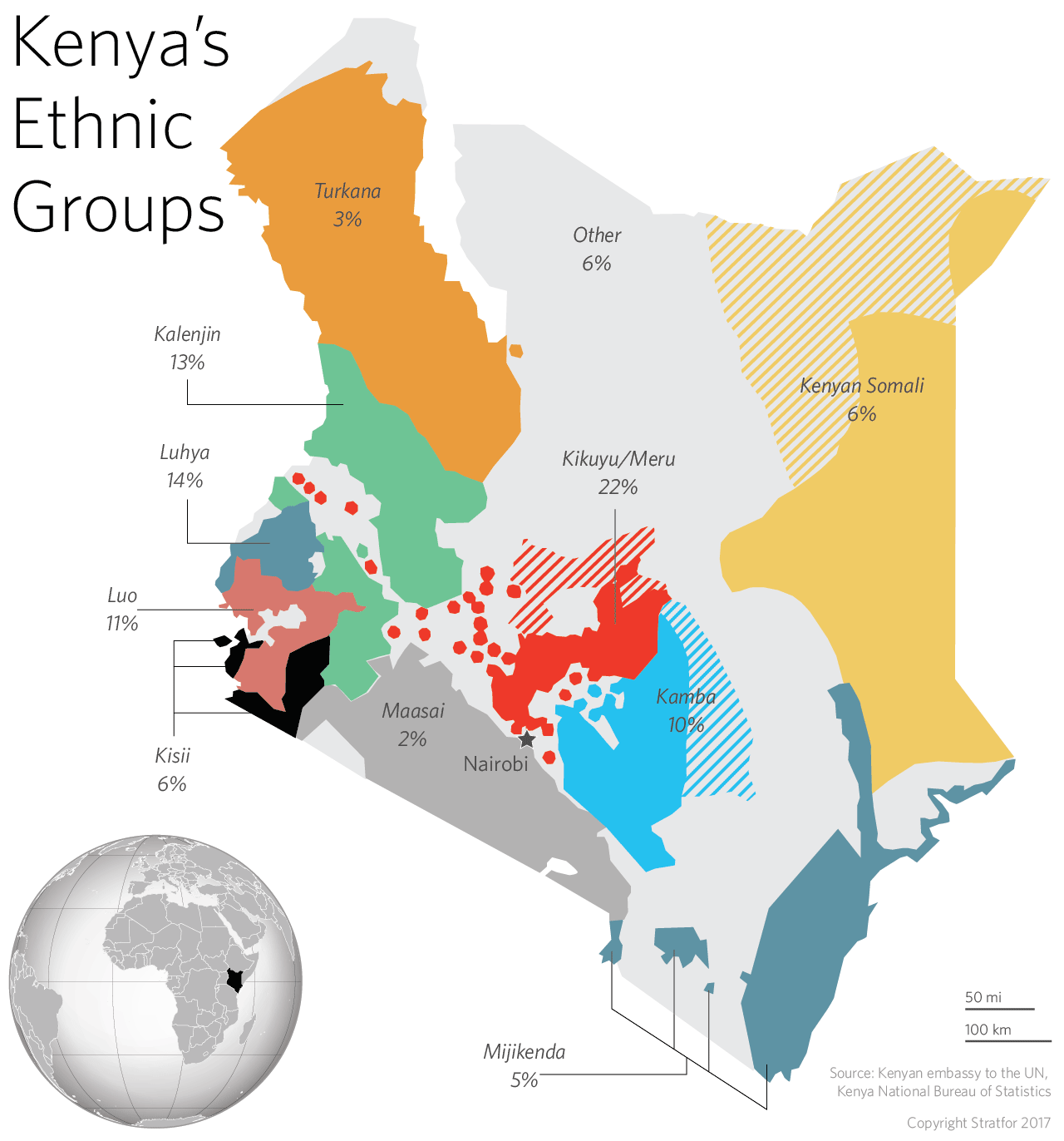
Though unrest is unlikely to reach the level seen after the 2007 vote, there are signs that the upcoming contest could result in some violence. First, Kenyan politics are still largely dominated by ethnic affiliations. Since the country gained its independence from Britain in 1963, a group mentality has shaped contests over land, power and resources. The strong centralized government that former colonial administrators left to their successors helped fuel this ethnic competition, as different groups saw control of the administration as a way to funnel resources to their people. In recent years, Nairobi has granted additional autonomy to Kenya's regions in an attempt to cut down on the pervasive winner-take-all mindset of the country's policymakers. But because it is still highly advantageous to control the central government and the spoils that come with it, electoral competitions are often fierce and personal.
Further increasing the risk of bloodshed is the fact that Kenya's rural and semi-urban populations are flush with disenfranchised youths who have easy access to weapons. Despite repeated government campaigns to disarm local groups, weapons remain prevalent. Moreover, many of these youths are vulnerable to sentiments of ethnic hatred, and some of the most intense clashes in 2007 centered on the shantytowns surrounding Nairobi.
Making matters worse are the inconsistent quality and uneven distribution of Kenya's security forces. In May, Nairobi announced its intention to hire an extra 10,000 police officers to help address the country's high crime rates. But the resources available to train new recruits are extremely limited, and even vigorous recruitment efforts wouldn't significantly boost police numbers in time for the August election. Consequently, Kenyan security forces will need to be carefully dispersed throughout the country and concentrated in urban centers like Nairobi, which have the highest likelihood of violence. Kenya's countryside, by contrast, will be left to fend for itself as it was in 2007, when conflict raged largely unabated there thanks to a weak security presence and the alleged complicity of local police.
Finally, there's the issue of Kenyatta and Odinga's repeat matchup, four years after the two went head-to-head in 2013. Over the past several months, Odinga and his National Super Alliance coalition have pushed the narrative that the ruling Jubilee Party intends to steal the upcoming election. Should election results prove unclear or controversial after polls close on Aug. 8, the opposition's allegations of a seedy government plot, whether real or imagined, could spark violent protests. Indeed, the perception of corruption may already have reared its ugly head: On July 31, senior electoral commission official Chris Msando was found dead, and his body showed signs of torture. According to reports, Msando had received death threats related to his commission work, suggesting that his killing was anything but random.
Glimmers of Optimism
Still, there are signs that post-election violence may be stymied this year. Both within and beyond Kenya's borders, there is an overwhelming fear of a return to the unrest of 2007. Other countries have been pressuring the two candidates to cut down on inflammatory rhetoric, and they have largely acquiesced. (There are, however, indications that hate speech has continued online and at smaller rallies.) Of course, it's difficult to quantify societal fear. But muted reactions to the 2013 election suggest that the opposing sides were eager to avoid bloodshed then, and they could exercise similar restraint now.
Meanwhile, Kenyan authorities are pursuing ways to better prepare for possible violence. In response to claims that the government was planning to shut down internet access, Communication Authority Director-General Francis Wangusi acknowledged that he was considering the controversial move of cutting access to social media, should it "be necessary." While this can certainly be seen as an attempt to clamp down on dissent, it also underscores Nairobi's willingness to disrupt any coordination of violence. And as previously mentioned, the Kenyan government opted for a more decentralized model in 2010, which has lessened the bruising contest between ethnic groups vying for control of the limited resources at the government's center.
The familiarity of the 2017 race also offers some comfort. When Kenyatta faced off against Odinga in 2013, he won handily, 51.5 percent to 43.7 percent. And while past results are not a perfect indicator of future outcomes, both candidates have maintained the loyalty of their tribal coalitions: the ethnic Kikuyu for Kenyatta and the ethnic Luo for Odinga. Recently released polls suggest that the field has tightened in the weeks leading up to the contest, but polling in Africa is generally fraught. So although a close election could result in flare-ups based on accusations of vote-rigging, a clear victory declared early on would limit extreme popular reactions.
Finally, the Kenyan Court of Appeals ruled on June 23 that state election results would be final, rejecting the national Independent Electoral and Boundaries Commission's claims that it would make the ultimate ruling on the vote. The court decision was a notable victory for the opposition, which has railed against potential election-rigging. The decentralized nature of the vote reporting may also reduce any suspicions of the ruling party falsifying the election's results.
As the weeks leading up to Kenya's Aug. 8 election have turned to days, anxiety over the impending backlash has grown. The ethnic divisions intrinsic in the country's politics will always leave room for violence. But a decade after the devastating fallout from the 2007 race, there is reason to think the unrest may be more manageable this time around.
