
Ethnic divisions and competition have always challenged Kenyan politics, though normally not enough to disrupt the system. In 2007, however, the presidential election sparked sustained violence that left more than 1,000 people dead, displaced hundreds of thousands more, and almost completely shut down the economy. During the next vote, in 2013, things seemed to be back to their normal state: tense but generally peaceful.
A new presidential election will be held in August 2017, pitting President Uhuru Kenyatta and Vice President William Ruto against a host of other candidates. This May, violent protests over the perceived bias of the country's independent elections commission broke out and led to a harsh crackdown by security services. The flare-up caused concerns that the upcoming presidential contest could lead to a repeat of 2007's post-electoral violence.
An outbreak of violence is not outside the realm of possibility, but several factors behind the conflict in 2007 are not present now. When assessing how plausible a repeat is, three questions should be asked: What factors led to the outbreak of violence in 2007? Why weren't they a factor in 2013? And are they present now?
Embedded Divisions
Kenya's political environment is defined by deep ethnic rivalries. Tribal competition over land, power and resources underpins much of the political dynamic, manifesting itself in political parties that often have specific ethnic tilts and in elections that are often already decided by entrenched ethnic voting patterns. So, though the 2007 violence took much of the international community by surprise, given Kenya's reputation for stability, it was not altogether unpredictable. In fact, similar violence had broken out in the 1990s.
When assessing a situation as complex as the run-up to Kenya's 2007 presidential election, it is crucial to examine its most salient details. First, the political environment leading to the elections was weak. President Mwai Kibaki's government, elected in 2002 on a platform of change following decades of rule under President Daniel arap Moi, lost support after it was implicated in several high-profile scandals. It was accused of involvement in the reportedly massive Anglo Leasing deal that involved fake companies (and became known as the Anglo Fleecing deal), of failing to implement reforms after an initial burst of them, and of being incapable or unwilling to improve the security situation across much of the country. This last misstep, which notably included the failure to disarm local groups (even given the ethnic violence that had historically erupted in the country), would later haunt the government when the country fell into chaos after Kibaki's re-election. But even if the Kibaki government had focused on disarmament, it would have struggled. Many previous government initiatives to disarm local populations over the years had largely failed. By 2003, it was estimated that more than 160,000 people had been displaced by rural violence in the country's north. The conflicts had led local communities to stockpile small arms, which helped sustain the violence in 2007.
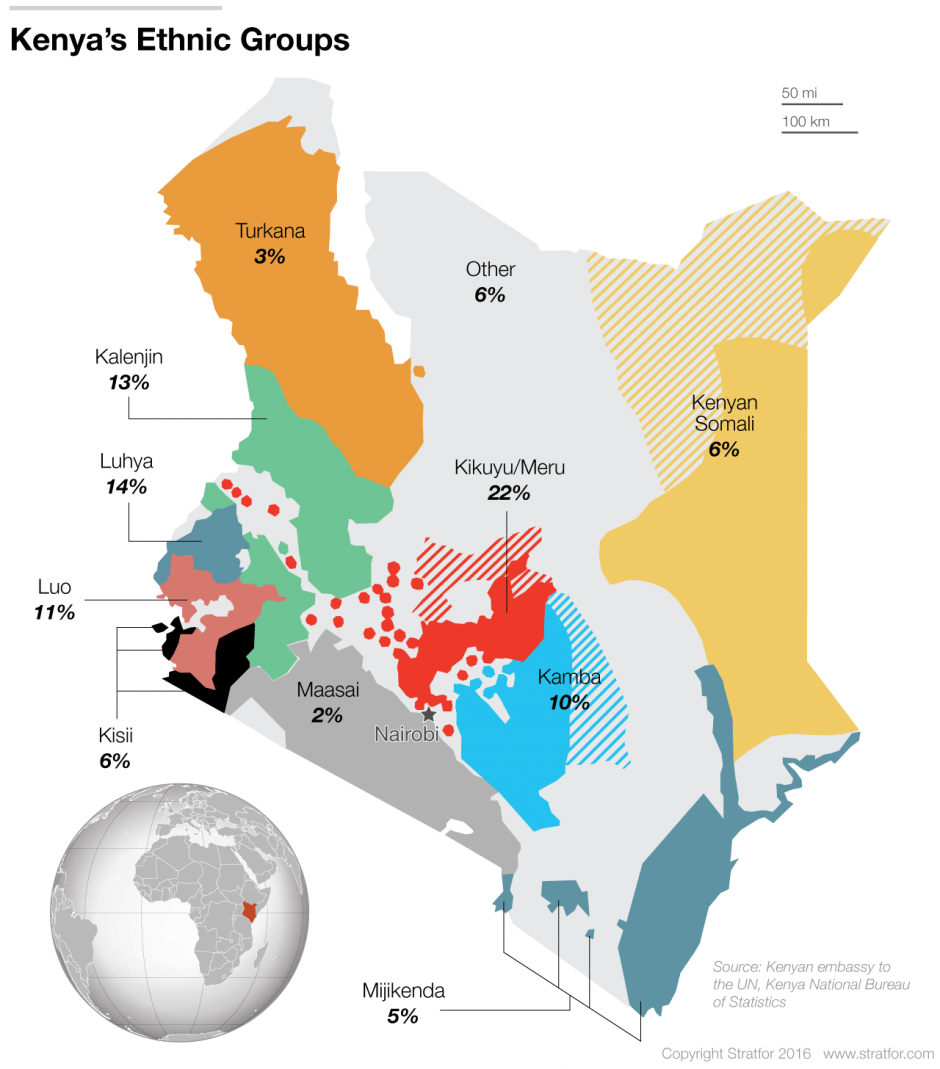
The drop in Kibaki's popularity in the years before the 2007 election jeopardized his chances at re-election and guided his decisions thereafter. As election day approached, Kibaki and his government were struggling for political survival. They turned to their ethnic power bases — including the Kikuyu, Embu and Meru — to make up for their political failures, creating what scathingly came to be known as the Mount Kenya Mafia in Central Province. The tactic was a departure from those adopted by previous administrations, which rewarded their ethnic bases with employment but also sought to appeal to all ethnic groups. The administration's focus on those ethnic groups also explains why Kenya's economic growth — its gross domestic product increased from 0.5 percent in 2002 to 7 percent in 2007 — did not translate into increased popularity for the government. Though there were many reasons that the central region benefited primarily from that growth, those in other regions saw it as further confirmation of Kibaki's bias.
Kibaki's unequal treatment of ethnic groups, far from bolstering his position, provoked a backlash against him. Local politicians accused Kibaki of oppressing certain groups, including the Kalenjin, which makes up roughly 13 percent of Kenya's total population and is concentrated in the country's far west. Meanwhile, opposition candidate Raila Odinga and his Orange Democratic Movement made ground on the promise to rectify perceived injustices and to redistribute jobs and resources. Yet, Kibaki's power base was strong, and the election results were close.
Several days passed after voting was complete without an announcement of results, causing tension to mount. Suspicion that the government was rigging the outcome arose in opposition areas, and the distrust grew after initial results signaled that Odinga had won but later counts named Kibaki the winner. Reports of voting irregularities from both sides fanned the flames. And matters only got worse after Kibaki was quickly sworn in.
Soon, large swaths of the country descended into chaos, as ethnic groups — particularly the Kalenjin — turned to violence to express their frustration with the election results and to seek revenge for perceived injustices. Many local communities were well armed, and security services were largely subservient to politicians, so containing the violence was difficult. The unrest endured for two months.
Post-Violence Reform
Changes were introduced in the wake of the violence, and the 2013 presidential election was relatively peaceful. First, Kenya's political system underwent a reformation after 2007. In 2010, the country adopted a new constitution that helped decentralize the national government. The winner-take-all system of a strong central government — which had intensified competition among the country's ethnic groups — was abolished. Instead, the provinces were replaced with more powerful counties, enabling more resources to be distributed automatically and granting more local autonomy. Local ethnic groups no longer have to battle to win presidential elections.
Additionally, ahead of the 2013 elections, intense international pressure for peaceful elections was brought to bear, something that was lacking in 2007. Kenyan politicians on all sides were pressed to prevent a repeat of the violence — and Kenyan citizens likewise were uninterested in reliving the chaos. Moreover, Kenyatta, the son of the country's founding leader, was perceived to be a new generation of candidate despite his links to the Kibaki administration. (He was born in 1961, just two years before Kenya's independence from Britain.) Kenyatta campaigned for the vote of his ethnic Kikuyu, the country's largest ethnic group. His running mate, William Ruto, helped deliver the Kalenjin vote, the country's third-largest ethnic group. The opposition campaigned on a platform directed at smaller ethnicities: Odinga courted the Luo, and running mate Stephen Kalonzo Musyoka, the Kamba. Kenyatta captured 50.5 percent of the voting share to Odinga's 43.7. Crucially, results were released without delay.
Fostering Unity
The 2017 contest looks to be similar. Kenyatta will again face Odinga. And now that the International Criminal Court has dropped its charges against Kenyatta and Ruto for their roles in the 2007 violence, Kenyatta's position is even stronger. In fact, he has been able to spin the abandonment as a victory over the court, which many Africans see as a tool of neocolonial oppression. It also means that the incumbent president will be more willing to agree to a peaceful transfer of power in the event that he loses the election, since now he does not have to worry about arrest. Furthermore, in September, Kenyatta formed a new political party, dubbed the Jubilee Party of Kenya, from pieces of the Jubilee Alliance coalition, which had been made up of several parties that supported his candidacy in 2013. The unified party even includes several members of Odinga's Orange Democratic Movement.
Kenyatta's ability to expand his already notable appeal, even modestly, contrasts starkly with Kibaki's reliance in 2007 on a couple of particular ethnic groups just to eke out a victory. While Kibaki's popularity had been plummeting ahead of the 2007 election, Kenyatta's has held steady and, by some measures, even is rising. Though the Kenyan opposition staged massive protests in May and June over the Independent Electoral and Boundaries Commission, the unrest dissipated once the government reached a deal with members of the commission. The institution replaced the discredited electoral body that oversaw the 2007 election, but it is still not entirely trusted. Still, the bargain struck seems to have mostly appeased the opposition.
As of now, the opposition is not strong enough to significantly challenge Kenyatta, but if that changes and the election becomes closer, the chance of unrest could rise. Warning signs would include a sustained drop in Kenyatta's popularity, a narrowing of Kenyatta's support based on ethnic divisions and an increase in ethnic conflict more generally. Though ethnic divisions are a permanent part of Kenyan politics, making the possibility of violence ever-present, the country's post-violence reforms and the broad popularity of Kenyatta make a repeat of 2007 unlikely. By most accounts, Kenya's 2017 election will be mostly peaceful.
