
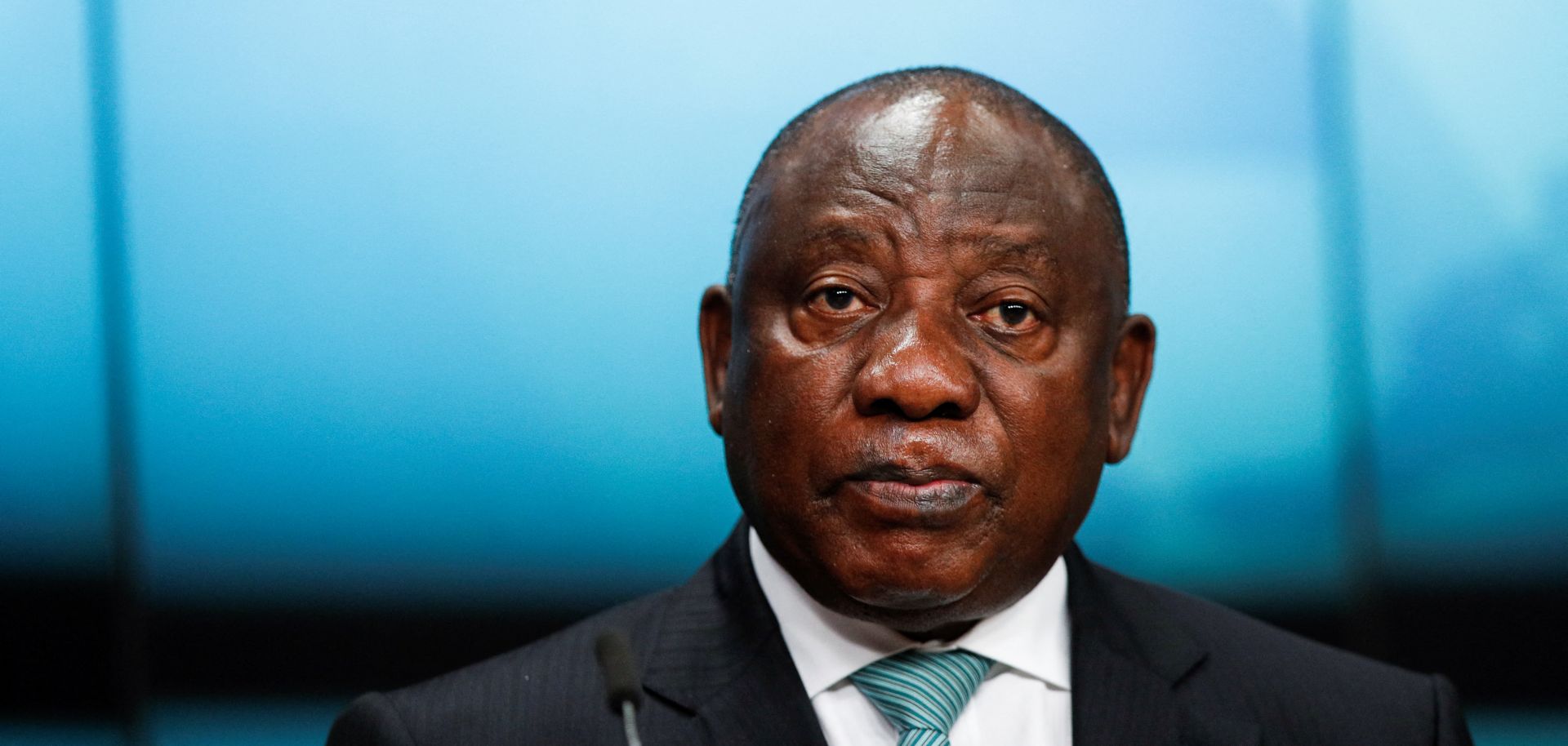
South African President Cyril Ramaphosa gives a statement during a summit at the European Union in Brussels, Belgium, on Feb. 18, 2022.
High commodity prices have given South Africa some breathing room to maintain social spending programs, but long-term fiscal consolidation will require politically challenging structural reforms that the country’s embattled government may be unwilling to undertake prior to 2024 elections. Without those sweeping reforms, high unemployment, inequality and poverty will continue to beset the South African economy. In a speech delivered on Feb. 23, South African Finance Minister Enoch Godongwana outlined the government’s budgetary priorities for the 2022-23 fiscal year while underscoring the country’s unexpected revenue windfalls. Godongwana said that over the past year the South African government generated R182 billion ($12 billion) more revenue from taxes than it had budgeted for — driven largely by the 2021 surge in global commodity prices, which benefitted the country’s large mining sector. The South African Treasury now has more fiscal room than it had predicted, leading to Godongwana’s generally positive outlook, which also included upgraded debt and deficit projections.
- The finance minister announced several key policy changes, including cutting the corporate tax rate by one percentage point to 27% and increasing the employment tax incentive by 50%. He also said the government will adjust personal income tax brackets by 4.5% to account for inflation.
- Additionally, Godongwana announced that the treasury budgeted R44 billion ($2.9 billion) for the extension of the COVID-era monthly welfare payments of R350 ($23). Notably, Godongwana did not include a proposal for restructuring public utility firm Eskom’s R450 billion ($29 billion) debt.
- South Africa’s finance ministry now expects gross government debt to peak at 75.1% of GDP in the 2025 fiscal year, which is a year earlier and 3 percentage points lower than its projections in Nov. 2021. The budget deficit is also expected to drop from 5.7% of GDP (2022-23 fiscal year) to 4.2% of GDP in the 2025 fiscal year.
- Godongwana also announced that the government is now expected to reach a primary budget surplus by 2024 — a year earlier than the ministry previously estimated.
President Cyril Ramaphosa faces pressure from his own party, the opposition and the general public to maintain social spending programs, like the monthly stipend program. The higher-than-expected revenue over the past year follows years of meager economic growth. While the government’s coffers may be fuller, an increasing number of South Africans are struggling to make ends meet. The World Bank estimates that more than half of South Africa’s 59.3 million citizens are living at or below the national upper poverty line of R992 ($65) per month, and that nearly just as many citizens are welfare recipients. On top of massive inequality between socioeconomic classes, the country’s youth unemployment rate has reached approximately 70% in recent months. Widespread economic hardship has led to high social pressure to maintain the COVID-19 relief payments and institute universal income grants. Various opposition political parties, most notably the Economic Freedom Fighters (EFF), have been exploiting the country’s increasing poverty, unemployment and inequality rates to drum up resistance against Ramaphosa’s ruling African National Congress (ANC) party. Within the ANC, Ramaphosa’s rivals have also been using the citizenry’s economic hardship to accuse him of fiscal incompetence.
- The EFF and other South African opposition parties have historically used popular grievances to incite or worsen instances of unrest. In July, the arrest of South Africa’s former president Jacob Zuma triggered widespread riots and violence that killed over 300 people. The unrest quickly snowballed into grievances over poverty and inequality, which Ramaphosa’s opponents exploited in some localities for attempted political gain. If the South African government decides not to extend the $23 monthly welfare payments through 2023, it could trigger another bout of potentially violent protests, even though any such unrest is unlikely to reach the scale seen last summer.
Continued high welfare spending is unsustainable when coupled with the long-term economic reforms that Ramaphosa says will solve South Africa’s unemployment, inequality and debt problems. The R44 billion ($2.9 billion) budgeted for the $23 monthly welfare payment and other social spending initiatives contradict Ramaphosa’s repeated pledges to reduce “unsustainable” social expenditures, drive job creation through private sector growth, and improve South Africa’s business environment. Godongwana noted that continuation of the monthly welfare payment beyond the 2022-23 fiscal year will require permanent spending reductions and tax increases — pulling funding and resources from further tax cuts and/or incentives for businesses, as well as measures to increase power generation capacity, promote domestic investment in manufacturing to reduce independence on imports, launch employment stimulus plans and introduce structural reforms to state-owned enterprises, lift barriers to regional trade, and reduce the difficulties associated with doing business.
- In his annual State of the Nation Address on Feb. 10, Ramaphosa announced that the nearly 10 million South Africans currently receiving the monthly $23 monthly welfare payments would continue getting those checks until March 2023. The stipend was initially set to expire in March of this year.
Given the fragility of the ANC and Ramaphosa’s tenuous position within it, South Africa is unlikely to see sweeping fiscal consolidation ahead of the 2024 election, which means the country will continue to face a host of economic risks that could trigger periodic crises. In addition to the immediate pressure exerted by the public and external political opponents, internal rifts within the ANC may threaten Ramaphosa’s position as the leader of the party in the December 2022 national convention. Furthermore, the ANC’s waning national popularity means that it will likely face viable challengers in the 2024 general elections, which could threaten its decades-long hold on national power. This means Ramaphosa will become increasingly unlikely to pursue robust economic reforms and cancel social expenditures as he tries to shore up popular support for a second term ahead of the election. Without fiscal consolidation, South Africa will also remain extremely vulnerable to global commodity prices; a fall in prices for coal, mineral products, precious metals and/or iron and steel products could quickly reverse the government’s revenue gains. Meanwhile, the key socioeconomic issues facing South Africans (unemployment, poverty, inequality, lack of access to basic services) are unlikely to improve over the next two years, which means Ramaphosa’s pro-business agenda is equally unlikely to promote desired growth levels due to investor concerns over stability and profitability.
- In local elections held this past November, the ANC lost several key municipalities and won less than 50% of the overall vote — marking its worst electoral performance since the party led South Africa out of the apartheid era in 1994.
