
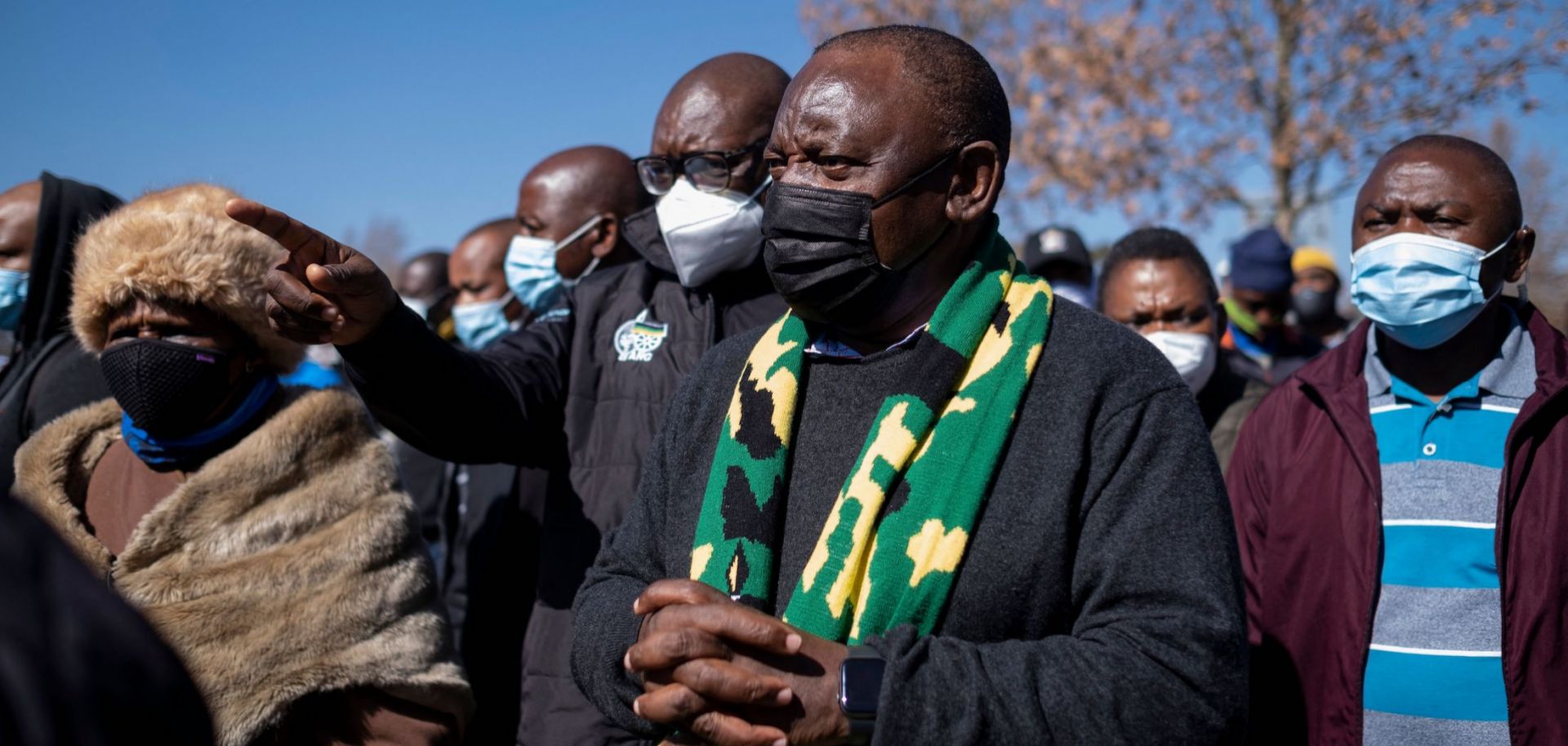
South African President Cyril Ramaphosa (center) visits a mall in Soweto that was damaged by looters on July 18, 2021.
South African President Cyril Ramaphosa’s cabinet reshuffle aims to reinvigorate economic reforms while consolidating more personal control amid factionalism within his ruling African National Congress (ANC). But Ramaphosa will still struggle to implement those reforms as the pandemic and socio-economic stress in South Africa endures. The Aug. 4 reshuffle is Ramaphosa’s first since the 2019 presidential elections and saw more than one-third of his cabinet replaced. The move comes a month after the arrest of former President Jacob Zuma triggered violent unrest in Gauteng and KwaZulu-Natal provinces.
- The Ministry of State Security — South Africa’s intelligence and national security ministry — was disbanded with its functions being transferred to the presidency. Ramapohsa also fired the country’s long-time defense minister, Nosiviwe Mapisa-Nqakula, who had held the post since 2012.
- Enoch Godongwana was named finance minister after Tito Mboweni asked to be replaced. Mboweni was lauded by investors and markets due to his commitment to austerity measures aimed at making South Africa’s finances sustainable. Godongwana, a Ramapohsa ally, has backed such measures and headed the ANC's economic transformation subcommittee before being named finance minister.
- Other reshuffled cabinet positions include the health, communications, public service, small business, tourism and water ministers.
Zuma’s security reforms will strengthen his hold on the ANC, increasing his capacity to push through his own policies. But the violent uproar between the pro-Zuma and Ramaphosa-led camps will undermine the party’s unity. The corruption campaign against Zuma and his allies, including suspended ANC Secretary-General Ace Magashule, has been viewed by his supporters as a political crusade by Ramaphosa to pin all of the ANC’s woes on Zuma. This faultline was most apparent in last month’s riots due to the high degree of concentration of the riots in KwaZulu-Natal Province, home to the largely pro-Zuma Zulu ethnic group. For his part, Ramaphosa has long been concerned about party factions due to his relatively small base within the ANC. Last month, Mapisa-Nqakula and former State Security Minister Ayanda Dlodlo wanted to frame the unrest as criminal activity while Dlodlo’s deputy Zizi Kodwa called it an attempted coup and wanted to label it an insurrection. Dlodlo and Mapisa-Nqakula were both fired in the cabinet reshuffle while Kodwa is now Ramaphosa’s deputy minister for state security in the presidency.
- In ANC leadership elections held in December 2017, Ramaphosa narrowly defeated Nkosazana Dlamini-Zuma Zuma’s ex-wife — who he still supported in the leadership race — by about 3% of the vote.
- Ace Magashule was suspended as the ANC’s secretary-general in May after being arrested last year over corruption charges. His corruption trial resumes on Aug. 11.
Ramaphosa’s continued consolidation will be politically crucial ahead of municipal elections and next year’s ANC party leadership vote. The ANC’s popularity has continued to wane in recent years. The party lost control of key metro areas like Johannesburg in 2016 municipal elections. Deep factionalism in the ANC could leave it exposed in the next municipal elections, which are officially scheduled for Oct. 27 but are likely to be delayed until at least February 2022 due to COVID-19 and integrity concerns. With the economic and COVID-19 crisis unlikely to be over anytime soon in South Africa, Ramaphosa is hoping that the anti-corruption campaign can shore up support for the party ahead of the next ballot.
- The ANC will hold a new leadership election in December 2022 where Ramaphosa will likely try to increase his grip even further on the party by installing more allies in the so-called "Top Six" positions on the party’s National Executive Committee (president, deputy president, chairperson, secretary-general, deputy secretary-general and treasurer).
- In July, South Africa’s electoral commission recommended delaying elections until at least February over concerns about being able to hold free and fair elections during the pandemic. South Africa’s government has said it will back a delay if a petition the commission files with a court is accepted.
South Africa’s new finance minister is likely to face many of the same impediments that his predecessor did when it comes to helping orchestrate a true economic restructuring. Godongwana will find some success in fiscal consolidation, but the need to also appease labor unions and respond to strained socio-economic conditions will prevent him from fully hitting the government’s debt stabilization targets and timeline. A longtime ally of Ramaphosa, Godongwana is likely to maintain the same policies as Mboweni, including pro-business structural economic reforms. But during the first three years of Ramaphosa’s term, Mboweni had been barely able to push any of those reforms, due largely to the continued strength of the pro-labor and -poor wings of the ANC and its union allies. And that difficulty will likely increase following the riots.
- In response to the unrest over Zuma’s arrest in Gauteng and KwaZulu-Natal, Ramaphosa recently promised to reintroduce a 350 rand ($24) monthly stipend for those affected by the riots in addition to South Africa’s ongoing COVID-19 crisis. Ramaphosa is likely to follow through on this pledge and reinstate the stipend, which would likely be scheduled to expire at the end of the fiscal year in March 2022. South Africa’s financial situation, however, is unlikely to drastically improve by then, given that the country’s GDP per capita has fallen every year since 2015. The stipend may thus prove politically difficult to remove when it expires amid pressure from unions and average citizens to continue providing much-needed economic assistance.
- South Africa’s powerful unions will likely stymy Godongwana’s attempts to reduce the public wage bill as well, just as they did with his predecessor. Prior to the pandemic, Mboweni had proposed a three-year freeze on salaries but was forced to compromise in ongoing negotiations with unions, which will now be led by Godongwana. As those talks continue, an interim agreement that includes a 1.5% annual pay increase and a 1,000 rand ($68) monthly stipend will remain in place. Still, Godongwana is an ANC insider and, unlike Mboweni, is also a former union leader himself. This could, in turn, give him greater leverage to reach a compromise solution to avoid high annual pay increases that labor unions became accustomed to when commodity prices were high and South Africa’s economy was growing prior to 2015.
- Under Mboweni, South Africa’s treasury targeted debt stabilization at 88.9% of GDP by 2026. Controlling spending levels is critical to hitting that level. In a May client note, Fitch Ratings said it expected South Africa’s debt-to-GDP ratio to reach 87.1% in the 2022/23 fiscal year, but noted that it reduced its forecasted debt level for 2022/23 from 94.8% due to the South African government’s success in reining in some spending. A resumption of the monthly stipends could, however, result in Fitch changing its tune.
