
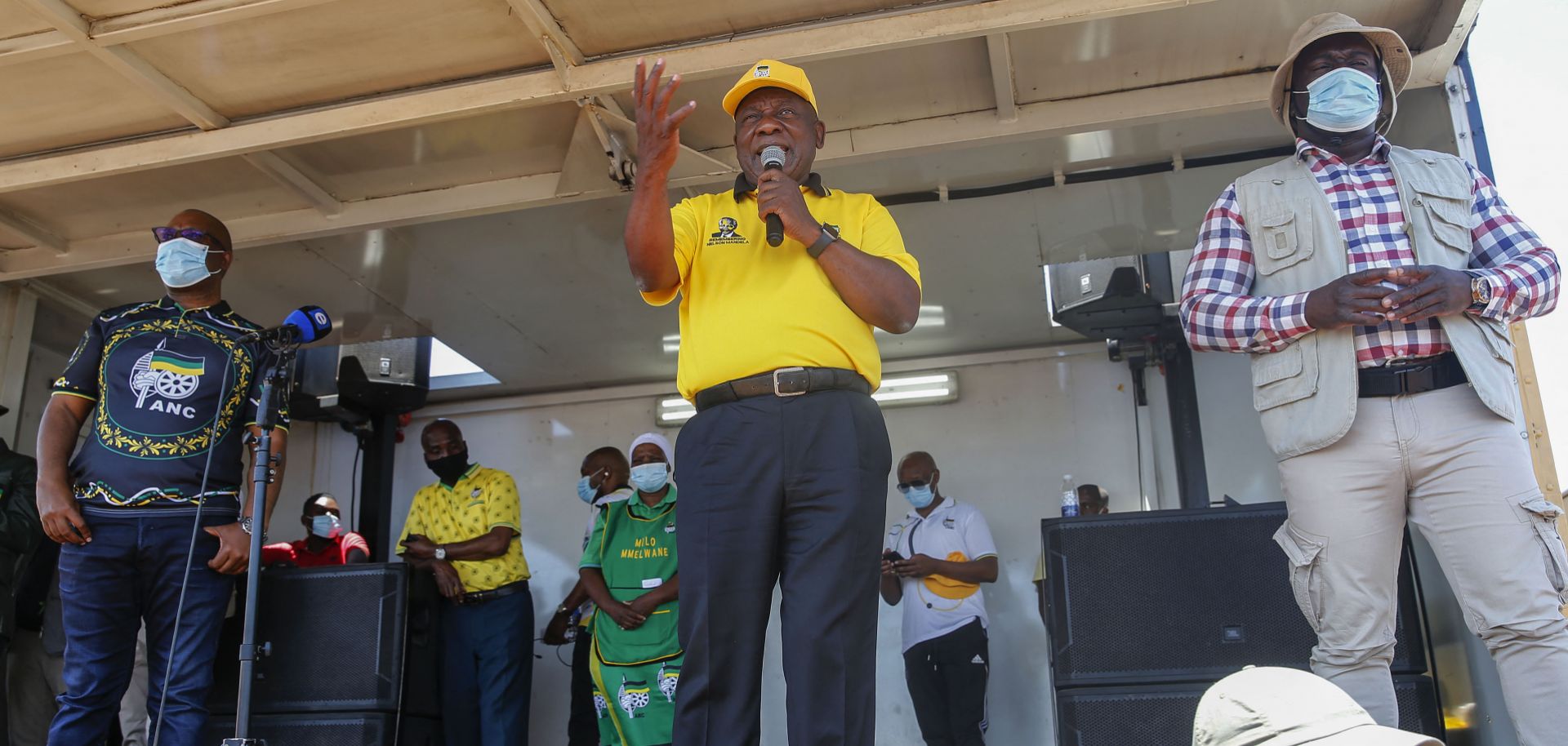
South African President Cyril Ramaphosa (center) addresses supporters of his African National Congress (ANC) party during a rally ahead of local government elections in a township north of Pretoria on Oct. 15, 2021.
Record electoral losses and widespread voter apathy will deepen rifts within South Africa’s ruling African National Congress (ANC) and further impede the party’s ability to impose economic reforms. The ANC, once the clear majority party, won just 46% of the vote in municipal elections on Nov. 1, marking its weakest performance since the party led South Africa out of the apartheid era in 1994. Much of the ANC’s loss can be attributed to low turnout, with only 47% of eligible voters casting ballots in the municipal elections. But opposition parties also capitalized on the ANC’s waning support to make electoral gains.
- The ANC’s biggest rival, the Democratic Alliance (DA), came in second with 22% of the vote and held on to its long-held majorities in cities like Cape Town, but overall did not perform as well as expected. The DA, which draws support from primarily white and Afrikaans-speaking voters, advocates for increasing the size of the police force, as well as increased spending on social services and healthcare. The party is also staunchly against land redistribution, a key issue among the ANC and Economic Freedom Fighters.
- The Economic Freedom Fighters (EFF), won 9.9% of the vote nationally (up from 8.3% in the 2016 municipal elections) and, while it didn’t take control of any councils, its 131 seats could prove influential in future coalitions. Led by Julius Malema of Limpopo province, the EFF is known for its land redistribution without compensation policy. The party is supported by largely young, rural, low-income and black South Africans.
- The Inkatha Freedom Party (IFP) won 5.6% of the vote nationally (up from 4.6% in 2016) now controls nine municipal councils. With its base in KwaZulu-Natal, the IFP is largely supported by voters from the Zulu ethnic group, and advocates for devolution of power to provincial governments and more flexible labor laws.
- In its first-ever municipal election, ActionSA won 2.6% of the vote nationally and notably took 16% of the vote in the Johannesburg municipality. Established by the former Mayor of Johannesburg Herman Mashaba after he left the DA in 2020, the party advocates for non-racial politics and anti-corruption efforts.
- In the 2016 municipal elections, the ANC lost control of the Johannesburg, Tshwane and Nelson Mandela Bay metros to DA-led coalitions. These losses deepened in the Nov. 1 vote, with the ANC capturing only 31% of the council seats in those three municipalities, down from 42% in 2016.
ANC losses reflect South Africans’ frustration with the perceived mismanagement of public funds, along with their longstanding outrage at the ongoing economic crisis and political corruption. After decades of entrenched political power, the ANC is frequently criticized for failing to deliver on economic and development promises, as many of their strongholds have fallen into disrepair in recent years. Sanitation services, access to clean water, electricity distribution, health services and education are persistent problems throughout South Africa, particularly in poor areas. State electricity company Eskom’s rolling blackouts regularly leave thousands of South Africans in the dark. ANC critics, including IFP and ActionSA officials, accuse Eskom of operating independently of the energy ministry and say corruption between politicians and Eskom executives is an ongoing issue. Corruption scandals are also commonplace within the ANC itself. In May, the ANC’s former secretary-general Ace Magashule was suspended from his position after being arrested last year over corruption, fraud and money laundering charges. The following month, ANC member and former president Jacob Zuma was then arrested and sentenced to 18 months in prison for contempt of court after he failed to appear before a judicial panel investigating graft during his presidential term between 2009 and 2018. The widespread perception that politicians mismanage public money or engage in corrupt deals fuels voter apathy toward political institutions and leaders in South Africa, as exemplified by the low turnout on Nov. 1.
- The unemployment rate in South Africa is currently over 33%. Food prices have increased 10% since November 2020 and fuel prices are on track to reach record highs this month.
- Eskom’s debt now totals $28.2 billion after reporting $1.9 billion in losses in 2020. Electricity prices have quadrupled since 2006. Rolling blackouts are commonly used to deal with shortages due to lack of capacity or poor maintenance of existing facilities.
- ActionSA party leader Herman Mashaba told reporters after the elections that his party’s gains in Johannesburg, Soweto, Orlando and Protea in the Nov. 1 municipal elections are a direct result of the ANC’s failures to deliver housing and electricity, as well as high unemployment and increasing poverty.
- The South African government estimates corrupt public officials stole over $35 billion in public funds during Zuma’s nine-year tenure. The former president’s trial will continue in April 2022.
Declining support for the ANC illustrates the need for coalition governance in many localities. Many parties, however, will either refuse to partner with the ANC or make unattainable demands. The Nov. 1 elections resulted in 36 hung councils, which may force the ANC to make compromises on land reform and public spending with opposition or minority parties. In the municipalities where they gained seats, the DA, IFP and ActionSA have all announced that they will not form a coalition with the ANC. The EFF, meanwhile, has said it’s open to working with the ANC, but only if the ruling party agrees to a list of conditions, including amending the constitution to allow for land expropriation without compensation in the next six months, nationalizing South Africa’s central bank within 12 months, canceling student debt within 12 months, and removing apartheid-era Afrikaans lyrics from the national anthem. If the ANC fails to form a coalition with these opposition parties, some municipalities may be forced to hold another vote in the coming months, which would likely result in even greater losses for the ruling party.
Weak electoral support will hinder President Cyril Ramaphosa’s ability to enact economic reforms ahead of the ANC’s leadership elections in 2022. The ANC is split between Ramaphosa’s faction and the Radical Economic Transformation (RET) faction led by Zuma and Magashule. Both of these factions will attempt to gain influence ahead of the December 2022 national ANC leadership elections. Currently, Ramaphosa has a leg up: his approval rating as president is ten points higher than that of the overall ANC, largely due to the ongoing corruption charges against the leaders of the party’s RET faction. Even so, the internal rift will impact Ramaphosa’s economic initiatives, as his pro-business plan seeks to rein in public spending through measures like budget cuts and layoffs, that would hit the ANC’s support base of largely black and poor South Africans the hardest. Pandemic public spending, like the $23 monthly welfare payment introduced after widespread protests and violence in July, is set to expire in March. Should Ramaphosa proceed with increased austerity measures and discontinue welfare payments, the likelihood of instability and protests will grow significantly. Rampaphosa’s own approval rating would likely also take a hit, with the RET faction likely attributing the ongoing economic hardship to the introduction of new austerity policies. The need to drum up support following the Nov. 1 municipal elections may also motivate Ramaphosa to double down on his anti-graft campaign, which is popular with his supporters but would likely draw sharp criticism (and potentially protests) from Zuma’s supporters amid the former president’s ongoing corruption trial. Meanwhile, Ramaphosa’s plans to improve South Africa’s business environment by reducing debt, cutting public spending and providing corporate tax cuts — which were already delayed by the COVID-19 pandemic — may be further postponed or blunted for fear of drawing more political backlash.
- The South African government will unveil its mid-term budget on Nov. 11. The level of spending cuts included in the budget will indicate the degree to which the election results will impact the Ramaphosa administration’s economic plans in the coming years.
