
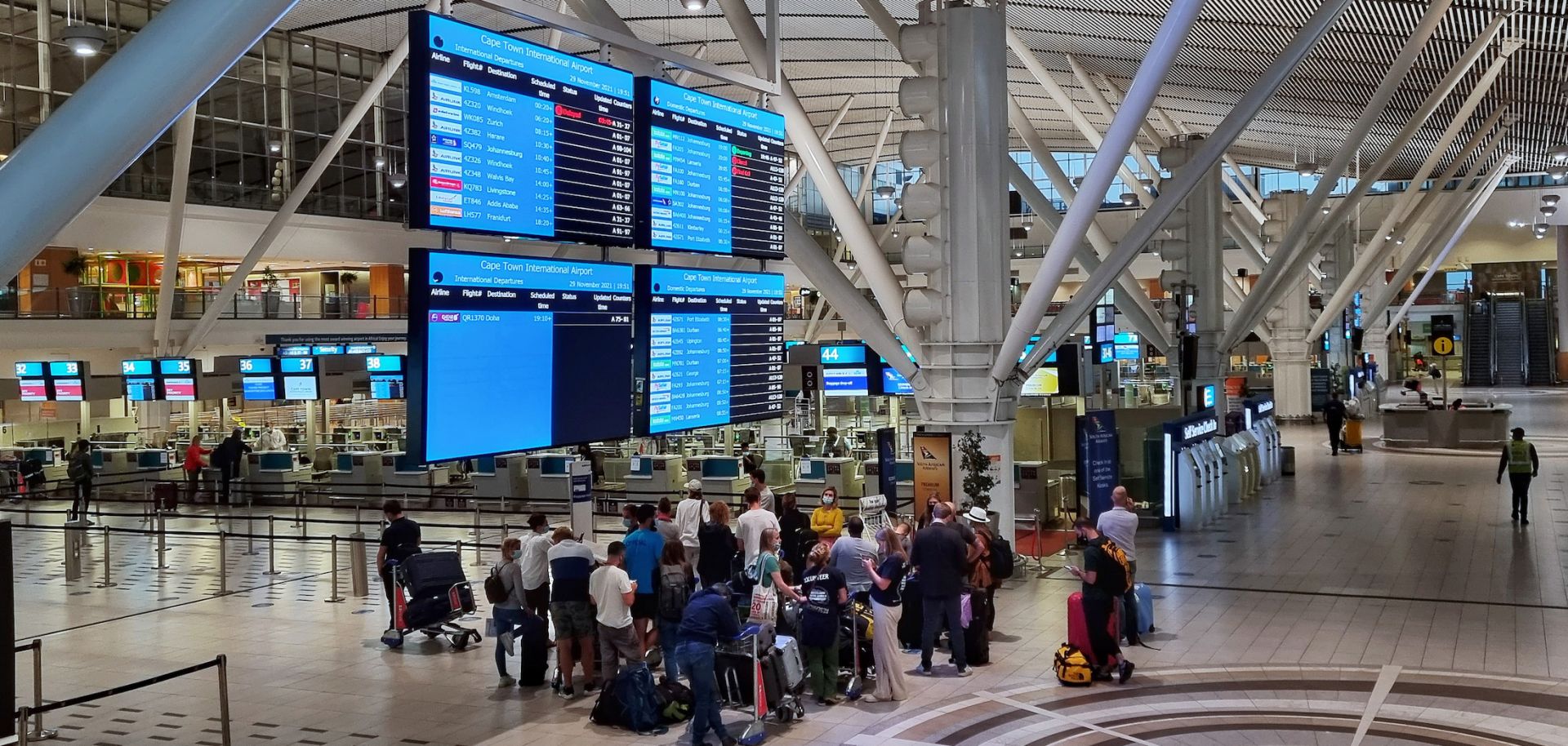
Passengers wait at an otherwise empty terminal on Nov. 29, 2021, to check in for one of the last international flights out of Cape Town, South Africa, following the discovery of the omicron COVID-19 variant.
The onslaught of omicron-related travel bans will devastate South Africa’s tourism industry, increasing inequality levels and social resistance to President Cyril Ramaphosa’s economic policy agenda. The European Union and more than a dozen countries around the world — including the United States, the United Kingdom and Israel and several EU members — have imposed travel restrictions on South Africa and neighboring states upon the discovery of a new COVID-19 strain, which the World Health Organization has named "omicron." On Nov. 26, two days after South African health officials released details of the variant, the South African rand fell to 16.4 against the U.S. dollar on Nov. 26. While the rand has since slightly rebounded to trade at 16.2 per U.S. dollar, the currency remains low and in flux as worries over the strain linger. Ramaphosa condemned the countries that have implemented travel bans for failing to uphold commitments to economic recovery in the developing world and for unfairly targeting South Africa for its transparency in reporting the new variant. Ramaphosa also announced that South Africa would not institute another lockdown, but instead consider making vaccines mandatory for some public spaces in an effort to increase vaccination rates.
- In a speech on Nov. 28, Ramaphosa said that he was “deeply disappointed” in the 15 countries that recently banned travel from South Africa. He specifically condemned Group of 20 (G-20) members for what he called “a clear departure” from the forum’s commitment to stimulate international travel among developing countries.
- The South African province of Gauteng, which includes Johannesburg and Pretoria, has seen an outbreak of the omicron strain in recent weeks. According to the director of the Center for Epidemic Response and Innovation in South Africa, the variant is now estimated to make up 90% of COVID-19 infections in Gauteng, which also accounted for more than 80% of the new COVID-19 cases South Africa reported on Nov. 29.
- Roughly 26% of adults in South Africa are fully vaccinated against COVID-19, according to Oxford University. But demand for shots has been so low that the South African government recently asked Pfizer and Johnson & Johnson to stop sending vaccine shipments so that the country could use up its current stock. Vaccination rates are particularly low among young South Africans.
Travel bans will severely hurt South Africa’s tourism industry in the coming months. South Africa typically hosts millions of international visitors between November and February. But with the recent discovery of the omicron variant, the country’s tourism sector now risks losing out on another busy summer season due to COVID-19. The United Kingdom’s newly imposed travel ban will prove particularly painful; over 430,000 U.K. tourists visited South Africa in 2019 and spent an estimated $49 million every month during the busy summer season. The Federated Hospitality Association of South Africa is working with the national government to challenge travel bans in court if necessary, although such cases have a slim chance of yielding a ruling in their favor. Lobbyists for the country’s tourism industry have also decried the international community for punishing South Africa for reporting a variant that may have originated elsewhere, but rhetoric won’t overcome the initial global prudence as the world gathers more information on omicron. And while Ramaphosa’s decision not to institute a lockdown will enable domestic tourism to continue, travel within South Africa will not account for the lost revenue from international visitors.
- The South African tourism sector lost roughly $10 billion in bookings in 2020 amid the onset of the COVID-19 pandemic. The industry generates 3% of South Africa’s GDP and employs 4.5% of the country’s labor force, of which the majority are low-wage workers.
- The World Travel and Tourism Council recently warned that South Africa will lose out an estimated $10 million every week that flights are suspended from the United Kingdom alone.
This continued damage to the tourism sector will further impede Ramaphosa’s plans for economic reform as the risk of unrest rises due to worsening living conditions and inequality levels in South Africa. The long-term economic impacts of a fourth COVID-19 wave in South Africa will become clearer as more information emerges about the severity and transmissibility of the omicron variant in the coming weeks. But in the meantime, the growing list of international travel bans will only deepen the divide between affluent South Africans and those reliant on the services sector and tourism industry for income, who are primarily poor and Black. Short-term uncertainty surrounding the Omicron variant will also magnify current inflationary pressures in the country — making already high food, fuel and water prices all the more unattainable for the growing number of South Africans who are out of work and/or struggling to make ends meet. The windfall of government revenue and support to the rand from the mining sector amid high commodity prices over the past year will serve as a cushion for Ramaphosa, who is known for his pro-business stance and longstanding desire to reduce the national debt. And, unless those prices fall (a trend that would require slower demand growth at a global level), the added mining income will also help offset the impending loss of tourism revenue. The fallout from back-to-back slow summer seasons and the rising cost of living, however, may still force Ramaphosa to impose additional social welfare measures in order to stave off protests over unemployment and inadequate government services.
- The unemployment rate in South Africa reached a record 34.9% in the third quarter of 2021, up from 34.4% in the previous quarter.
- Food prices in South Africa have increased 10% since November 2020. Fuel prices are also expected to surpass R20 ($1.24) per liter for the first time on record in December, according to the South African Department of Mineral Resources and Energy.
- In the first quarter of 2021, South Africa achieved its first quarterly primary budget surplus since 2018, largely due to high commodity prices that benefited the country’s lucrative mining industry. The government’s primary balance reached 0.6% of GDP in the first quarter of this year, up from a deficit of 2.2% of GDP in the previous quarter.
- In its 2021 medium-term budget, the Ramaphosa administration outlined several measures to rein in spending, including a freeze on both public wages and additional support to state-owned companies (one of which is the heavily indebted South African Airways, which is sure to suffer from the new travel bans).
