
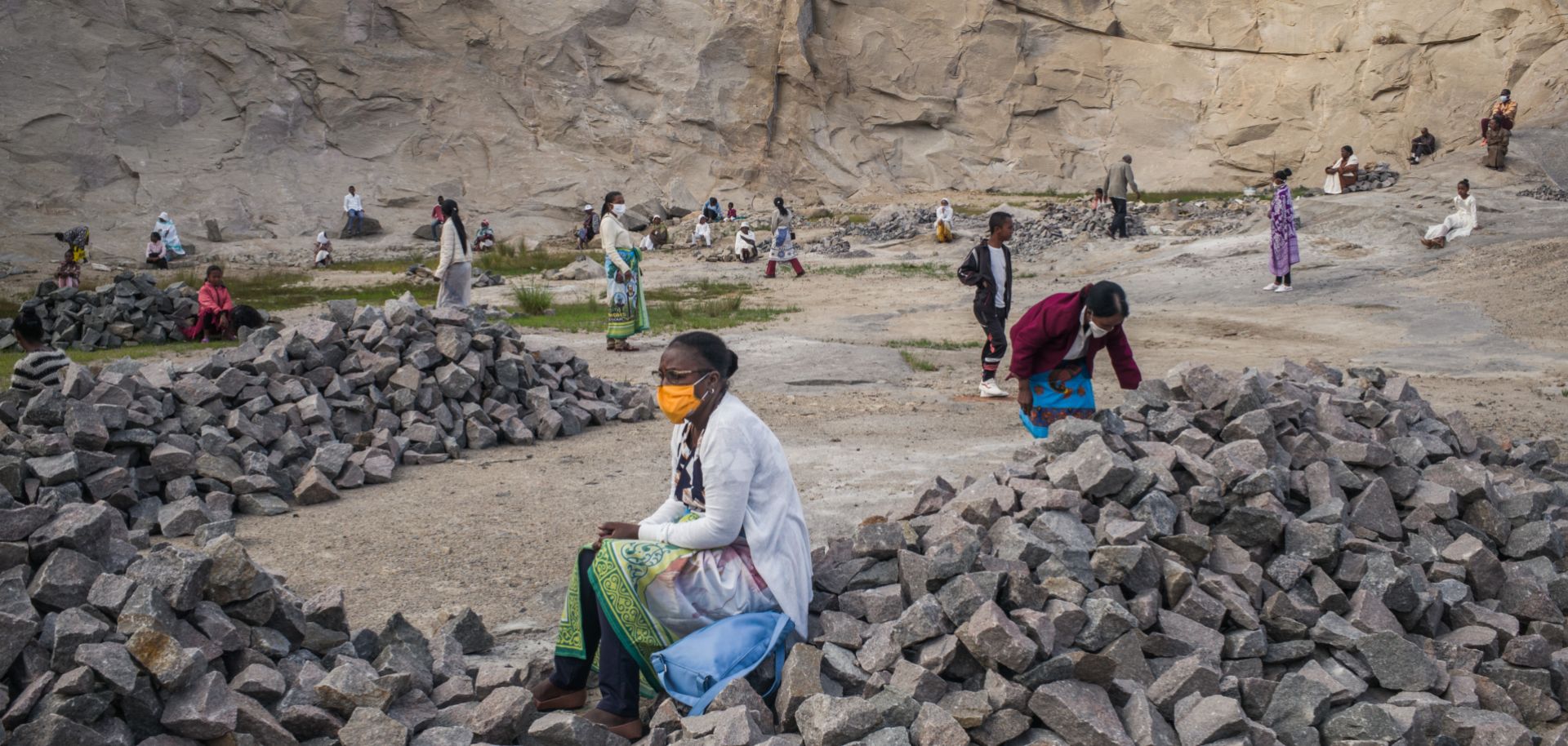
People wearing masks gather in a granite quarry in Antananarivo, Madagascar, for an Easter celebration while practicing social distancing on April 12, 2020. The capital city has been on lockdown since March 23 to curb the spread of COVID-19.
Current COVID-19 disruptions may provide only a short-term challenge for Southern Africa's lucrative mining operations. But they will come just ahead of a longer-term blow to revenue caused by the pandemic-induced global recession and the subsequent drops in demand for mineral resources. After soaring throughout 2019, platinum prices, for example, have already dropped roughly 20 percent since the beginning of the year. Meanwhile, the world’s largest producer of platinum, South Africa, has been forced to shutter its massive mining sector in the hopes of containing its own fast-evolving outbreak. Some countries such as Tanzania and Namibia have managed to benefit from the new influx of export traffic afforded by South Africa’s COVID-19 crisis. But it may be only a matter of time before widespread outbreaks force more mining firms across the region to choose between securing their profit lines or the safety of their workers. Regardless of the direct health impacts, however, steep losses in revenue due to a continued drop in prices and demand could stymie new investment and expansions of existing mining projects across Southern Africa or the foreseeable future.
Approaches to Protecting Mining Revenue
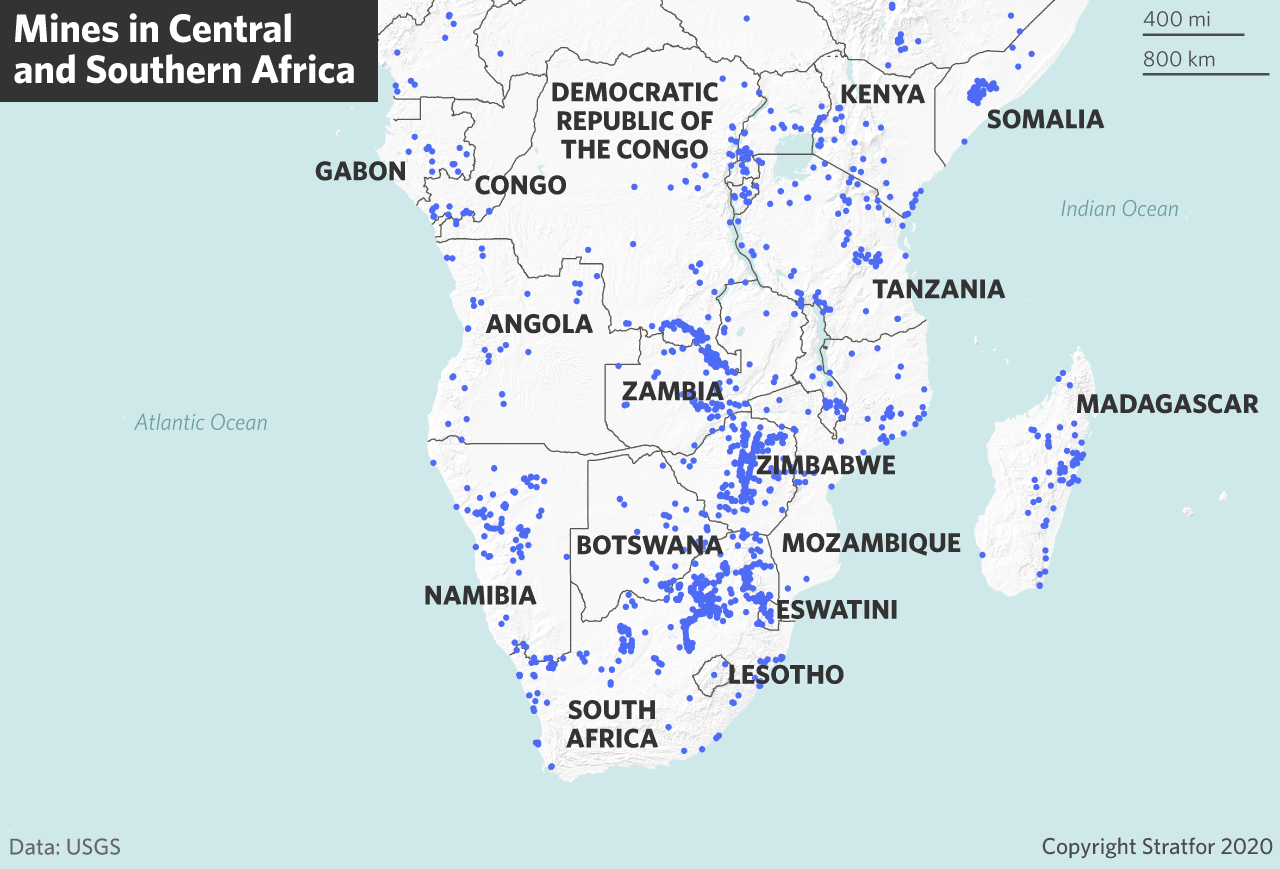
Governments in Southern Africa have so far taken different approaches in their response to the pandemic, depending on the severity of their own outbreaks at home. But even in countries not directly enforcing the closure of their mining sectors, such as the Democratic Republic of the Congo and Zambia, economic constraints and the risk of further spreading COVID-19 are still effectively shutting down production.
- As one of Africa’s most urbanized and globally connected states, South Africa has emerged as the regional epicenter of the COVID-19 pandemic, with over 2,500 cases identified so far. To contain the virus, the country’s massive mining industry has been under lockdown since late March and has suffered indirectly from disruptions across other domestic sectors. The government is now considering an incremental lifting of the lockdown, with its crucial mining sector one of the first in line to restart activity, but mining unions that want to keep workers out of harm's way have already objected to this.
- Neighboring Namibia has also instituted a mining shutdown in response to the pandemic, which is currently planned to last until May 4. But due to the significantly lower scale of the COVID-19 spread within its borders and the fewer subsequent disruptions across different sectors, supply chains running through Namibia to other mining countries have remained largely intact.
- The Democratic Republic of the Congo only observed a localized, government-mandated 48-hour lockdown on March 23 in the Katanga province. Mining companies, however, have begun to close or scale down operations on their own volition due to both increased global supply chain challenges, as well as fears of COVID-19 spreading among their employees.
- In Zambia, the government has not only been reluctant to impose any national shutdowns, but it has even threatened to revoke mining licenses from companies who independently move to suspend their operations in light of the crisis.
COVID-19 Switches Up Export Routes
South Africa’s COVID-19 disruptions, in particular, have reverberated through the mining sector across the region, and has at least temporarily shifted the flow of minerals out of Africa. Mining operations in the Copperbelt (primarily in Zambia and the Democratic Republic of the Congo), which typically route their products through South Africa’s port infrastructure, have instead been moving into competing ports such as Dar es Salaam in Tanzania, Walvis Bay in Namibia and, to a lesser degree, Beira in Mozambique. Even though South Africa has not closed its ports to such traffic, uncertainty over the interpretation of lockdown rules and concerns of future delays due to South Africa’s escalating COVID-19 outbreak have temporarily caused miners in other countries to seek alternative routes to sell their exports. This presents opportunities for these regional ports in nearby Tanzania, Namibia and Mozambique, which have long competed for supply chain activity related to the region’s inland mining industry.
So far, it appears Tanzania’s port of Dar es Salaam has seen the most significant boost in rerouted traffic. Tanzania, along with Namibia and Mozambique, will try their best to facilitate the new activity in order to retain as much of the new trade flows as possible, but they themselves may yet face their own severe disruptions related to COVID-19. Should the virus begin to more significantly spread within their borders as it has in South Africa, these governments could face similar capacity constraints due to smaller workforces operating their ports. But even if they’re able to evade wider contagions, the time efficiency and cost-effectiveness offered by South Africa’s transport infrastructure will likely bring back most of this traffic once the pandemic eventually subsides.
Indeed, the African mining industry as a whole is also particularly vulnerable to the spread of a highly contagious, potentially life-threatening virus, as it depends on a tight concentration of human labor and operates in an environment with limited health infrastructure. In South Africa, which is home to the Continent’s largest mining industry by value, the prevalence of HIV and tuberculosis, in addition to occupational risks of lung diseases associated with certain mining activities, raises the risk for a severe impact on the workforce from COVID-19. Worker unions across the region have voiced concerns regarding miners’ health, which has prompted some governments and companies to limit or suspend operations.
Lasting Global Repercussions
But even if mining operations in Africa are able to evade wider disruptions from the virus itself, the industry is still likely to face a longer-term challenge in the form of a global recession that will keep demand for natural resources suppressed. Mining companies with limited reserves will face increasing financial challenges once operations slowly start up again, as global demand is only expected to slowly recover and oversupply could continue to restrict prices until at least well into 2021.
As the initial epicenter of the pandemic, China’s tempo of recovery will be an important factor in defining just how long this could take, as the country represents a significant source for both investment and demand for Africa’s mining sector. As things stand, the suspension of mining operations has provided a correction of supply relative to reduced global demand. But recovering to prior levels of demand on a global scale will likely take significantly longer than ramping mining operations back up.
