
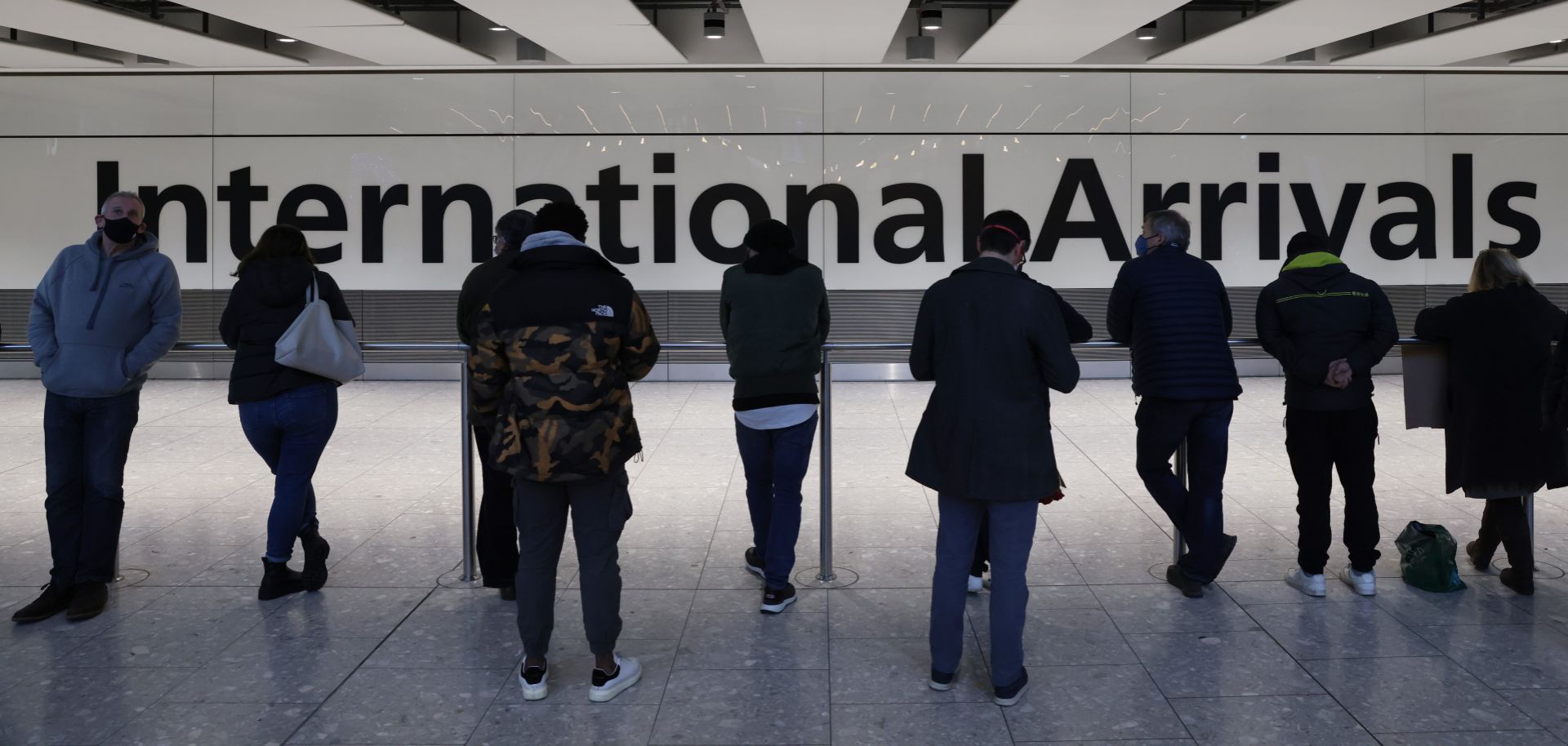
People wait at the international arrivals gate at London’s Heathrow Airport on Nov. 28, 2021. The United Kingdom recently imposed new travel restrictions following the discovery of the Omicron COVID-19 variant.
Uncertainty around the emergence of the Omicron COVID-19 variant will exacerbate global economic trends in the short term, though the new strain’s long-term impact on those trends will depend on not just the behavior of the virus but how governments choose to balance political and social drivers. On Nov. 24, South African health officials released details of a new COVID-19 strain that contains more than 50 mutations — including up to 32 variations in the spike protein, which is responsible for how well the virus can infect its hosts. At an emergency meeting on Nov. 26, the World Health Organization classified the new mutants a “variant of concern,” naming in Omicron. In recent days, confirmed Omicron cases have been reported in a number of new locations, including the United Kingdom, the Netherlands, Belgium, Canada, Australia, Hong Kong and Israel.
- The South African province of Gauteng, which includes Johannesburg and Pretoria, has since seen a moderate localized outbreak of the Omicron strain in recent weeks. Multiple Omicron cases have also been reported in nearby Botswana, where researchers found samples containing the new variant from as early as Nov. 11. On Nov. 28, Dutch officials also announced they had traced at least 13 cases from two fights from South Africa that arrived in the Netherlands on Nov. 26.
- Multiple travel bans have already taken effect. The United States has banned foreign nationals who have been to eight countries in southern Africa, including South Africa, in the last 14 days. The United Kingdom is instituting strict hotel-only quarantine requirements for those traveling from South Africa. The EU has also closed its borders to travelers from a handful of southern African nations, including South Africa, Mozambique and Namibia.
In the coming weeks, the world will be looking for several indicators to better understand the Omicron variant and the potential threat it poses. Assuming the virus propagates globally, two scenarios are probable depending on the characteristics of the new variant: one where the symptoms are mild and vaccines continue to provide protection (even if efficacy somewhat decreases), and another where vaccines provide significantly less protection and infection causes moderate symptoms in inoculated individuals. Similar to the Alpha strain of COVID-19, Omicron has a specific deletion mutation that makes it easy to detect in PCR tests. This means more Omicron cases will be identified compared with other variants like Delta, which will help the global science community spot trends more quickly.
- Early information from South Africa indicates increased transmissibility, but health officials and scientists will be watching for a larger outbreak beyond Gauteng to better gauge how quickly Omicron spreads compared with other COVID-19 strains.
- The many mutations in the spike protein may make current vaccines less effective against Omicron, though early discussions within the scientific community suggest immunization will likely still provide some protection, which booster shots will likely increase.
- A doctor in South Africa cited by Reuters reported that her patients who had tested positive for the Omicron variant had all reported mild systems. Those patients, however, were also young and at least half were vaccinated, making it difficult to draw too many conclusions from this early anecdotal observation.
- Moderna and Pfizer have both stated that tailored boosters could be ready if necessary in as little as three months.
Another round of travel bans and the potential for extended restrictions in some locations will compound existing global economic pressures like rising inflation and supply chain uncertainty, with the services sector once again being hit hardest. Countries will likely maintain aggressive travel restrictions in the coming weeks, regardless of what new information emerges on Omicron. This comes at a time when the global economy is already struggling with labor shortages, rising inflation, high energy prices and supply chain imbalances, as well as uncertainty surrounding U.S. monetary policy and Chinese economic growth. Omicron's emergence will only accelerate these global economic trends — the combination of which could lead to mild recessions in certain parts of the world. As was the case during previous waves of COVID-19, the services sector in both the United States and especially Europe will be particularly vulnerable to renewed COVID-19 uncertainty and reintroduced lockdown measures.
- In the United States, recent statements made by President Joe Biden indicate the federal government will seek to avoid instituting additional nationwide restrictions. . But in response to the discovery of Omicron, individual U.S. states like New York have already increased COVID-19 mandates, which could have trickle-down effects on regional economies ahead of the busy holiday season. There will also certainly be an increased emphasis on increasing the percentage of the U.S. population that has received a booster shot.
- In Europe, governments are also likely to expand the application of booster shoots from the at-risk populations to the broader populations. Stricter lockdown measures are likely as well, even if governments will try to avoid a full-on lockdown for as long as possible. Prior to the emergence of Omicron, some European governments had already been increasing restrictions in response to a COVID-19 resurgence fueled by the Delta variant. European countries will also probably expand travel restrictions beyond the current list of African countries. By limiting business activity and tourism rates, such measures will further slow down economic growth in Europe.
Political and social pressures, however, will ultimately drive national responses to COVID-19 regardless of the new variant’s properties, muting Omicron’s overall impact on economic outlooks for 2022. The potential for localized restrictions and mask mandates, combined with the widespread focus on travel bans in the near term, will increase social inequality by disproportionately hurting those who depend on services sectors — the same working class that continues to be hit by increasing consumer prices, supply chain bottlenecks, public debt levels and/or hesitancy surrounding economic reopenings. Omicron might worsen these existing trends, given that the most likely outcome is a mild or moderate strain and not a severe one. But it’s unlikely to throw the global economic recovery completely off-track, as national leaders’ response to the new variant will be tempered by the waning political will to impose COVID-19 restrictions and the growing social fatigue to adhere to them. The risk of causing more social unrest, business disruptions and political backlash will likely still compel most governments to adjust their greater COVID-19 strategies only slightly, if at all, in response to Omicron — thus reducing the variant’s long-term impact on the global economy.
- Numerous U.S. state leaders have either outright refused or expressed reticence to return to any form of lockdown measures.
- Recent anti-lockdown protests in numerous Northern European countries illustrate the kind of pushback these governments would face in reimposing restrictions on activities.
- The end of the Delta wave saw a number of Southeast Asian countries ease COVID-19 restrictions despite still seeing high infection rates, showing a low political and social tolerance for continued economic pain incurred by lockdowns.
