
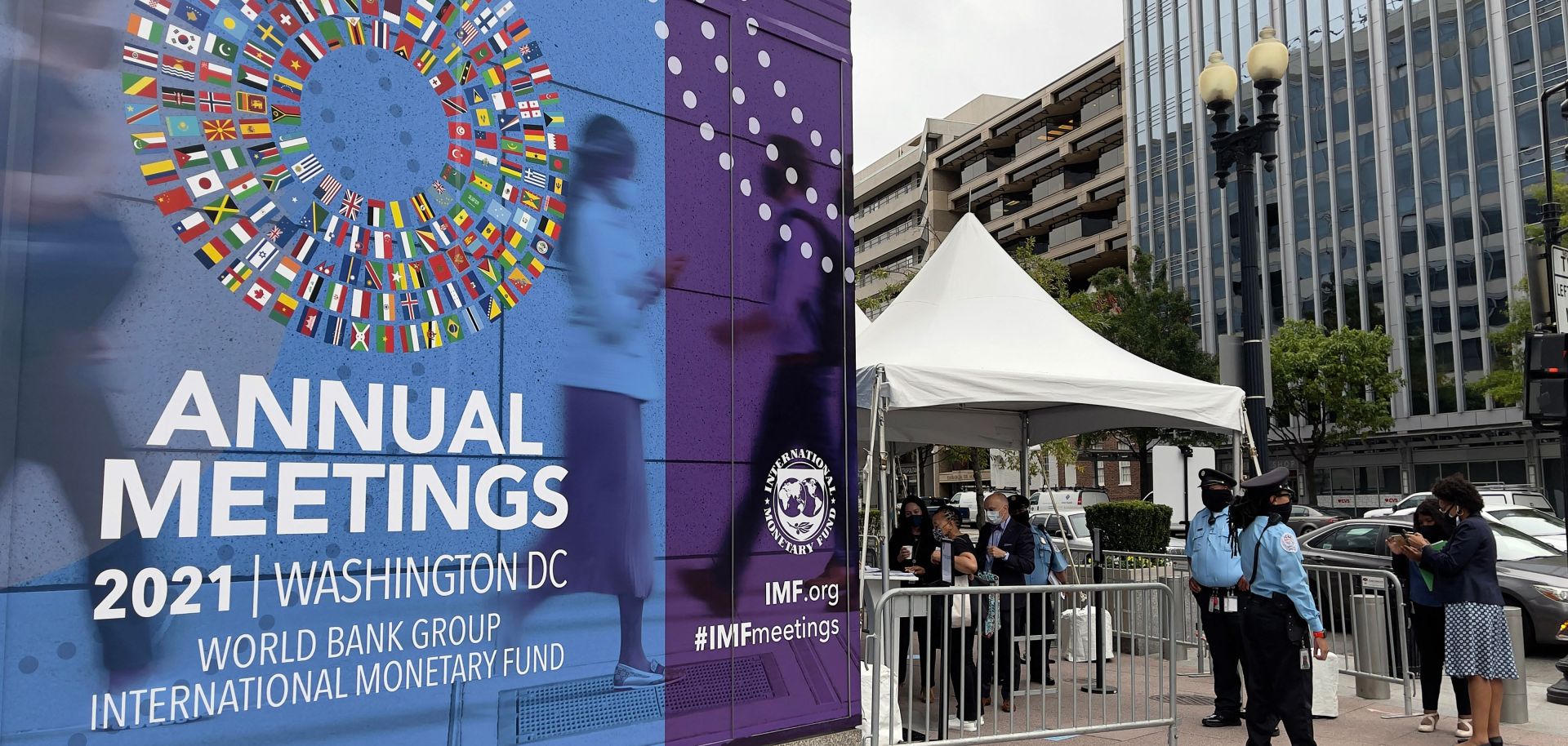
People wait near the entrance to the annual meetings of the World Bank and International Monetary Fund (IMF) outside the IMF headquarters in Washington D.C. on Oct. 11, 2021.
Internal leadership problems at the International Monetary Fund (IMF) and the World Bank, combined with domestic issues facing both institutions’ main shareholders, will severely limit room for substantive progress during this year’s IMF-World Bank meetings. The lack of a clear path forward for international policy coordination in the transition to a post-pandemic world will, in turn, leave their 190 member countries to mostly fend for themselves in addressing risks and vulnerabilities. On Oct. 13, the IMF and World Bank will begin substantive discussions on the uneven global recovery and the associated economic and financial risks. The IMF is set to release its updated World Economic Outlook on Oct. 12, which will be the backdrop of most discussions. IMF Managing Director Kristalina Georgieva offered a preview of the report earlier this month, when she said global growth in 2021 will be slightly below the previous forecast of 6% made in July. In contrast, the World Bank, which tends to be less optimistic than the IMF, in June projected only a 5.6% global growth rate for 2021.
The global economy has changed significantly in the 19 months since the World Health Organization officially declared the COVID-19 outbreak a pandemic, and these meetings will only begin to consider the implications. Factors on which there will be broad pleas for cooperation include:
- Maintaining economic growth in developed countries. Recoveries are strong but slowing in the United States and China, which together account for about 40% of global output. Developed economies have or soon will regain pre-pandemic levels of output based largely on vaccination progress.
- Boosting vaccination rates in emerging markets and developing countries. Uneven vaccination rates are contributing to slower and uneven recoveries in poorer parts of the world. The IMF has urged every country to have at least 40% of their population vaccinated by the end of this year, and 70% by the end of 2022. But there are no clear plans for either financing or administering more shots in these countries, and none are likely to be approved at the annual IMF-World Bank meetings.
- Mitigating rising global prices. Inflation could be higher and longer-lasting than most forecasters had anticipated just a few months ago, and the tightening of monetary and financial conditions could further slow recovery. Issues including persistent supply chain bottlenecks, disrupted labor markets, and global food prices at their highest level in more than 10 years all add to inflation pressure from already high energy prices. The IMF is concerned that tightening of monetary policies in response to increased inflation will stifle the global recovery by raising financing costs and interest rates across the world and adversely affecting exchange rates for highly indebted, vulnerable economies.
- Lowering global debt levels. Debt issues persist, particularly for the poorest countries that benefited from the Group of 20 (G-20) Debt Service Suspension Initiative (DSSI), which expires this year, even as global debt is at an all-time high. The G-20’s Common Framework for Debt, which is supposed to include China and private sector debt, has yet to be tested. Chad is currently in negotiations led jointly by France and China, but the Central African country is a small debtor with only a few creditors, meaning such talks are unlikely to set precedents. The far larger case of Zambia, which owes $15 billion to bilateral and private creditors, will be the first real test of the feasibility of the G-20 framework as a new paradigm for solving international debt problems.
New policy initiatives on these issues, however, are unlikely, with the world’s largest economies currently engulfed in a myriad of pressing matters forcing their attention home. While the United States temporarily avoided a debt ceiling debacle, U.S. Treasury Secretary Janet Yellen will be preoccupied with the White House’s efforts to scale back its economic program to unite Democrats in both chambers of Congress and prepare for the next debt ceiling deadline in December. In Germany, Finance Minister Olaf Scholz’s Social Democratic Party is currently focused on forming a governing coalition following last month’s inconclusive federal election. The United Kingdom, meanwhile, is preoccupied with an ongoing energy crisis, with other European countries are looking for ways to keep their recoveries going while addressing high public debts in several countries in the bloc’s currency area. Finally, China is preoccupied with ensuring the collapse of large property developers doesn’t infect the country’s banking system at a time when widespread energy shortages are threatening China’s GDP growth prospects.
Room for substantive reforms in the global financial architecture will also be further limited by corruption allegations involving the leaders of the IMF and the World Bank. Recent media reports suggest that the United States and Japan are pressing IMF Managing Director Kristalina Georgieva to step down amid accusations that she helped manipulate the World Bank’s Ease of Doing Business Index to improve China’s ranking when she was a senior bank official in 2018 — a time when the World Bank was seeking a larger capital contribution from Beijing. China and Russia reportedly want Georgieva to stay, with European countries allegedly more ambivalent on the matter. Meanwhile, current World Bank President David Malpass has also been accused of pushing for China to be downgraded in subsequent Ease of Doing Business reports because of his personal and ideological worldview as an appointee of former U.S. President Donald Trump’s administration, which had a notably hawkish approach to Beijing. The ongoing investigations threaten to undermine both the IMF and World Bank’s credibility as the institutions begin their most visible meetings of the year and try to set the tone for greater international cooperation in addressing global economic and financial risks.
Within the context, the IMF-World Bank meetings are unlikely to yield progress on proposals that would see advanced economies voluntarily redistribute newly allocated IMF funds to emerging markets and developing countries. During this week’s meetings, the IMF and World Bank will discuss using the former’s allocation of $650 billion in Special Drawing Rights (SDRs). The Aug. 23 creation and distribution to the membership of new international reserve assets was on the basis of IMF quota shares. As a result, advanced economies — including the United States and European countries — received a far greater share of those assets compared with their less-advanced counterparts, where the pandemic has significantly increased development and financing needs by squeezing exports. The IMF is hoping wealthier countries will contribute their share of the SDR allocation to the institution’s Poverty Reduction and Growth Trust, as well as to a proposed Resilience and Sustainability Trust, to finance the balance of payments and development needs in emerging markets and developing countries. But this week’s discussions are unlikely to yield new major contributions or any sizable increase in funds available for IMF grants, which will contribute to the further slowing of the post-pandemic recovery.
