
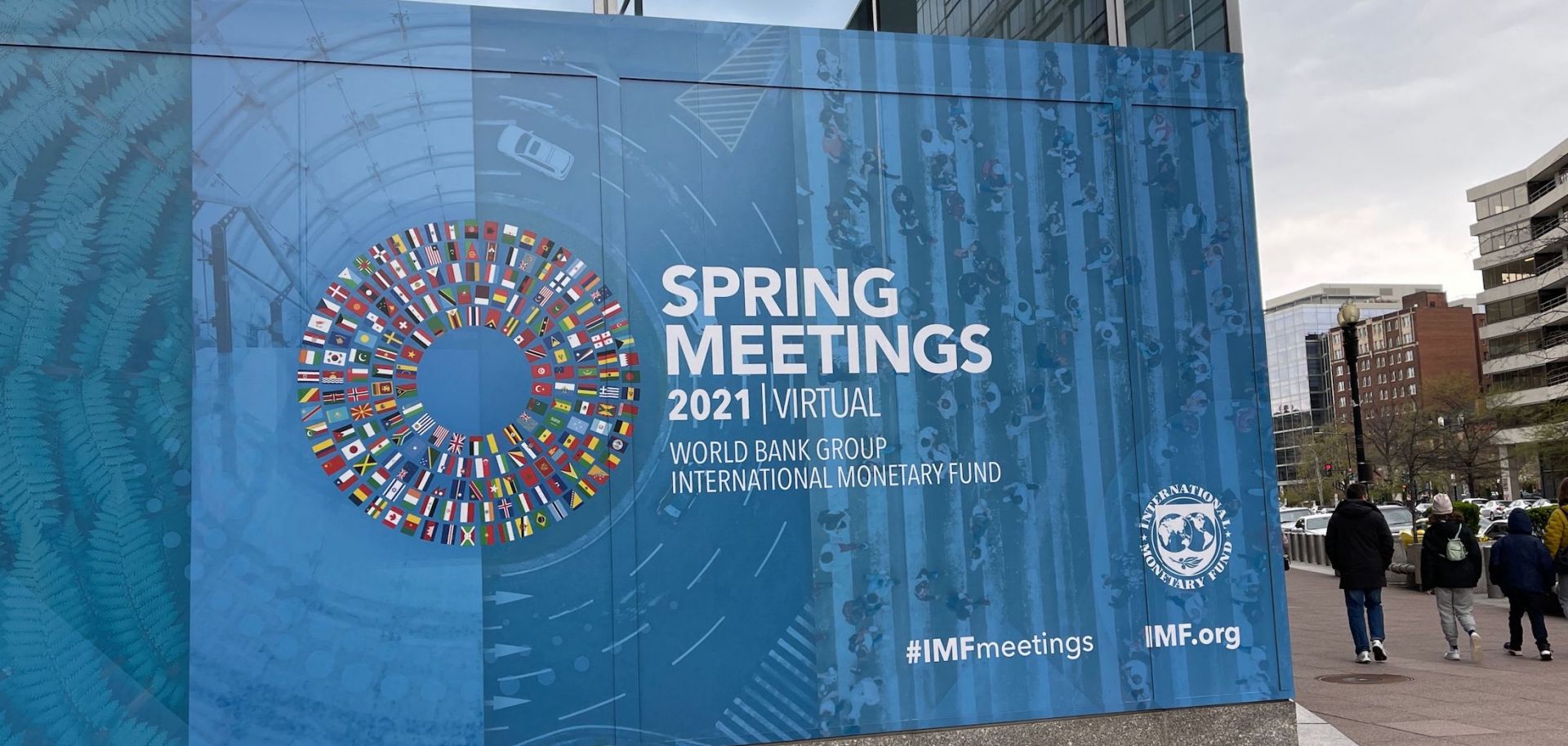
International Monetary Fund headquarters on April 5-11, 2021, in Washington.
The International Monetary Fund will revise its forecast for global growth in 2021 and 2022 upwards, but will also warn about divergences in the recovery and potential financial problems caused by stimulus programs. Significant progress in reforming the global financial architecture is improbable, which means that many countries will struggle to repay their debt if financial conditions tighten. The IMF and the World Bank will hold their semiannual meetings April 5-11. The IMF's spring World Economic Outlook, due April 6, will probably improve its earlier projections of global growth of 5.5% in 2021 and 4.2% in 2022, mostly to reflect faster than expected rebounds in the United States and China, which account for more than 40% of the world economy and explain the IMF's more optimistic approach. The predictions for Europe could be revised down, as the Continent may be in recession through the first half of 2021 because of new lockdowns.
- The IMF believes the global economy will be 3% smaller in 2024 than projected before the pandemic, and projects that poor countries will need an additional $450 billion over the next five years to compensate for losses.
- Persistent weakness is expected in tourism and services sectors that depend on personal contact. The IMF will probably recommend continued official support for labor markets to prevent the atrophy of skills in the long-term unemployed, aid to young and unskilled workers, and job retention programs where countries have sufficient means.
The IMF and the World Bank will express concern about financial fragility caused by rising debt around the world. The probable creation of $650 billion in new reserve assets through an allocation of new IMF Special Drawing Rights will ameliorate, but not fill, potential fiscal needs. In its Global Financial Stability Report, also released April 6, the IMF will warn about rising debt caused by the pandemic, which has reached record levels. The dropping of U.S. objections to the new SDR allocation will help countries in financial distress, but there may be a debate in the IMF and World Bank over the need for additional resources and other ways to find them. The IMF will likely ask richer developed countries to place their newly issued SDRs into a trust fund for lending to poor countries. There are political impediments in the United States, however, to allowing the creation of more of what is free money and to donating the U.S. share. SDR allocations greater than those proposed would require U.S. congressional approval, where majority support probably is not feasible.
- The IMF has noted in early comments on financial stability that rapidly increasing leverage is often a precursor to financial crises, although it has also suggested that due diligence by regulatory authorities will help.
- Governments provided $16 trillion in fiscal support in 2020 and so far in 2021, equivalent to nearly 20% of 2020 estimated nominal world GDP of $84 trillion. Borrowing to finance that spending (much of it monetized by borrowing from central banks) raised debt-to-GDP ratios globally by 11 percentage points through Q3-2020 and global debt is an estimated 355% of GDP.
- Capital flows to emerging markets and developing countries should continue as long as there's enough risk appetite among global investors, the dollar does not strengthen, and long-term U.S. and European bond yields do not increase substantially.
IMF and World Bank members will also discuss reforming the international financial architecture for debt restructuring, with all eyes on China's participation plus pleas for greater burden-sharing by private sector creditors. Progress with private creditors is unlikely, however, which will delay the granting of debt relief to poor countries. China has agreed provisionally to participate in a "common G-20 framework" for debt restructuring, which presumably includes joint negotiations over traditional Paris Club claims and those of China. There does not seem to be a solution at hand for private sector participation, however, because countries have been largely dissuaded from seeking private creditor debt restructuring in the face of possible sovereign credit rating downgrades that, at a minimum, would raise the cost of borrowing. At the same time, a comprehensive report and recommendations on debt restructuring from the Group of 30 (an eminent group of high-level former finance ministers, central bankers and international investors) will be delayed because the group is waiting for greater clarity on the global macroeconomic picture. This means that poor countries are unlikely to receive additional rounds of debt relief in the short to medium term, even if the G-20 will consider extending its Debt Service Suspension Initiative through end 2021.
