
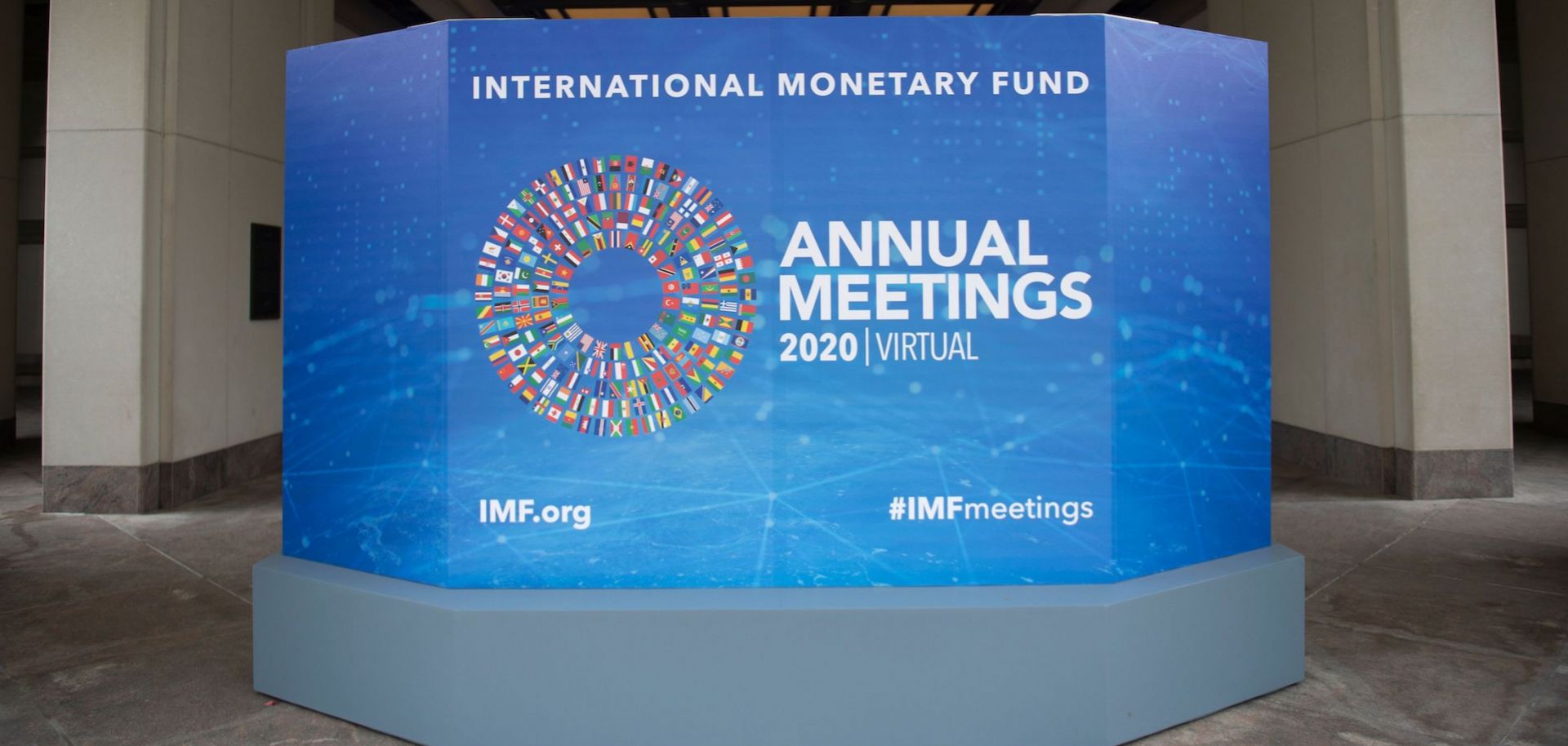
A promotional board for the annual series of meetings between the International Monetary Fund (IMF) and the World Bank is seen outside the IMF headquarters in Washington D.C. on Oct. 13, 2020.
The Debt Dilemma
Growing debt vulnerabilities in emerging markets and developing countries amid the ongoing COVID-19 pandemic, along with the enduring need to prop up global growth with money from developed countries, will be the primary focus of the virtual meetings between the International Monetary Fund (IMF) and the World Bank over the next week. Between Oct. 12-22, the two global financial institutions will hold their annual series of joint discussions via video conference amid burgeoning disagreements on extending the Group of 20 (G-20)’s Debt Service Suspension Initiative (DSSI), as well as broadening the plan to include more comprehensive treatment of debt stocks.
Until issues with creditor participation are resolved, there is virtually no scope for broadening the DSSI beyond a temporary debt deferral.
- World Bank President David Malpass said on Oct. 12 that some G-20 countries were reluctant to broaden and extend DSSI relief, and that for now, there could be a simple extension of the payments deferral until June 2021.
- The World Bank and IMF earlier called for a one-year extension of the DSSI, as well as longer-term reforms to the international architecture to deal with debt problems, with Malpass calling debt service suspension a “stopgap.”
- Some G-20 member countries evidently want to make decisions on further action on a case-by-case basis, with debt sustainability issues playing a decisive role, and are not ready to consider debt reduction or changes to the international financial architecture for sovereign debt.
China’s smaller and more opaque participation in the DSSI has created a critical gap in the implementation of the DSSI, which has so far been uneven. Member countries of the Paris Club of Western creditors have provided the most relief, with notably less participation by China, who is not a Paris Club member and whose investments lack transparency. On Oct. 12, China announced that it was canceling “interest-free” government loans owed by 15 African countries that were maturing in 2020. Nonetheless, Beijing has refused to include commercial loans made by state-owned policy banks, including the China Eximbank and China Development Corporation. China’s latest announcement is thus likely just an effort to head-off criticism in the G-20, and it’s unclear how far the G-20, or alternatively the G-7, will push China on the issue this week.
- Under the DSSI, payments owed from May to December 2020 were supposed to be deferred for countries eligible for borrowing from the World Bank’s International Development Association. As of mid-September, 43 countries had requested DSSI participation, covering $5 billion in principal and interest payments owed to bilateral creditors in G-20 countries.
- In early October, the IMF called on official bilateral creditors to work together more closely and expand combined debt relief beyond that provided by the Paris Club. But there seems to be a lack of international leadership on the issue. Some observers believe China restructures debt as needed, but a lack of transparency undermines international confidence in burden-sharing among official creditors.
Private creditors’ participation in the DSSI has also been virtually non-existent. In the absence of private creditor action, official creditors — including those in the Paris Club, IMF and World Bank — are providing debt relief that can be used to pay off other creditors. Moreover, the big three credit rating agencies (Moody’s Investors Service, Standard & Poor’s and Fitch Ratings) have all said requests for deferrals made to private creditors would be treated as an event of default, which has prevented all but Angola and Zambia from seeking that relief. The IMF recently called for changes in collective action clauses for eurobonds, but as with official creditor participation, there does not seem to be international leadership for a more comprehensive approach.
- The Institute of International Finance (IIF), a private association of financial institutions, initially lobbied for a global debt plan that was slated to include private sector participation. But when the time came to act, the IIF bailed on the plan — indicating that what it really wanted was for governments and institutions to act so its members could get paid.
The Bigger Economic Picture
Separate from (but related to) the upcoming debt discussions is the recent release of the IMF’s updated World Economic Outlook, which will have implications for policy and financing in both developed and developing countries, particularly as fiscal deficits rise and add to public sector debt. The IMF’s June forecast for 2020 global production was -4.9 percent. The latest update, released on Oct. 13, shows a slightly less drastic decline in global output after better-than-expected recoveries in many countries in the third quarter of 2020.
A looming question is whether governments have the ability or the political will to keep up the pace of emergency financial support during an extended or renewed pandemic, and if they can deal effectively with long-term “scarring” caused by lockdowns. Governments globally addressed the recession with unprecedented policy support that included fiscal efforts of more than $12 trillion, negative real interest rates and large injections of liquidity into financial markets. Yet in the United States, for example, further fiscal stimulus remains elusive, which could have political and social implications by leaving people exposed to economic distress. An emerging second wave of COVID-19 cases across the world also indicates governments have been less effective in addressing the public health crisis than previously thought, and casts doubt over whether targeted lockdowns can be sustained to contain the pandemic.
- Renewed COVID-19 outbreaks are popping up across Europe. And in the United States, daily new cases have topped 50,000 for four successive days.
- In the United States, there are also concerns that the Federal Reserve may have exhausted monetary policy, with the U.S. economy possibly in a liquidity trap. Long-term unemployment in the country has also increased, with 10 million fewer jobs in the economy than in February.
- Prior to the pandemic, the global economy had already slowed below previous trend growth, which contributes to skewed income distributions. Policymakers will now need to consider how to overcome such “secular stagnation” in a post-COVID world.
The IMF and World Bank have also expressed concerns about the ability of many emerging markets and developing countries to sustain high levels of public spending in the face of declining commodity prices, tourism receipts and global remittances. Existing debt vulnerabilities, exacerbated by pandemic spending, create new financing problems. Even in an environment where global investors are hungry for yield, they may pay attention to deteriorating credit fundamentals in countries with sub-optimal domestic policies that are heavily reliant on external financing.
- IMF Managing Director Kristaline Georgieve recently said that African countries will have a $345 billion financing gap in the next two years, which will set back development efforts and could lead to new financial crises.
- Emerging markets elsewhere in the world, such as Brazil, South Africa and Turkey, were able to weather the sudden stop in capital flows in March. But enduring risks to external financing remain, which may force many countries to suppress imports and take other potentially painful measures.
