
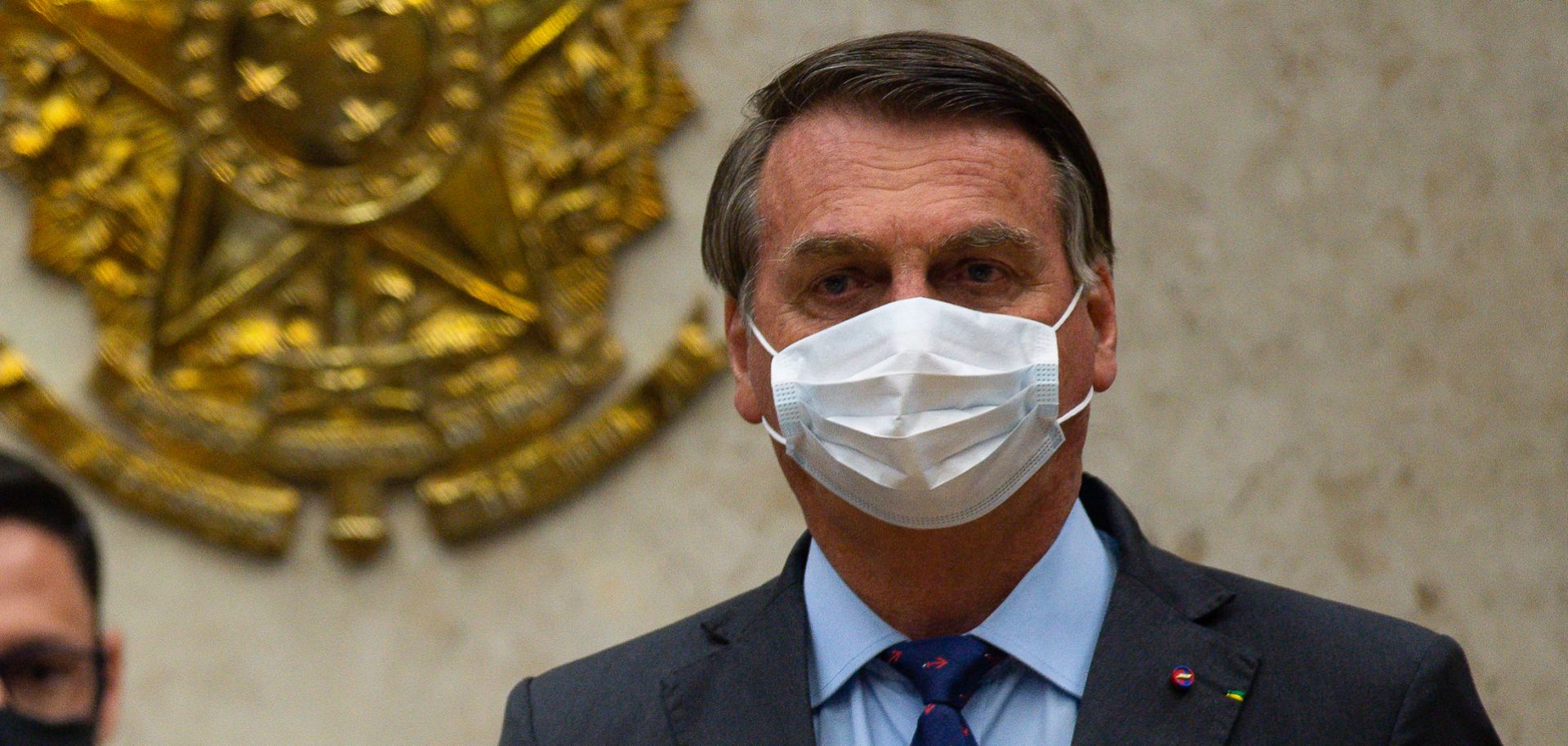
Brazilian President Jair Bolsonaro attends the inauguration ceremony of Supreme Court Justice Luiz Fux on Sept. 10, 2020, in Brasilia, Brazil.
Brazilian President Jair Bolsonaro’s announcement of a new social cash-support program has raised concerns about the government’s long-term fiscal discipline, as well as its policies to balance the needs for domestic social spending with longer-term debt issues. On Sept. 28, Brasilia announced a new cash transfer social program, dubbed the “Citizens Income,” which offers an extension of current COVID-19 support programs for low-income citizens into 2021. To soften the blow of the COVID-19 outbreak, Bolsonaro’s government has offered multiple fiscal stimulus programs in the past few months at a cost estimated to be more than eight percent of the country’s GDP.
- Brazil’s Congress previously approved a one-time “emergency” budget of more than $100 billion in 2020. The International Monetary Fund (IMF) estimates that the two programs could precipitate a public deficit of around 16 percent of GDP in 2020, which would put Brazil’s public debt over 100 percent of the GDP by the end of the year.
- The Brazilian economy is still expected to fall significantly in 2020 (between -5.8 and -6.5 percent, per the latest IMF and Organization for Economic Co-operation and Development estimates, respectively). But the size of the stimulus has been able to limit the fall in economic output, especially compared with the rest of the region, which the IMF expects to decline overall by 9.4 percent.
Bolsonaro’s COVID-19 stimulus package has improved his approval ratings, prompting him to seek ways to extend some of these social programs, which has raised concerns within his administration about the direction of the fiscal policy and Bolsonaro’s commitment to economic liberalization. Despite the criticisms for his management of Brazil’s COVID-19 outbreak, Bolsonaro’s popularity has grown in the past couple of months thanks to the transfer programs. The bump in approval ratings led Bolsonaro to look for funding to convert the cash disbursements into a new social welfare program, precipitating a disagreement over fiscal policy and funding between Bolsonaro and his finance minister, Paulo Guedes.
- Guedes, an orthodox regarding fiscal discipline, has advocated deficit-neutral funding through the reduction of other social programs, including the popular “Bolsa Familia.” Bolsonaro is resisting, asserting that he will not “take away from the poor to give to the poorest,” signaling an unwillingness to sacrifice social programs he previously criticized, recognizing their political value.
- In the past couple of months, and before the current debate about the Citizens Income program, several of Guedes’ top advisors have resigned, citing a lack of commitment to pursue the pending structural reforms around the tax and pension systems, among others.
Investors, economists and international institutions are questioning the options for sustained funding of the new social spending program, and any others that might come in the future. There’s also a fear that the popularity of these programs will create an incentive for the Bolsonaro administration to get rid of constitutionally mandated spending caps (or at least try to find a way around them), as well as indefinitely delay or archive any other controversial reforms that could hurt his popular standing, such as the pending reforms to Brazil’s pension system. On Oct. 5, the IMF declared that the financial and economic risks Brazil might face in the future are “exceptionally high and multifaceted,” and urged the Bolsonaro administration to adhere to the spending caps and the economic reform agenda.
- Introduced in 2016 to control public debt, Brazil’s cap, included in the country’s constitution, limits the growth of public spending to no more than the level of inflation for the previous year. Bolsonaro and Guedes had been staunch defenders of the cap. And after an initial negative reaction in the markets, both were compelled to explicitly affirm that it should be an unalterable guardrail of Brazil’s macroeconomic discipline.
- The inflexibility of Brazil’s budget has also been the impetus of the modernization programs championed by Guedes, including a postponed and controversial pension reform.
- During a public roll-out of the Citizens Income program on Sept. 28, officials said the Brazilian government may redirect funding by delaying or limiting court-mandated payments. They also said Brasilia was considering tapping into an educational fund known as Fundeb, which would force the Bolsonaro administration to eventually find other revenue sources for the fund.
Brazil is not about to fall into a massive economic crisis beyond the slump created by the COVID-19 outbreak, though its current deficit levels are clearly unsustainable, as the IMF made evident in its latest report. Brazil is still the largest economy in Latin America, with the largest amount of foreign reserves (which have returned to the levels of the closing of 2019 after several months of sizable outflows in the second quarter of 2020), and an important industrial base, Before the COVID-19 outbreak, the Bolsonaro administration seemed to be determined to advance an economic reform agenda to reign in growing entitlement expenditures. The new political realities are creating competing claims for the administration’s priorities, and markets seem to be taking note. But even in a COVID-19 world where the markets seem to be more understanding of the needs for more fiscal room, Bolsonaro will need to make some tough choices if he wants to prevent Brazil from entering a larger economic crisis.
