
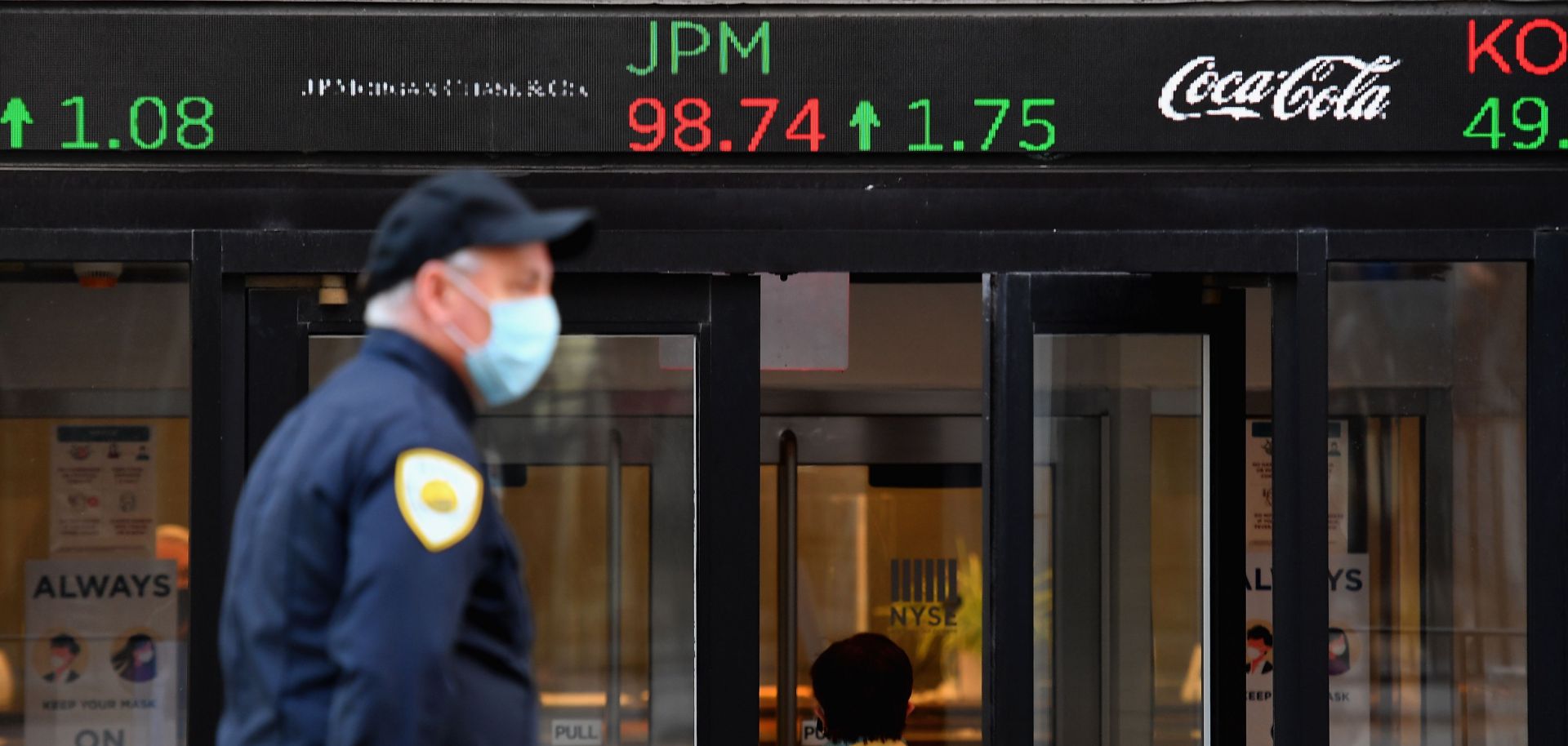
A security officer wearing a mask walks by the New York Stock Exchange (NYSE) building on Oct. 5, 2020.
New data shows the U.S. economic rebound remains underway but is running out of steam amid the country’s ongoing COVID-19 crisis, as acutely illuminated by President Donald Trump’s own diagnosis and recent hospitalization. What John Maynard Keynes described as “animal spirits” in 1936, today’s economists define as “sentiment,” “confidence,” or just plain “certainty” and “trust.” But regardless of what you call it, it appears Americans’ economic decisions are still being constrained by the course of the virus in their communities, and now their government — underlining that the biggest threat to the United States and other global economies remains the continued, heightened uncertainty created by the COVID-19 pandemic.
- According to the Johns Hopkins University tracker, the United States now has nearly 7.5 million reported COVID-19 cases and 210,000 deaths nationwide, and is still averaging about 300,000 new cases per week. 26 states have reported increases in infections over the past week, and only 10 are reporting declines.
News of Trump’s positive test overshadowed everything else, but three sets of data released in the past week show a slowing or sluggish economic recovery and volatile sentiment. The Conference Board’s consumer confidence survey was released on Sept. 29 followed by the U.S. government’s September jobs report on Oct. 2. The Institute of Supply Management’s manufacturing index and sentiment services index was also released on Oct. 1 and Oct. 5, respectively.
The “hard” economic data in the latest jobs report, in particular, paints a very mixed picture that reinforces the precariousness of the U.S. economy. The unemployment rate dropped to 7.9 percent in September as employment increased by 661,000 jobs, even while the level of employment remained 10.7 million below its February level. Much of the fall in the unemployment rate was from a shrinking labor force participation rate. And despite more than 60 million new claims for unemployment since mid-March, only 12.6 million people are now recognized as officially unemployed. The U.S. economy has recovered the easy gains from some temporary layoffs being reversed, especially in service industries. And labor market growth is decelerating from the 1.49 million jobs added in August. The September data, however, also does not include people whose unemployment benefits may have expired and are considered out of the labor force. Other highlights in the latest U.S. jobs report include:
- The number of persons on temporary layoffs decreased by 1.5 million to 4.6 million, after hitting a high 0f 18.1 million in April. The number of temporary layoffs is still 3.8 million higher than in February.
- The number of long-term unemployed, which the U.S. government defines as those jobless for 27 weeks or more, rose to 2.4 million — an increase of 781,000 people from the August jobs report. Median unemployment duration was up in September to 17.8 weeks compared with the pre-pandemic median of nine weeks.
- The labor force participation rate fell by 0.3 percentage points to 61.4 percent, two percentage points lower than in February, with 7.2 million Americans reported as not in the workforce but seeking a job.
- At 56.6 percent, the U.S. employment-to-population ratio is also 4.5 percentage points below the February level.
- Had the labor force participation rate been unchanged, the unemployment rate would have been 8.3 percent — only 0.1 percentage point lower than in August.
Consumer and business confidence increased in September, but remain below pre-crisis levels. In addition, monthly data shows retail sales at pre-pandemic levels and home sales at a 10-year high. U.S. manufacturing was also up by 1 percent in September for its fourth consecutive monthly gain, though factory output was still 6.7 percent below its February level. And in reporting the latest data, the U.S. Federal Reserve noted that “the gains for most manufacturing industries have gradually slowed since June.”
The expected spike in U.S. GDP in the third quarter of 2020 amid the lifting of COVID-19 restrictions is unlikely to be sustained through the fourth quarter, as indicators of economic health in future months will be bleaker. The September payrolls report, for one, did not include several large-scale layoffs in the past weeks, including a drop in federal employment from the beginning of layoffs of temporary census workers. Major companies announcing layoffs or furloughs that will be reflected in October data include American Airlines (19,000), United Airlines (13,000), and the Walt Disney Company (28,000). International employers announcing worldwide layoffs were Continental Tire (20-30,000), and Royal Dutch Shell (9,000). Looking forward, other factors affecting the sustainability of current growth drivers include:
- According to Black Knight Mortgage Monitor, an estimated 6.9 percent of mortgages, more than 3.6 million, were delinquent as of end-August. This is a slight decline from the delinquent mortgages reported in July, but still 3.7 percentage points higher than before the COVID-19 crisis. The number of mortgages in serious delinquency (90+ days past due) has also increased by 5 percent, and an additional $3.4 million in mortgages are in forbearance.
- An estimated 13 million American adults were behind on rent in September, according to the U.S. Census Bureau’s Pulse Survey, or 17 percent of U.S. renters. At the same time, 23 million adults reported not having sufficient food in the week ending Sept. 14.
- As of mid-August, 29 large retail stores had filed for bankruptcy protection, according to data published by the Wall Street Journal. The total number of retail giants filing for bankruptcy is expected to reach 48 before the end of this year, compared with the 22 companies that filed in 2019.
- US job openings declined in August, the first time in four months according to the Department of Labor on October 6.
The continued lack of new economic stimulus from the federal government is also slowing the U.S. recovery. Fiscal measures, including disbursement of government stimulus checks in recent months and the end of the Paycheck Protection Program, have helped support consumer spending. Average hourly earnings were up slightly again in September, although gains were exaggerated by an upward shift among low-income workers. With a continued lapse in enhanced federal unemployment benefits, additional increases will be difficult. An effort on Oct.2 to restart assistance to U.S. airlines was killed in the House of Representatives, and there is no guarantee that any compromise reached between House Speaker Nancy Pelosi and Treasury Secretary Steven Mnuchin would pass the Senate. Congress also has yet to agree on a plan to provide federal assistance to cash-strapped U.S. states, meaning the next wave of layoffs could include state and local employees.
The uncertainty surrounding Trump’s health and the status of fiscal negotiations in Washington, combined with the expected dearth of new economic data, will be reflected in market volatility in the coming days. It’s too soon to say whether a relaxation of lockdown measures will be reversed or more people decide to take additional precautions. But until there is a viable vaccine that can be widely trusted and distributed among the U.S. population, American consumers and businesses will remain reluctant to resume their pre-pandemic spending and investment habits.
