
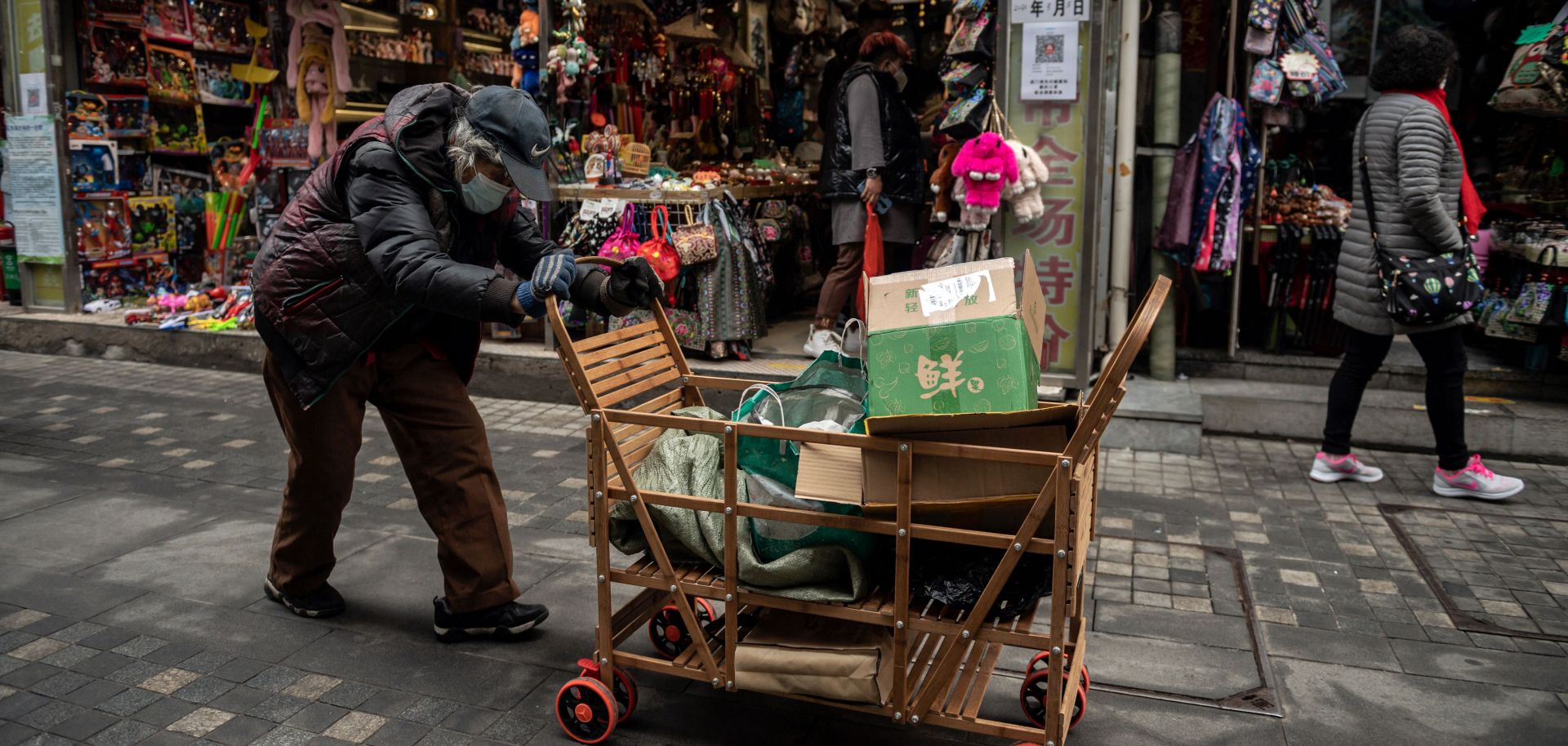
A woman pushes a cart down a street in Beijing, China, on March 5, 2021.
China’s newly announced GDP growth target for 2021 indicates that China is reverting to past growth drivers at the expense of reforming and reorienting its economy toward innovation and sustainable growth. This conservative approach could be an early indicator that China’s post-COVID economic recovery is not as solid as raw data indicates. In his speech to the National People’s Congress on March 5, Premier Li Keqiang set a growth target of “above 6%” well below most forecasts, including the International Monetary Fund (IMF) projection of 8.1% and consensus forecasts of 8-9% GDP growth in 2021.
- The 6% target sets a low bar, probably intentionally, and may be easily achievable, especially after a more than 40-year low growth rate of 2.3% in 2020. China did not set a 2020 growth target given the uncertainty created by COVID-19 and it presumably has rebounded sharply from pandemic-induced economic dislocations, although evidence remains that the recovery until now is unbalanced and mainly supply-driven.
- Initial chatter among some China-watchers is that a modest and flexible economic growth target for 2021, along with not setting an average growth goal for the five-year plan creates space for returning to structural reforms and deleveraging of underlying financial risks.
- China is also likely avoiding an overly ambitious growth target because it wants to avoid pushing provincial governments into unsustainable spending that could overheat the economy, even as all 31 provinces project growth of 6-10% this year.
China’s continued high rate of fiscal stimulus doesn’t match up with the narrative that its economy has recovered from the COVID-19 crisis. Li projected a small cut in the central government’s budget with a deficit of 3.2% of GDP, down from 3.6% in 2020. However, that number omits off-budget liabilities of local government financing vehicles, plus government-guided funds and special construction funds. When added to general government spending, those resulted in an “augmented general government deficit” of more than 18% in 2020, according to the IMF. Scaling back of special-purpose local government bonds from 3.75 trillion yuan to 3.65 trillion yuan is not a significant brake on provincial and local government spending. The reduction in the central government’s official budget deficit is also trivial in comparison to the real, underlying public sector deficit and growing debt.
China’s most critical near-term economic concern is increasing domestic demand to broaden the economic recovery while limiting increases in debt and addressing large, latent financial vulnerabilities. The new plans and programs do not address the latter. The “augmented general government debt” is the equivalent of 92% of GDP and, if total spending is cut by only 0.4% of GDP, it will contribute to another sharp increase in domestic debt, which further increases China’s financial vulnerabilities.
China does not face an external debt problem, but its domestic debt dynamics — that is, the evolution of the primary budget balance and the effects of interest rates — are potentially volatile. The Institute of International Finance reported recently that total Chinese debt is equivalent to 335% of GDP, a level high by any standards. Favorable projected trends in debt dynamics that keep debt manageable are based solely on a large negative interest rate-growth rate differential. Even so, the IMF estimated recently that stabilizing China’s debt-to-GDP ratio required a primary budget deficit of no more than 4.5% of GDP. That compares to an “augmented” primary deficit of nearly 15% in 2020, with projected declines to only 10.5% by 2025.
Li also presented the China Vision 2035 plan, which stops short of President Xi Jinping’s goal of doubling per capita income over the next 15 years. Assuming a stable population, Xi’s target implies an average annual growth rate in GDP of 4.6%. Meeting the per capita income goal will require large increases in productivity that may be beyond China’s ability, given the country’s low birth rate and an aging population that will require increased amounts of social services.
The growth target cannot be viewed as an indicator of actual economic activity, but rather one of policy direction. With such a conservative estimate, China’s post-pandemic economic emergence could end up being much weaker than Beijing is projecting or the world expects. Non-productive activity is counted in GDP even if it does not add to wealth or debt-servicing capacity. A common criticism of China’s economic data is that GDP is more a measure of political intentions and not real growth. Accordingly, with a return of easy-to-meet growth goals, economic targets will remain a key policy driver for Beijing.
