
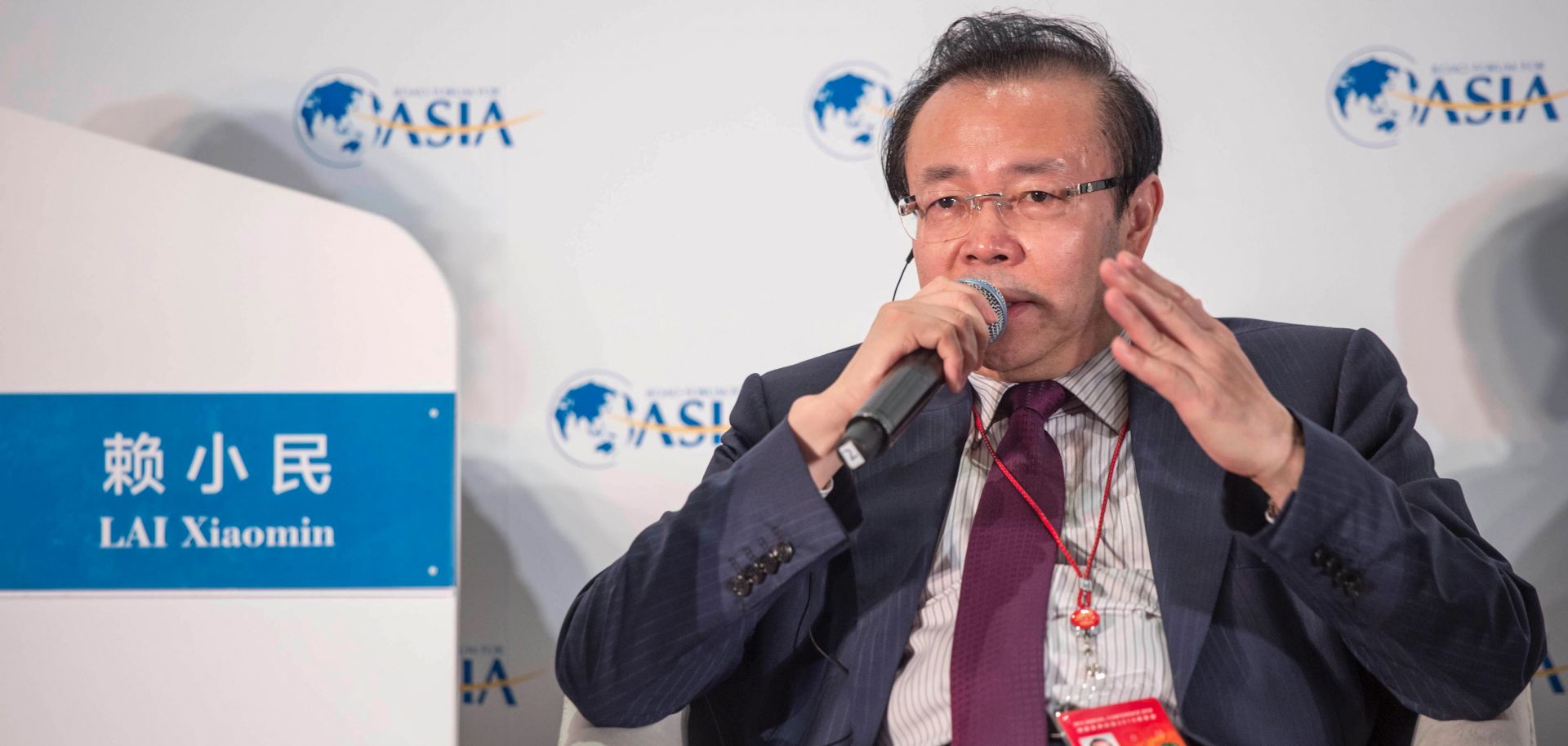
Lai Xiaomin, then-chairman of Huarong Asset Management Co., speaks during a conference in China in 2016. Lai was executed in January 2021 following his conviction on bribery charges.
China’s move to bail out Huarong Asset Management Company while leaving the privately-owned property manager Evergrande Group to work out its financial issues may appear to send mixed messages on how the government addresses financial risks. But it also hints at Beijing’s goal of tackling real estate investment as a priority in risk management. Allowing the potential failure of Evergrande, a privately-owned property developer, while rescuing Huarong is consistent with China’s recent actions to rein in financially risky behavior and distance the central government from implicitly insuring credit risk, especially in real estate.
- Huarong, a state-sponsored “bad bank” that helped China clean up bad debts in the banking system, announced on Aug. 18 that it was getting a $7.7 billion investment of fresh capital from state-owned Citic Group and other financial state-owned enterprises, according to reports in Bloomberg and Reuters. Existing private minority shareholders will see a dilution of their equity and the finance ministry will step back from its implicit guarantee of $242 billion in liabilities. Included is about $21 billion in offshore bonds owed by Huarong, of which $4 billion matures in 2021.
- Meanwhile, in sharp contrast, the People’s Bank of China and the China Banking and Insurance Regulatory Commission on Aug. 19 summoned Evergrande executives and issued a statement rebuking the development company for spreading “untrue” information about its debt problems, urging a resolution. Evergrande has more than $300 billion in liabilities, including $122.4 billion in debt outstanding at the end of June 2020, nearly half of which was to mature within a year.
Top Chinese authorities and through them, the Chinese Communist Party (CCP), could be setting up a scenario in which no firm is too big to fail, though some — namely, Huarong — are also too systemically important to allow bankruptcies.
- With China’s finance ministry as its largest shareholder (57%), Huarong appears to have indirect public promises to pay, much like government-sponsored enterprises Fannie Mae and Freddie Mac in the United States — making it a possible exception to Beijing’s drive to lessen moral hazard in China’s financial system. Long-term losses are being borne by Huarong’s private investors, bond-holders already subject to a market-induced haircut. The perpetrator of the company’s fraud (its former chairman) was also executed in January 2021. Recapitalization by Citic Group, a state-owned investment company reporting to the State Council, arguably upgrades the implicit government guarantee of its borrowing.
- Evergrande, on the other hand, while bigger and also posing systemic risks, is a private company facing what are probably liquidity problems and it may not be insolvent. The development company’s issues could be easier to address with private sector solutions, including asset sales and a reorganization under Chapter 11-like procedures. Failure of a company with a junk-bond credit rating might also be an acceptable risk — especially if it sends a message about property speculation (a key target of Chinese government reform) without bursting property investment bubbles, which is a high priority for Beijing.
A recent key economic leadership meeting, chaired by President Xi Jinping, made clear there is still much more to be done in fighting and alleviating financial risk. Western concepts of financial risk involve quantifying and subsequently trying to manage it through hedging strategies. But at the CCP’s Central Committee for Financial and Economic Affairs meeting on Aug. 17, Chinese leaders made clear that risk is to be avoided. In remarks to the meeting, Xi also promised “common prosperity for all” Chinese, a stance that forces losses on the private sector if for the common good.
- Huarong has been in trouble since 2018 after its then-chairman was found guilty of bribery. The company failed to release 2020 financial statements by a March 2021 deadline. Since then, trading in its shares has been suspended and its bond prices have become volatile.
- Huarong disclosed a $15.9 billion loss on Aug. 18 when outlines of the bailout/recapitalization were announced. China’s finance ministry was the majority shareholder (57%) at the end of 2020. But New York-based investment bank Goldman Sachs and private equity firm Warburg Pincus bought a $2.4 billion stake when Huarong went public in 2015 and thus may incur the greatest monetary losses.
- Evergrande, meanwhile — the world’s most indebted property developer — is selling assets to meet cash flow needs. Its share price has fallen by two-thirds this year, with its dollar-denominated bonds now priced below 50 cents. Regulators have been pressing the company to clean up its balance sheet for several months and could be losing patience.
The contrasting treatment of the two fragile companies sends a message that China’s precarious financial system will not be allowed to fail, but the CCP and government are attempting to control and eliminate financial risk — especially in sectors already identified for reform, like real estate. Private investors need to be especially attuned to the perils of operating in or with China, particularly when the government can impose losses. At the same time, the opaqueness of the differing approaches increases uncertainty about government support and underlines business risks in dealing with a party-controlled state.
