
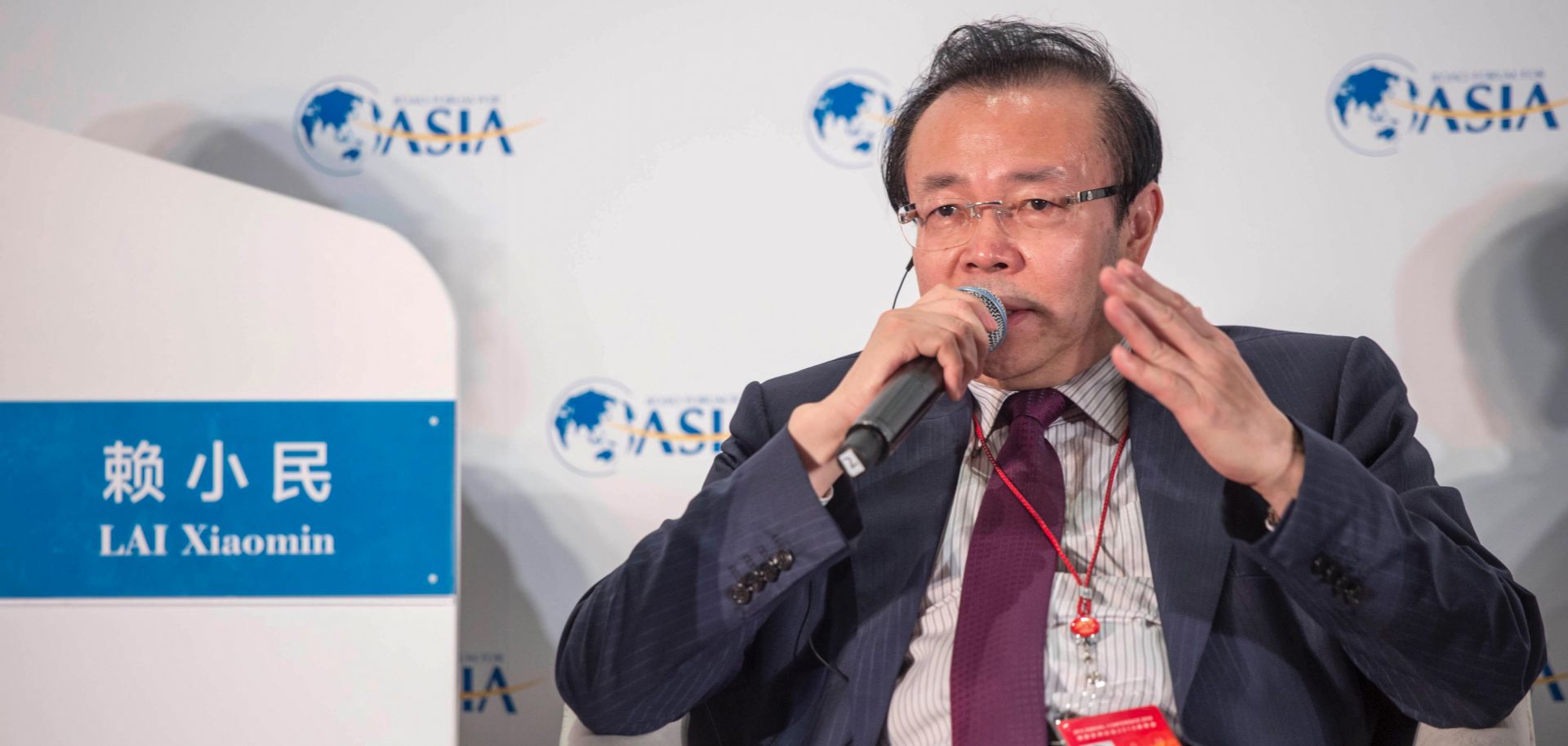
Lai Xiaomin, the then-chairman of China’s Huarong Asset Management, speaks at the Boao Forum for Asia (BFA) Annual Conference in 2016.
Given its low tolerance for market and political instability, the Chinese government will likely bail out embattled state lender Huarong Asset Management — highlighting China’s struggles with debt management and long-term economic health, while propagating moral hazards in global finance. Huarong’s failure to issue its 2020 financial statements by the March 31 deadline has cast doubt on the financial health of one of China’s big four asset management companies (AMCs), with Moody’s Investors Service and Fitch Ratings both recently downgrading the company’s credit rating. Huarong has since announced it would also miss the April 30 extended deadline to release its annual results, with the firm blaming both delays on its auditor processing an unspecified transaction. Amid the uncertainty, the firms’ dollar bond yields have skyrocketed, with one bond’s yield rising from 3% to 23% in just two weeks. These developments have increased speculation Beijing may intervene significantly to bail out Huarong.
- Beijing set up Huarong in the 1990s to service non-performing loans (NPLs) from China’s four largest state-owned banks. Since its founding, Huarong’s portfolio has expanded to a myriad of financial services. Its bond debt has ballooned to $42 billion (including $22 billion of offshore debt), with $16.9 billion due before the end of 2022.
- The company’s assets grew six-fold from 2012-2017 through mergers and acquisitions funded by cheap state loans, with assets at $260 billion today. Meanwhile, its total equity now sits at $26 billion.
- On April 27, Huarong procured a loan from the Industrial and Construction Bank of China — one of those banks that it was originally founded to save from defaulting — to pay back a $450 million bond that was due.
Despite allowing over $12 billion in debt from SOEs to default in 2020, the broader pattern in China’s interventions still points to an overall low tolerance for such defaults. The Chinese government’s response to several state-owned banks’ debt crises over the past two years illustrate the breadth of its bailout behavior: Between May 2019 and March 2020, Beijing let Baoshang Bank go bankrupt, while purchasing discounted debt from the Bank of Jinzhou and collaborating with local governments to inject cash into Hengfeng Bank. Notably, however, these companies were banks (not AMCs) and had around half the assets of Huarong. They were also much less important to the financial system than Huarong, which is China’s largest AMC by assets — increasing the likelihood that China would intervene to save Huarong from defaulting on its debt.
The Chinese government is very likely to bail out Huarong in some capacity because a default would cause too much instability at a politically and economically sensitive time. Beijing can’t delay action because Huarong has multiple bonds (and likely little funds to repay them) set to mature before the 100th anniversary of the Chinese Communist Party (CCP) in July, a time during which Beijing aims to project national stability and strength. Beijing can also not afford to let its third-largest financial issuer on international markets go bankrupt — especially amid China’s economic recovery from the COVID-19 pandemic — as it would hurt China’s credibility on and access to international bond markets at a time when Chinese companies desperately need access to credit. Furthermore, most of the SOEs that were allowed to default in 2020 were associated with regional governments, but Huarong is 65% owned by China’s Ministry of Finance. Its default would thus hurt the central government’s reputation. But perhaps most importantly, the default of one of China’s AMCs — which were intended to help China’s largest state banks avoid their own defaults — would significantly lower confidence in Beijing’s national debt management capabilities.
- As rising tensions with the United States, Europe and India increase fears of an anti-China global coalition, President Xi Jinping’s administration will seek security and political legitimacy to combat international pressure, reducing Beijing’s tolerance for domestic instability (and any reforms that fuel it). As a result, politically sensitive events — like the July CCP anniversary, the December legislative elections in Hong Kong, the February 2022 Beijing Olympics and the 2022 National Congress (which will herald Xi’s third term as president) — will increasingly hinder nationwide financial austerity measures aimed at discouraging bad debt.
- China also opened a fifth AMC, China Galaxy Asset Management, in December 2020 to handle bad loans brought on by the COVID-19 pandemic. As the first new AMC in 20 years, Galaxy shows Beijing’s ongoing commitment to intervention in major company defaults and the continued importance of AMCs (like Huarong) for debt management.
Potential bailout schemes for Huarong are likely to resemble previous bailouts, including spinning off bad assets or transferring ownership to other public entities. Moreover, previous bailouts suggest Huarong’s restructuring plan may occur in phases, with the first phase likely to be announced before the CCP anniversary in July.
- Huarong first submitted a plan to Chinese regulators on April 8 that involved offloading loss-making, non-core business segments and avoiding a restructuring.
- A leak on April 13 revealed China’s Ministry of Finance was considering transferring its stake in Huarong to Central Huijin Investment Ltd, a unit of China’s sovereign wealth fund, under the assumption Huijin is more adept at managing bad debt.
- A separate leak on April 21 noted Chinese authorities were considering letting the PBOC assume $15 billion in Huarong assets, while Huarong’s unit in charge of offshore bonds, China Huarong International Holdings Ltd. was considering transferring assets to a separate offshore unit named China Huarong Overseas Investments Holdings Co.
While it’d maintain short-term market stability, a Huarong bailout would also propagate moral hazards in China’s markets and those of the world, thus endangering China’s long-term growth prospects and the health of the global financial system. Firstly, a bailout would exacerbate the chief moral hazard of China’s economy — namely, that China’s biggest and most politically connected financial institutions borrow and lend irresponsibly based on the belief that Beijing will guarantee their solvency, thus contributing to runaway debt and speculative markets (like real estate) in which foreign firms participate. In the event of a bailout, China would protect its access to international bond markets as the government’s guarantee on foreign bonds persists. But this guarantee will continue to cause foreign purchasers of Chinese bonds to inaccurately price risk for issuing firms. Though authorities will pressure AMCs to refocus on servicing NPLs, the challenge of how to handle China’s NPLs will grow because the old strategy of debt management, which held that China’s economy could simply outgrow its debt, is becoming outdated as China’s growth rate slows. The modest uptick in SOE defaults in 2019 and 2020 shows that Beijing is ever so slowly revoking its financial protection of the public sector. But continued bailouts of companies like Huarong will propagate moral hazards in the meantime, thus compounding the long-term costs and market destabilizing effects of China’s bad debt.
