
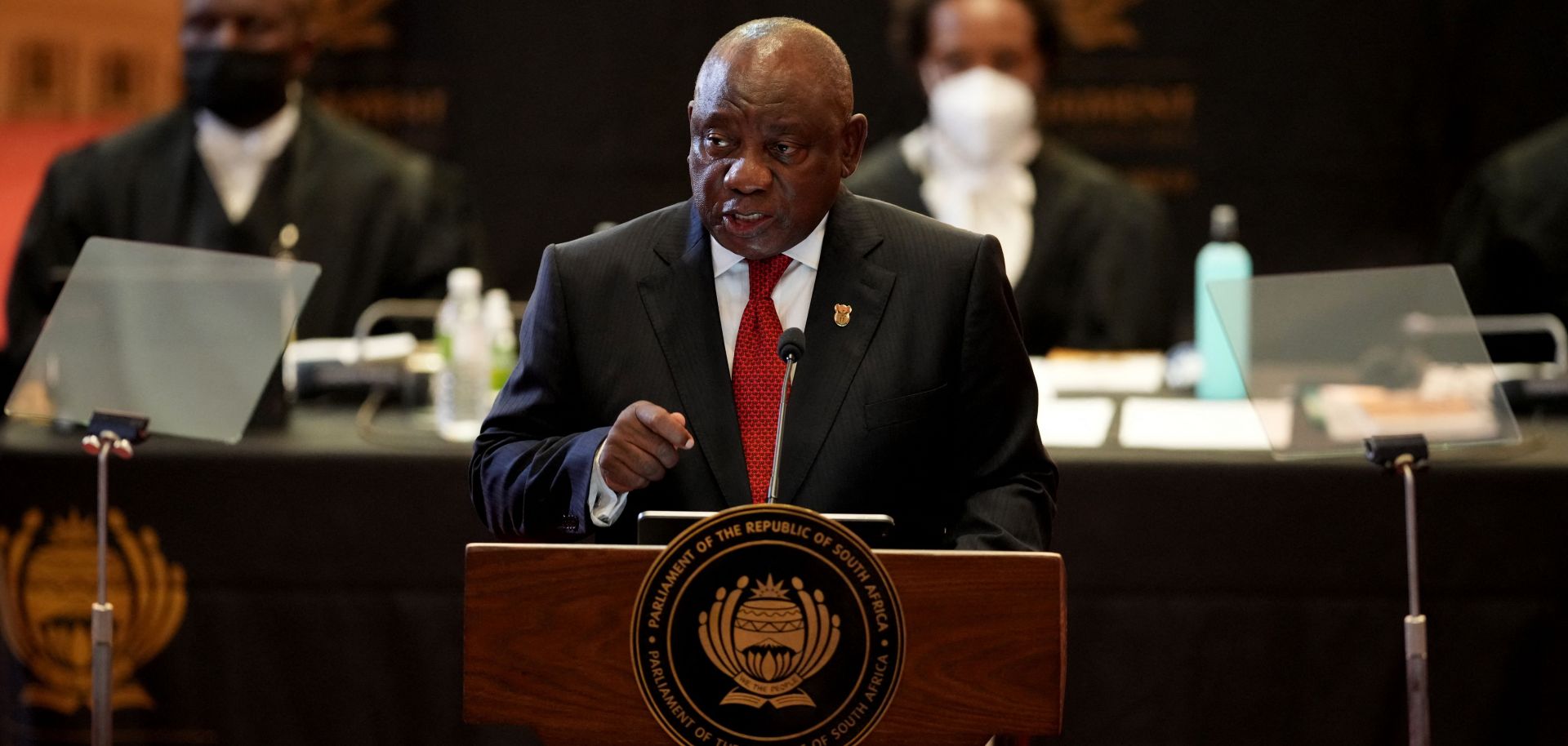
South African President Cyril Ramaphosa delivers his State of the Nation address in Cape Town, South Africa, on Feb. 10, 2022.
President Cyril Ramaphosa’s decision to extend welfare payments risks undermining South Africa’s long-term economic growth by compromising the government’s reform agenda and worsening the country’s fiscal deficit. In his annual State of the Nation Address on Feb. 10, Ramaphosa highlighted corruption, endemic poverty, inequality, unemployment and an unreliable power supply as some of the largest issues facing South Africa, and pledged to pursue sweeping economic reforms. In the same breath, Ramaphosa also announced that the nearly 10 million South Africans currently receiving monthly welfare payments of R350 ($23) would continue receiving those checks until March 2023. The extension of this stipend — which was initially set to expire in March of this year — will appease the growing number of South Africans reliant on government aid to make ends meet, who have historically cast ballots for the ruling African National Congress (ANC) party. But while this may help Ramaphosa stave off near-term political and social risks, financing the ongoing payments could come at the cost of the country’s future economic stability.
- Ramaphosa’s government initially introduced the $23 monthly welfare payment as a COVID-19 relief measure. Since the disbursement of payments began in August 2021, they have cost the federal government an estimated R24 billion ($1.5 billion).
Political pressure and fears of spurring additional unrest likely drove Ramaphosa to keep the monthly payments in place, despite his previous promises to reduce social spending. High global commodity prices through 2021 benefitted South Africa’s large mining sector, resulting in higher-than-expected state revenue. But the country’s low- and middle- socioeconomic classes are still struggling amid rampant unemployment and poor living conditions, which has fueled widespread calls for continued welfare spending, including the $23 monthly stipend. Overall support for the ANC has been slipping as well, driving calls from the party’s left-leaning factions to maintain the government’s popular welfare programs. In addition, Rampahosa is facing increasing pressure from opposition parties like the Economic Freedom Fighters, which (like the ANC) has a base composed largely of young, poor and Black South Africans — many of whom support redistributing land and wealth from the political elite to the common citizenry. Within this context, Ramaphosa’s rivals could also challenge his leadership of the party during an ANC national convention in December.
- Of the roughly 60 million people living in South Africa, nearly half (27.8 million) are recipients of social grants. Between the 2018-19 fiscal year and the 2021-22 fiscal year ending in March, the South African government’s total spending on social welfare increased from R860 billion ($56.8 billion) to R1.1 trillion ($72.7 billion)
- In November, South Africa’s youth unemployment rate was 74% and total unemployment was 34.9% — both notable increases from the 53% youth and 28% total unemployment rates recorded a year earlier.
- According to a recent report by the World Inequality Lab, the gap between the rich and poor in South Africa is larger than in any other country for which data is available. The report found that the richest 10% of South Africa’s population own more than 85% of household wealth, and more than half of the population has more liabilities than assets.
Finding the funds to finance another year of welfare payments will further strain the South African government’s already stretched budget. Ramaphosa did not say where the money to finance the extended monthly payments would come from, but possible sources include canceling funding from development and/or infrastructure projects, raising taxes on wealth and/or income, and/or soliciting external loans. The government could also tap into mining revenue, although this option may be limited due to what appears to be a soft decline in global prices and general uncertainty. The extension of the stipend goes against the advice of Finance Minister Enoch Godongwana, who has repeatedly warned that Pretoria will not be able to fulfill the goals outlined in the midterm budget his ministry proposed in November if the government continues what he sees as outsized social expenditures. Godongwana will likely outline an updated set of priorities in his Feb. 23 budget speech that accounts for the renewed grant. This will mark a shift in the policy direction outlined in the mid-term budget proposal, which detailed several projects aimed at reinvigorating the South African economy and providing growth opportunities — none of which included greater social spending.
The extended welfare payments will ultimately risk delaying much-needed economic reforms and digging South Africa into a deeper fiscal deficit. Although the South African fiscal deficit improved from 2020 to 2021 amid the uptick in commodity prices and the subsequent windfall from the mining sector, the government faces several barriers in ensuring continued progress. In addition to the short-term funding challenge, the social and political pressure deterring Rampahosa from ending the welfare payment will only intensify as South Africa approaches the 2024 general election. The longer the stipend is extended, however, the harder it will be to reduce the government’s fiscal deficit. The renewal of the social spending measures (whether just this year or beyond) will send South Africa deeper into debt and further from its stated goals of comprehensive economic reforms, which are centered on increasing private sector growth and improving the delivery of basic services (like water, sanitation and power) to South Africans.
- South Africa cut its 2020-21 fiscal deficit from the projected 14% to 10% due to higher-than-expected tax collection on mining revenue due to the uptick in global commodity prices. The government expects the deficit to reach 7.8% of GDP this fiscal year, still above the 4.77% in pre-pandemic 2019.
- The International Monetary Fund expects the South African government’s deficit to remain above 7% through 2025 “without stabilizing.” In its 2021 Article IV Consultation report, the global financial institution predicted that continued bailouts of South Africa’s embattled state-owned enterprises (like the electricity provider Eskom), along with overspending on wage bills and pressure to increase social grants, would lead to higher budget deficits and raise South Africa’s risk premium in the coming years.
- Credit rating agencies including S&P have also warned that Pretoria’s high levels of welfare spending to prevent social unrest could make it harder for the government to reduce its fiscal deficit and improve its debt-to-GDP ratio.
