
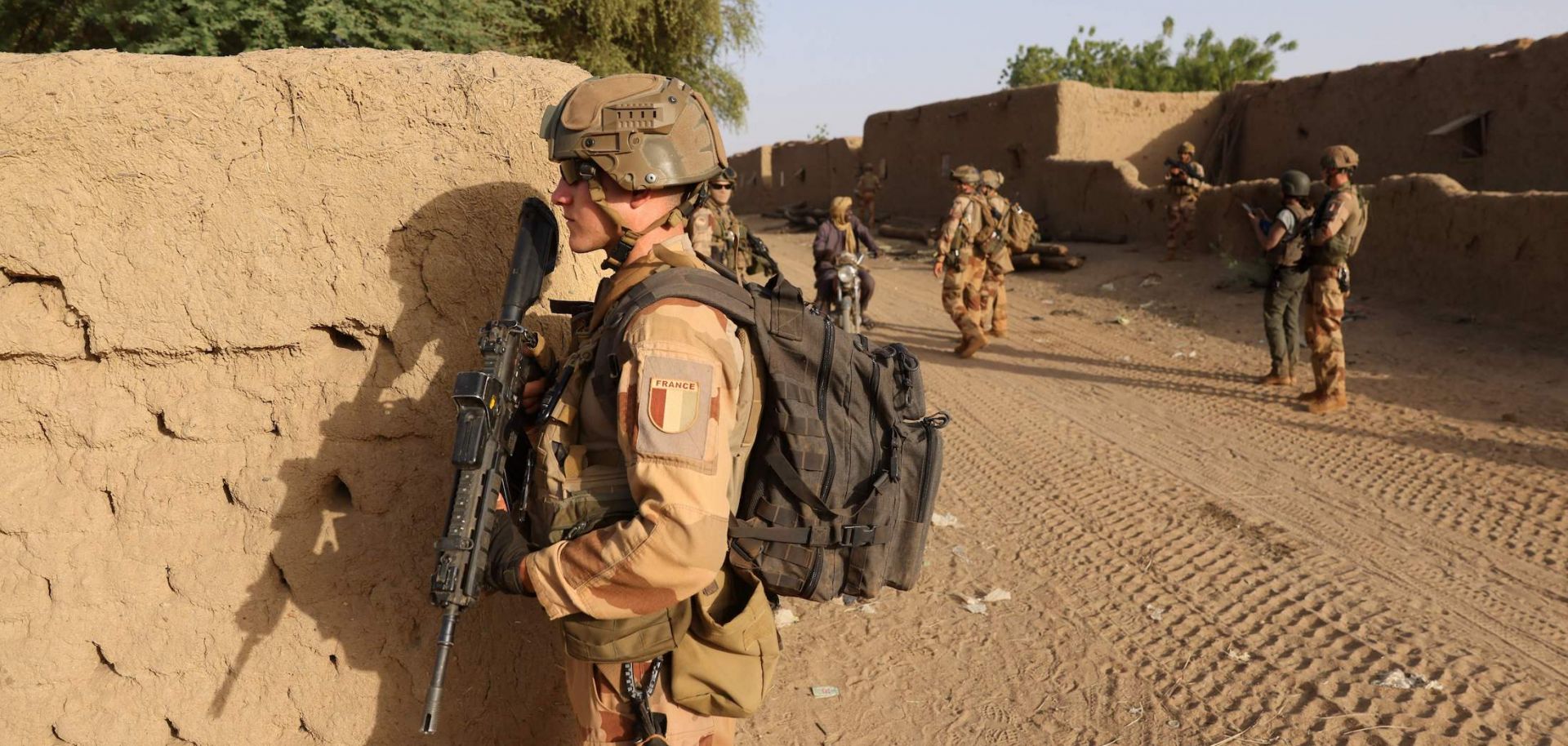
French soldiers patrol the streets in a village located in Mali’s Gao region on Dec. 4, 2021.
Despite their growing diplomatic row, France and Mali both have vested interests in preserving their longstanding security relationship. An abrupt exit of French troops from the African country and the wider Sahel region thus remains unlikely, though it can’t be ruled out. Tensions between France and Mali have increased in recent weeks after the latter moved to delay elections originally scheduled for February. On Dec. 30, Malian officials announced the general elections wouldn’t be held until 2026, despite strong pressure from France, the European Union and the Economic Community of West African States (ECOWAS) to stick with the original schedule. Following the announcement, European politicians and Malian junta leaders exchanged a spate of insults, which ultimately prompted Mali to expel the French ambassador from Bamako Jan. 31, along with Danish troops stationed in the country, earlier the same week. The French defense minister has said the situation is untenable, fueling speculation that the rift may prompt Paris to end its nine-year military intervention in the country. But while it can’t be ruled out, an abrupt French exit from Mali remains unlikely since both governments are still interested in preserving the status quo.
Amid this backdrop, there are four main ways Mali-French relations could evolve, starting from the most likely to the least likely:
Scenario #1 (Most Likely): France Stays in Mali.
In the most likely scenario, France maintains its presence in Mali while the antagonistic relationships between leaders continue to fluctuate. France has yet to fulfill its primary objective for its deployment to Mali (stabilizing the region), and to pull out of Mali would be to acquiesce that security in the country will worsen. Malian forces — even with the addition of Russian training missions and unconfirmed introduction of Russian paramilitary troops — do not have the capacity to successfully control their own territory. It’s possible that Assimi Goita, the current transitional Malian president, is aiming to rely on Russian support in areas of the country where anti-French sentiment is high, thereby reducing reliance on France and gaining space from French pressure to return to constitutional rule while still benefiting from French military presence in other areas of the country. But it’s ultimately in Mali’s best interest to maintain its security relationship with France. While expelling French troops would be a blow to France’s regional strategy, the Malian junta would also face increased threats to its sovereignty from insurgent groups and likely pushback from civilians experiencing greater security threats. The current inflammatory rhetoric coming from officials on both sides risks escalating to the point that Malin junta leaders demand French troops leave. While this would deteriorate Mali’s security environment, the junta's primary concern is staying in power, not maintaining territorial integrity.
- In this status quo scenario, France would continue to prioritize removing leaders of hostile organizations in the Sahel. French troops would remain stationed in bases in southern Mali, with the focus of their deployment gradually shifting to favor the relatively more stable relationship with Nigerien leaders.
- The diplomatic relationship between Mali and France, meanwhile, would continue to ebb and flow. But despite occasional disputes with Malian leaders, France would retain its troop presence in Mali and the surrounding Sahel region to increase security, combat terrorism and preserve geopolitical influence.
Scenario #2 (Somewhat Unlikely): French forces leave Mali.
In this scenario, French troops leave Mali at the behest of the Malian junta. While this would undermine Malian leaders’ ability to combat insurgent groups, it could happen if Malian posturing and rhetoric get out of hand and junta leaders “invite” France to leave as a means of asserting their autonomy and authority. Members of Jama'at Nasr al-Islam wal Muslimin (JNIM), a terrorist insurgency group operating in Mali and the greater Sahel, could also offer to negotiate a settlement deal with Malian leaders if French forces leave the country. One or both of these developments could compel Goita and his government to expel France in favor of a deepening relationship with Russia and inclusion of JNIM in the transitional authority.
- The principal factor impeding this sequence of events is the barrage of aftereffects that the junta would confront. If Mali were to eject France and embrace insurgent groups, Western states would impose additional political and economic sanctions. Sweeping ECOWAS and EU sanctions imposed following the Dec. 30 election delay has already prevented Mali from making domestic debt payments, in addition to causing widespread food and medical shortages. The French military, meanwhile, would likely continue to support Mali’s neighbors in combating insurgencies, but its efforts would be frustrated by lack of access to Malian territory, which could serve as a safe haven for terrorist cells.
- Even if specific JNIM factions are given a seat in Malian politics, hostile activity in neighboring states or from competing groups (like the Islamic State) is also unlikely to stop, posing increased security and terrorist threats to other countries in the Sahel.
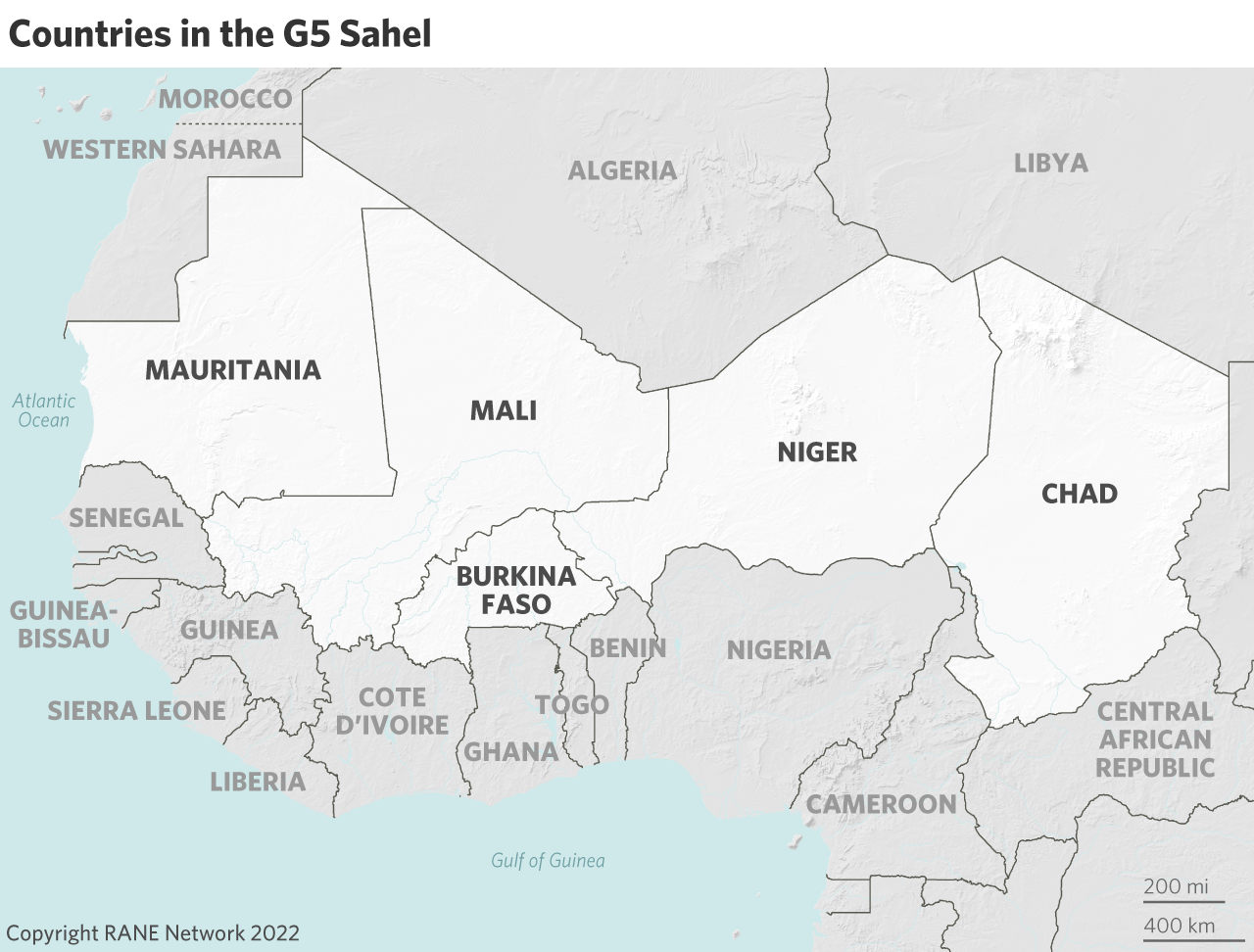
Scenario #3 (Unlikely): French forces leave the Sahel.
In this scenario, France’s relationship deteriorates with Mali, as well as other Sahelian states like Burkina Faso, to the extent that Paris leaves the region altogether. This scenario could feasibly come to pass if the newly installed Burkinabe coup leaders and Malian junta leaders expel France from each of their countries. This, however, is highly unlikely given how heavily Burkina Faso relies on France for security support. It’s more likely that France would decide to pull out from the region (rather than being forced) — prompted by some additional impetus, like an insurgent attack on French forces. But for France, ending a years-long military initiative that has cost billions of dollars would also mean an extreme loss of geopolitical influence, in addition to a strategic and financial defeat. While France’s image is certainly not favorable in many Sahelian states, it remains the foremost European partner for the region, meaning that the military, economic, political and/or social cost would have to be extremely high for France to leave the region.
- Withdrawing from the region as a whole would be in direct opposition to France’s strategic goals in the Sahel. Sahelian states and France would also face political backlash from their European and North American partners in the case of an uncoordinated exit. Western governments, which benefit from French counterterrorism missions in the region, are likely to pressure Paris not to withdraw from the Sahel.
- If France were to fully withdraw, the Sahel would likely see a massive devolution of security. Although it’s possible that other European powers would step in to fill the void, the French presence in the region is unparalleled, and insurgent groups would likely face far less resistance without it.
Scenario #4 (Very Unlikely): France reinstalls civilian leadership in Mali by force.
In this high impact (but extremely unlikely) scenario, France could opt to make an example of Mali and mount a ground force to re-install civilian leadership in Mali, potentially in partnership with ECOWAS. France is unlikely to take this course of action for several reasons. For one, such a blatant intervention in Mali’s political affairs would risk fueling the already significant levels of anti-French sentiment in many Sahelian countries by perpetuating France’s image as a colonizer, which could drive terrorist recruitment. Secondly, deposing Malian military leaders would likely be costly for France in regards to its other relationships in the Sahel and developing world in that France would lose trust and credibility. Lastly, ECOWAS is unlikely to support such action. And in the likely case that the reinstallment of civilian leadership prompts widespread protests and violence, ECOWAS would receive heavy blowback.
- The implications of a French intervention against the Malian junta range from subsequent military mutinies (factional rebellions against military or poliitcal authorities) to widespread civilian protests, to an uptick in terrorist recruitment — all of which would come at an enormous economic, military and human cost for Paris. As a result, the medium- to long-term implications would likely not be worth the short-term gain of reestablishing civilian leadership in Mali or French dominance in the region.
