
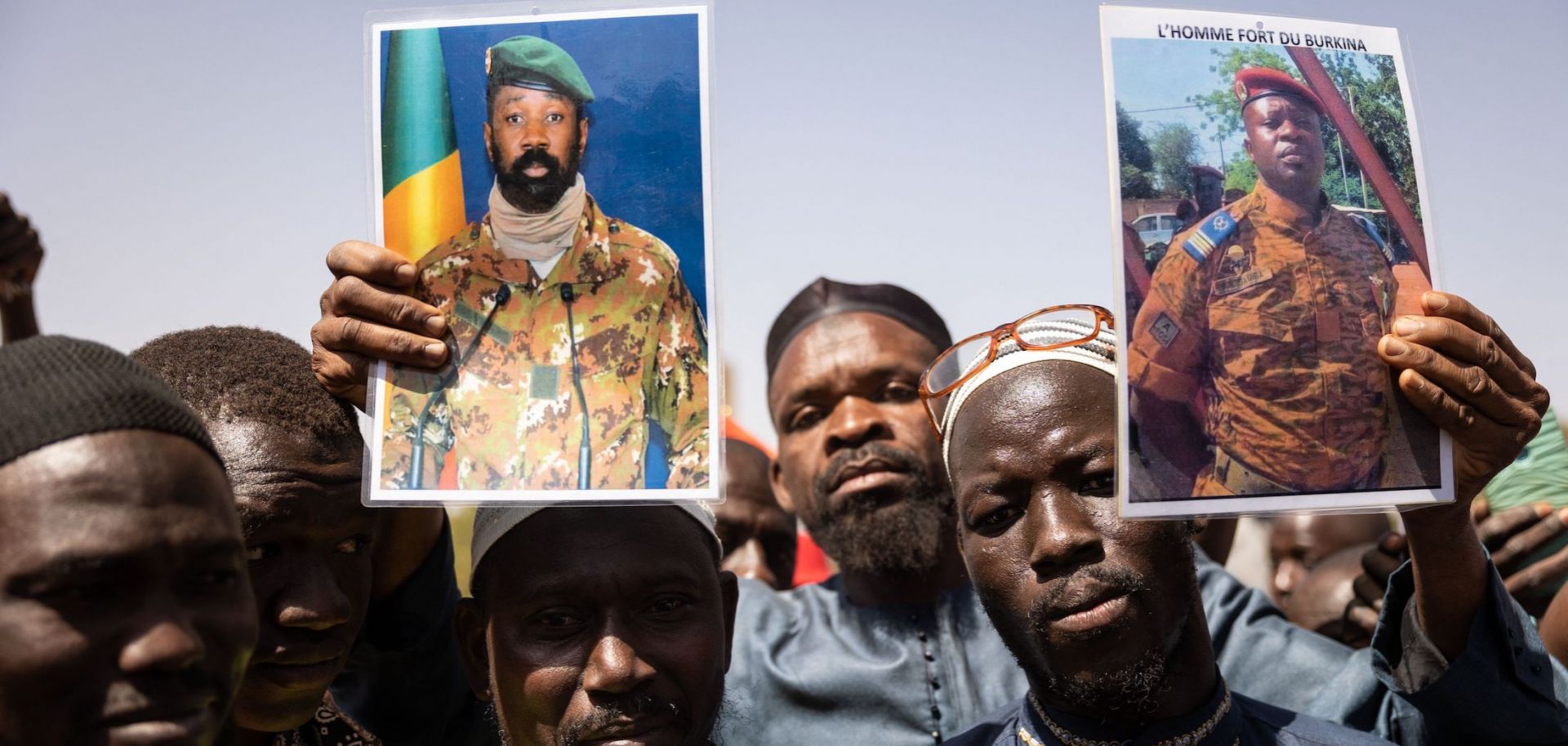
Demonstrators in Ouagadougou, Burkina Faso, hold up photos of Malian coup leader Assimi Goita (who seized power in Mali for the second time in a May 2021 coup) and Burkina Faso coup leader Paul-Henri Sandaogo Damiba on Jan. 25, 2022.
The lackluster international response to the wave of coups sweeping West Africa may encourage opportunistic military leaders to overthrow fragile governments elsewhere in the region, but internal dynamics lay the groundwork for military coups. In West Africa, this means other states are at risk of military takeovers and the resulting security and financing challenges. On Feb. 1, less than a week after military forces successfully seized Burkina Faso’s government, reports of gunfire near a compound where Guinea-Bissau’s president was holding a meeting set off alarm bells that yet another coup was underway in West Africa, which has seen five successful government takeovers in the past year and a half. Security forces ultimately quashed the attempt to overthrow the Bissau-Guinean government, but the incident nonetheless added to growing fears of a “coup contagion” in the region: During his opening address at a summit of West African leaders to discuss Burkina Faso’s military takeover, Nana Akufo-Addo — president of Ghana and current chairman of the Economic Community of West African States (ECOWAS) — said on Feb. 3 that Mali’s August 2020 coup had been “contagious” by prompting subsequent coups in neighboring Guinea and Burkina Faso.
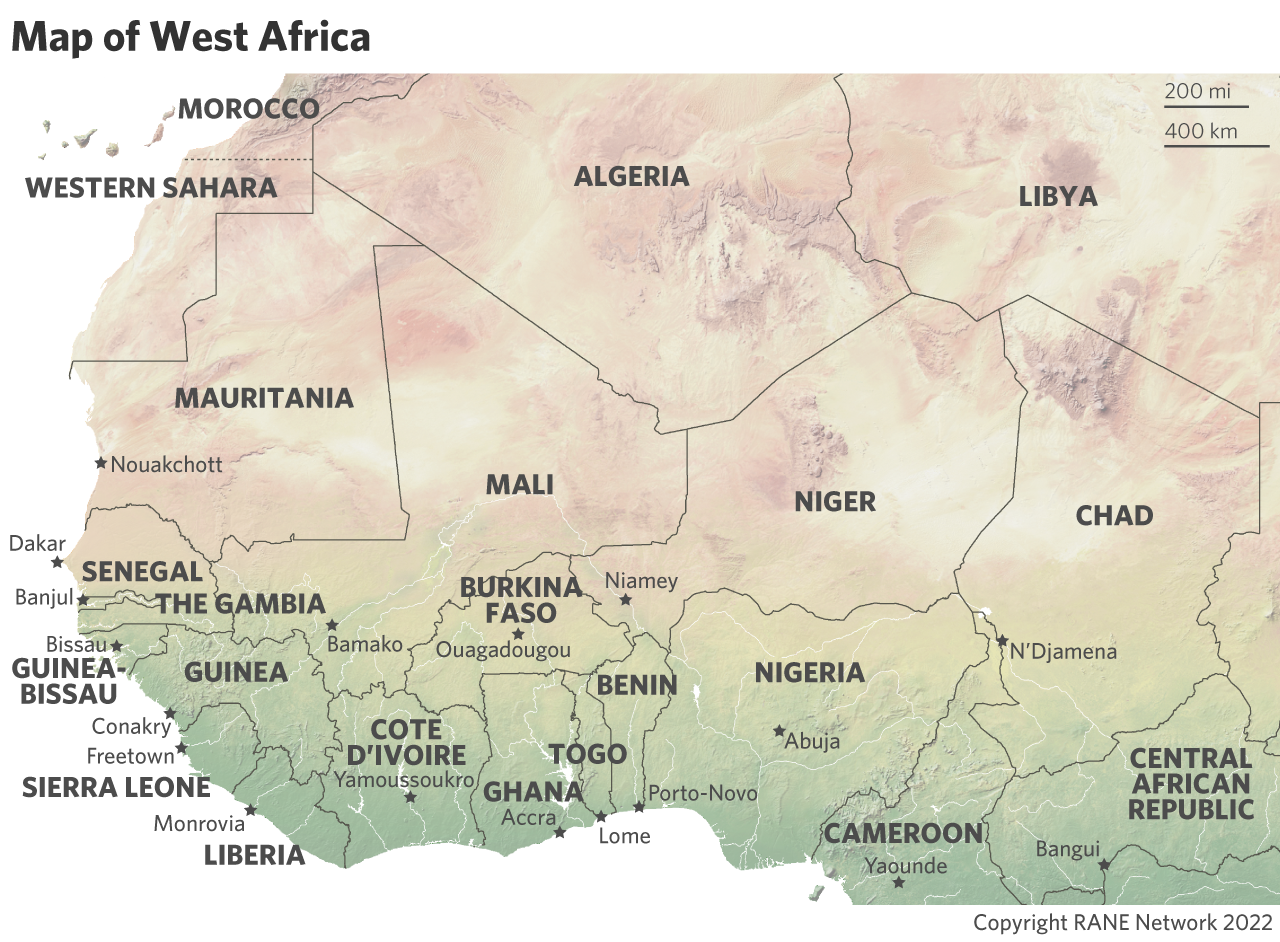
Since August 2020, military forces have seized control of the governments in Chad, Mali, Guinea and Burkina Faso, inciting claims by regional leaders that West Africa is in the midst of a “coup season”:
- In August 2020, a group of colonels in Mali ousted President Ibrahim Boubacar Keita and subsequently agreed to a civilian-led 18 month transitional period before elections. But in May 2021, military leaders clashed with the interim president and carried out a second putsch. The current junta, led by Colonel Assimi Goita, recently announced that it will delay elections until 2026. In response to the election delay, ECOWAS severed diplomatic ties with Mali and imposed a series of sanctions.
- Chad is a unique case. After President Idriss Deby was killed visiting troops in the north in April 2021, a military council dissolved parliament, which was supposed to assume power in the event of the president’s death. Deby’s son, General Mahamat Idriss Deby, was named interim president and — backed by parliament — is currently leading Chad through an 18-month transitional period. France has thrown its support behind Deby since the transition.
- In Guinea, a special forces commander Colonel Mamady Doumbouya led a coup against President Alpha Conde on Sept. 5 following backlash against Conde’s efforts to change the constitution in order to circumvent term limits and run for a third term. ECOWAS has since suspended Guinea’s membership in the bloc and imposed sanctions on the country.
- On Jan. 25, a military coalition in Burkina Faso led by Lieutenant Colonel Paul-Henri Damiba toppled President Roch Kabore. ECOWAS suspended Burkina Faso’s membership in the bloc, but has not imposed sanctions.
Although ECOWAS and the European Union have implemented sanctions regimes against some of the new military juntas, the measures have not elicited compliance, which limits their deterrent effect. The external response to recent West African junta actions has varied widely, falling far short of the resounding pro-democracy message that several regional leaders have advocated for. The ECOWAS and EU sanctions imposed following Mali’s recent election delay have marked the most severe response, followed by the similar ECOWAS sanctions package levied against Guinea’s coup leaders in late 2021. But although these sanctions have inflicted financial pain on both countries and their citizens, neither junta has acquiesced to the bloc’s demands for a swift return to civilian rule or given any indication that sanctions will compel them to participate in negotiations. Chad and Burkina Faso’s coups, by contrast, didn’t trigger any sanctions. The result of this disjointed and lackluster response is low deterrence — meaning opportunist military leaders already considering political overthrows in other African nations are unlikely to reconsider based purely on the threat of inciting regional and international repercussions.
- Following the announcement that Mali’s election timetable would be delayed until 2026, ECOWAS (and later the European Union) halted financial flows, instituted border closures and froze state assets. The sanctions have since led to widespread shortages of goods and increased prices in Mali. On Feb. 2, the country’s finance ministry also said it wouldn’t be able to meet two treasury bond payment deadlines, citing Mali’s severed economic ties with West African and European countries. But despite the economic fallout, the junta has given no indication that it plans to hasten the path to elections. In Guinea, a similar sequence of events transpired, culminating in sanctions against coup leaders and their families and still no election timeline.
- Following the coup in Burkina Faso, the European Union, the African Union and the United Nations have only verbally condemned the takeover. ECOWAS also suspended the country’s membership, but delegates from the regional bloc are in negotiations with junta leaders over an electoral timeline).
- International observers did not sanction Chad following the coup.
Internal factors, including economic hardship, turbulent political legacies and fractured military forces, lay the foundation for opportunistic military leaders to carry out political overthrows. Of the five recent coups, each is unique in its context and drivers. Nonetheless, three similarities permeate each case. According to peer-reviewed academic studies, the probability of a government overthrow is significantly influenced by economic well-being, with highly impoverished countries more likely to experience coups than wealthy countries. Countries that have previously experienced a coup are also at greater risk (meaning a nation that has experienced a military takeover in its history is more likely to experience it again). And countries with a more disjointed security apparatus are more likely to experience military putsches as well. All three of these factors apply to each of the West African countries that have seen coups since August 2020. Burkina Faso, Chad, Guinea, Guinea-Bissau and Mali are among the poorest nations in the world. They have also all experienced coups prior to 2020. And each of the recent overthrows in these countries occurred at the hands of internal security forces, highlighting the significance of internal military fissures.
Given the prevalence of these commonalities and the lack of effective international deterrence measures, some West African leaders may respond to threats with outsized force in the hopes of staving off a potential assault on their power. Recent takeovers have many West African leaders looking over their shoulders, attempting to shore up domestic support so that theirs is not the next country in political turmoil. This will likely compel heads of state to meet dissent — whether from opposition parties, members of their security establishment or otherwise — with more force than they might otherwise under regular circumstances. The use of such outsized force against dissenters, however, could backfire by raising the risk of an overthrow rather than lowering it.
The recent surge in military takeovers and the potential for more means that the region will struggle to defend itself against ongoing insurgencies and may face financial repercussions. Mali and Burkina Faso’s newly crowned junta leaders will likely struggle to contain the jihadist insurgencies in their countries, just as their predecessors did. But, unlike their predecessors, Malian and Burkinabe coup leaders may not have access to the same regional and international security support due to the manner in which they seized power and/or refusal to adhere to election timetables. If militant groups operating in Mali and Burkina Faso are able to expand their spheres of influence and ramp up the frequency and intensity of attacks, their increased capabilities could result in attacks in relatively stable states along West Africa’s coast, like Ghana and Ivory Coast. Both Ghana and Ivory Coast have seen attacks in shared border areas with Mali and Burkina Faso, but have so far been able to protect their interiors and capitals from major violence. This, however, could change if the regional security situation deteriorates further. Additionally, countries in the region that have previously experienced high investor confidence could suffer from a downturn in interest if the international community perceives West Africa as unstable. Ghana has been historically viewed as West Africa’s investment hub, but regional instability (along with the country’s rising debt problem) could jeopardize that status.
Niger is particularly at risk of becoming the site of West Africa’s next coup. While a few regional states suffer from relatively high poverty rates, tumultuous histories and low-intensity dissonance within their security forces, Niger stands out as particularly high risk for a military uprising. On top of extremely high poverty rates and a history of violent revolts, the Nigerien security forces are deeply divided along ethnic fissures. While the combination of these factors does not guarantee that President Mohamed Bazoum will be overthrown, it does mean that the risk to his administration is heightened.
- Niger has the fourth lowest GDP per capita in the world, and a poverty rate well above those of Burkina Faso, Chad, Guinea, Guinea-Bissau and Mali.
- Since independence in 1960, Niger has had four coups. In March 2021, security forces attempted and failed to overthrow civilian president Mahamadou Issoufou, two days before he handed power to current President Mohamed Bazoum.
- Niger’s population is composed of several ethnic groups — the largest of which is the Hausa, which makes up 56% of the population, followed by Zarma-Songhai (22%), Tuareg (8%) and many other smaller groups. Although several administrations have tried to create a national identity within military forces, ethnic tensions — particularly between the Tuareg minority and Hausa majority — continue to create deep divisions. Minority groups frequently claim that military appointments are made based on ethnic affiliation.
