
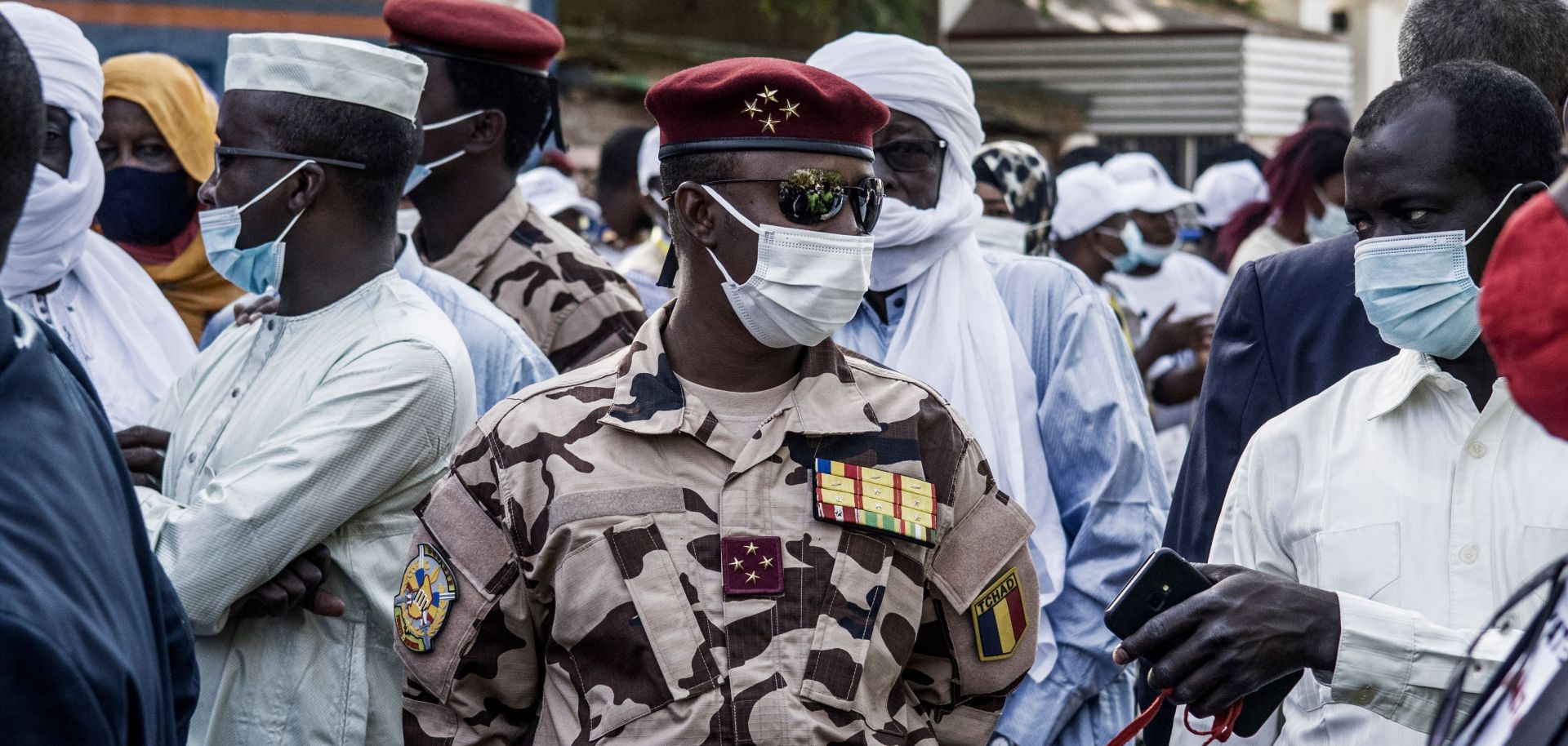
Mahamat Idriss Deby Itno (center), son of late Chadian President Idriss Deby Itno, is seen at a polling station in N'djamena on April 11, 2021.
The unexpected death of Chad’s president will impede the country’s involvement in regional counterinsurgency operations and may force France to intervene in order to avoid a violent power transition that would exacerbate security crises elsewhere in Africa. The Chadian army announced that long-time President Idriss Deby had been killed on April 19 while visiting the frontlines of the fight against a rebel group that invaded Chad on April 11. The army also announced the suspension of Chad's constitution, the dissolution of the government and National Assembly, and the creation of a transitional military council. Mahamat "Kaka" Idriss Deby, one of the late president's sons, will head the council during an 18-month transitional period.
- Deby had been in power since 1990 and had just won reelection on April 11.
- Prior to Deby’s death, a number of Western countries had urged their citizens and non-diplomatic staff to leave the Chadian capital of N'Djamena as an offensive launched by the Front for Change and Concord in Chad (FACT) rebel group edged closer to the city. The offensive appeared to end on April 19 after the Chadian army said it had stopped the incursion, with FACT’s leader also announcing that its forces had made a “strategic withdrawal.” But the rebel group has since announced it would continue the offensive following the announcement of Deby’s death.
- Other rebel groups could also try to exploit the uncertainty surrounding Derby’s death, including the Military Command Council for the Salvation of the Republic (CCMSR) and Union of Resistance Forces (UFR), which have both launched incursions into Chad from Libya in recent years.
The military’s move to effectively stage a coup by forgoing the constitutional succession process suggests that it is preparing for significant domestic conflict. As the FACT offensive continues, the new military council is trying to present continuity with Deby’s regime in the hopes of gaining support from France, which intervened on several occasions to back Deby against armed rebellions. The establishment of a transitional military council and suspension of the constitution effectively places N’Djamena under martial law (a de facto coup), giving the military greater leeway in dealing with threats directly to the capital if FACT rebels get that far. The fact that the council is made up of high-ranking military officials appointed by Deby and aligned with his Zaghawa ethnic group also suggests an intent to protect the military’s interests that could be targeted if they are no longer in power.
France is likely to align itself with Chad’s new transitional military council and attempt to protect it from rebel groups over fears of a total government collapse. But broader concerns about human rights issues and the suspension of the constitution will limit support from other Western countries. France’s reaction to the FACT offensive and Deby’s death has so far been relatively subdued. The French military has also not launched airstrikes against FACT’s convoy, as it did in 2019 against a different group. As a part of its Sahel counterterrorism strategy, France has been trying to boost European support, financing and deployments in the region to share some of the burden. But while Paris has shown a willingness to step in and support autocratic governments in Africa to protect French security interests, other European countries place a higher priority on humanitarian consequences. Nonetheless, as it continues trying to convince other European countries to get involved militarily in the Sahel, France will likely try to pressure Chad’s military council to maintain the 18-month timeline to elections in order to appease its European allies, as many of them will want the country’s constitutional process to be respected.
A prolonged conflict with FACT rebels would force Chad’s army — which is one of the region's most active and professional militaries — to reduce its presence in the G5 Sahel initiative, likely prompting France to reevaluate its strategy in the region. At the very least, the transitional military council will need to redeploy some of its forces away from the French-backed G5 Sahel mission in order to deal with a more pressing domestic security and existential crisis. Chad had been one of the bigger contributors to the G5 Sahel force and announced in February that it would increase deployments by 1200 forces to the tri-border region between Burkina Faso, Mali and Niger. A reduction in Chad forces and a disruption of military operations against militant groups will complicate French President Emmanual Macron’s goal of reducing France’s footprint in the Sahel by 2022, perhaps forcing even more delays.
A reduction in Chadian forces fighting the various factions of the Islamic State-West African Province (ISWAP) will increase the operating space of Islamic State militants in Niger, Nigeria and Cameroon. ISWAP’s two main factions have been particularly active in 2021, overrunning military camps in northwestern Nigeria. On several occasions, Chad has worked with Nigeria and Cameroon on joint border deployments in order to stabilize the Lake Chad region. But with a more significant crisis in N’Djamena itself, Chad is less likely to prioritize efforts against ISWAP, which remains a more existential threat to Nigeria.
An internal crisis in Chad also raises the risk of spillover violence in Sudan and the Central African Republic, given Deby’s historical meddling in the region. Both Sudan and the Central African Republic are in the middle of their own fragile political transitions or conflicts. Deby’s Zaghawa ethnic group is deeply tied into the Darfur conflict historically. Zaghawa’s historical homeland straddles the region’s ethnic groups, which were used as pawns between Deby and Sudan’s ousted authoritarian ruler, Omar al Bashir. Some Sudanese figures that have aligned themselves with Deby now find themselves having prominent roles in the delicate Sudanese transitional process that, depending on how Sudan’s political crisis evolves could be affected.
