
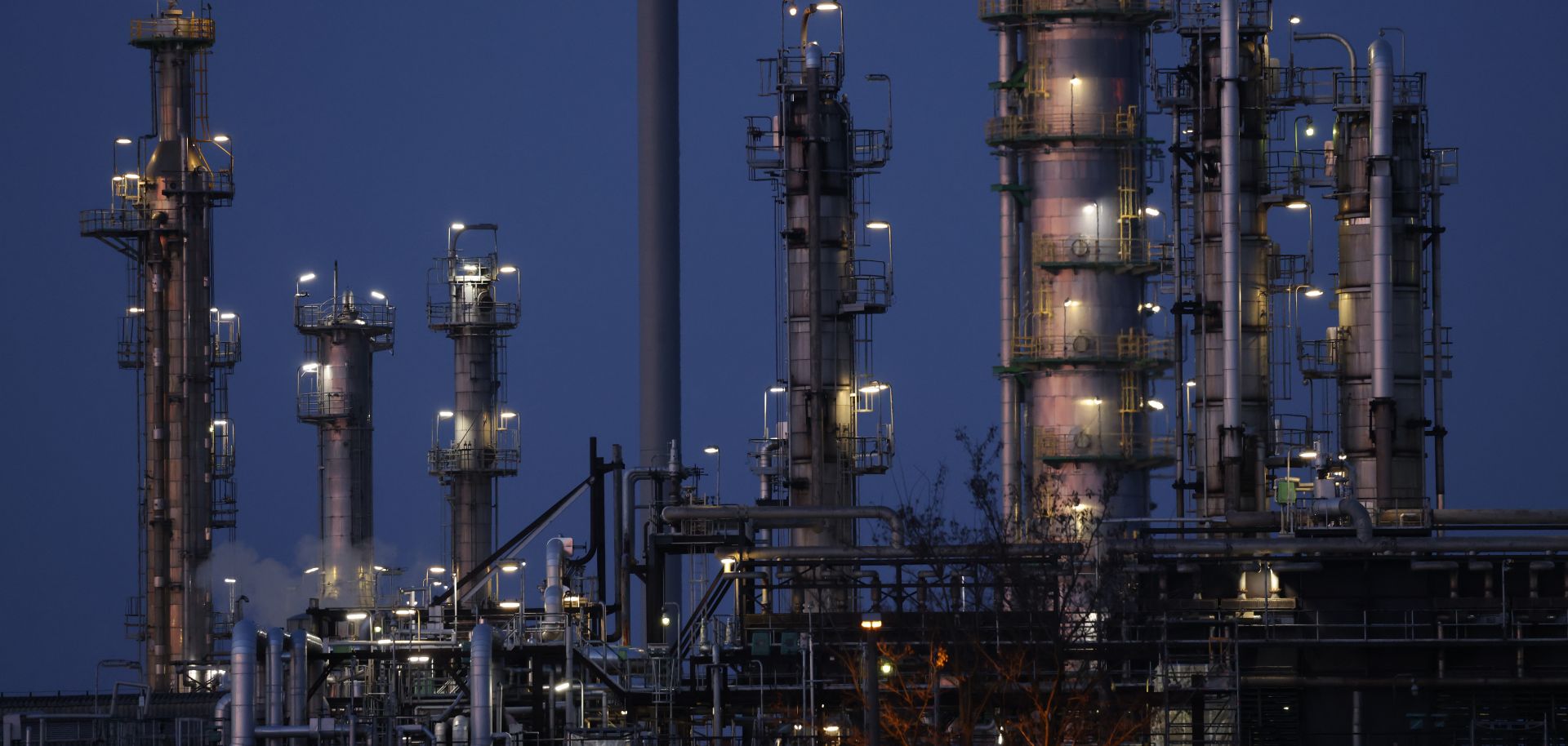
The PCK oil refinery, which is majority-owned by Russian energy company Rosneft, on March 21, 2022, in Schwedt, Germany.
One month after the start of the Russian invasion of Ukraine, oil markets are still dealing with significant volatility in supply and prices that is showing few signs of relaxing, which will lead to more social unrest and force governments to extend aid packages to households and companies. European oil benchmark Brent crude broke $120 per barrel on March 23 as traders remain concerned about supply shortages as major refiners shun Russian crude oil. On March 22, French supermajor TotalEnergies announced that it would phase out its purchases of Russian crude oil and petroleum by the end of 2022 and no longer buy Russian crude on the spot market. The same day, Russia announced that storm damage at a crude oil export terminal on the Black Sea could take up to two months to fix and disrupt the roughly 1 million barrels per day of Kazakh crude flowing through the Caspian Pipeline Consortium system. The high price comes ahead of OPEC+'s March 31 meeting where it will discuss its oil production policy for May. Saudi Arabia, OPEC's de facto leader, has made few indications that it is willing to tackle high prices aggressively.
- OPEC+ is currently planning to increase oil production by another 400,000 bpd in May.
- On March 20, Saudi Arabia said that it could not be held responsible for global oil supply shortages after the Iran-backed Houthis attacked several Saudi Aramco facilities in Saudi Arabia. The Saudi statement was a message to the United States that it was unhappy with the Biden administration's lack of support for Saudi Arabia against Houthi attacks.
While Russia has been able to find some buyers for its crude oil, its oil production could fall by 2 million to 3 million bpd in April compared to prewar levels, which would continue to help support oil prices above $100 per barrel. Russian oil is having a difficult time finding buyers in Western countries. Canada, the United Kingdom and the United States have banned Russian petroleum from their markets. Even though the European Union has not gone that far, several energy companies operating refineries in Europe have announced that they will not enter any new supply contracts or buy Russian oil on the spot market because of legal and reputational risks. In coming months, Russia's long-term contracts with foreign refineries will be phased out. While some non-Western refiners are likely to continue buying Russian crude oil and petroleum products, they will likely be doing so at a significant discount of as much as $30 per barrel, highlighting Russia's struggle to find buyers. Moreover, even though Western sanctions do not directly affect the oil trade, the sanctions complicate the transaction process for getting insurance coverage and contracting tankers for delivery.
- In its March 16 monthly Oil Market Report, the Paris-based International Energy Agency forecasted that Russian oil production would decline by 3 million bpd in April, dropping to 8.6 million bpd.
- In a March 16 client note, Morgan Stanley upped its Q3 Brent price forecast by $20 per barrel to $120 per barrel and added that in a bull price scenario, prices could average $150 per barrel in 2022.
- Japan's top refiners, Eneos and Idemitsu Kosan, announced they would stop buying Russian oil. Chinese and Indian refiners have not made similar announcements and some have bought more cargoes since the war began on the spot market.
In the developed world, high oil prices are causing protests and forcing governments to consider taxing any revenue windfall on energy companies as well as tax cuts, price caps and other measures. Protests or strikes over high fuel prices have occurred in March in Canada, France, Spain, Germany and the United Kingdom, among others. Spain's trucker strike, which has been particularly disruptive, has exacerbated high food prices and continues even after Madrid passed a $551.35 million aid package on March 21. Other countries are considering similar packages, such as a $4.9 billion Italian aid package that includes a .25 euro per liter cut in fuel prices paid at the pump. Southern European countries are also pushing for EU-wide price caps for natural gas and electricity prices, although Northern European countries remain skeptical of the plan. For developed countries, the energy crisis is continuing to undermine economic recoveries, but – at least for now – has not resulted in a physical shortage of energy supplies, though traders are concerned that a diesel shortage could occur if Russian diesel exports continue to be disrupted. If this becomes the case, more widespread protests are likely, disrupting key European industries, supply chains and transportation systems.
High energy prices coupled with rising food prices and other budgetary constraints mean the fallout from the Russian oil shock will affect developing and emerging economies more strongly than it will affect the developed world. For many developing countries and emerging markets, high oil prices are just one of several financial challenges. Before the war, Russia and Ukraine accounted for more than 30% of the global wheat export market, which means that war-caused disruptions will negatively affect grain importers worldwide. Moreover, others like Turkey have a large amount of U.S.-dollar denominated debt, which makes them vulnerable to the Fed's March 16 decision to start raising interest rates, which in turn will strengthen the dollar vis-a-vis other currencies. This will increase other countries' debt servicing and borrowing costs on dollar-denominated debt. Governments will be under pressure to alleviate rising food and fuel prices with cash transfer programs, tax cuts and price controls, but for some, this will come at the expense of fiscal sustainability programs that will necessitate some governments to seek IMF bailouts and debt restructuring in the future. The countries at the highest risk are already facing other political or financial challenges. Morocco, Pakistan and Sri Lanka are key examples of how the high oil price environment in the wake of the Ukraine war can trigger a broader crisis.
- Morocco may slip back into a recession this year as it struggles with rising energy prices and its worst drought in more than 40 years. The latter is forcing the government to ration water in some regions, and is expected to cut Morocco's annual agricultural output by three-quarters this year; the sector employs roughly 30% of the population. This puts Morocco in a dangerous position where it could see a variety of economically motivated protests as the drought continues. An Arab Spring-like revolt is unlikely because of the government's increased willingness to crack down on protesters, but demonstrations appear likely.
- Pakistan is heavily dependent on natural gas imports, which have seen an even higher price shock than oil prices. It also has also struggled to unwind subsidies and price controls on fuel and electricity because of domestic political and social pressure. On Feb. 28, Prime Minister Imran Khan announced the government would freeze gasoline and electricity prices until the government's next budget in June. The IMF, which is reviewing its $6 billion bailout package, asked the Pakistani government how it will pay the estimated $1.5 billion cost of maintaining the subsidies. For Pakistan, reversing its decision could lead to Khan's ouster via a vote of no confidence and widespread protests. But perhaps most damaging, rising global prices and the freeze and domestic prices could leave the country's natural gas and oil importers insolvent and cause physical shortages in the country.
- Sri Lanka may be the first country forced to go to the IMF since the start of the war in large part due to the crisis of rising energy and food prices. Sri Lanka has a $1 billion bond maturing in July and $7 billion in debt repayments this year, but just $2 billion in foreign currency reserves. Before the Ukraine conflict, Sri Lanka opposed going to the IMF due to the austerity measures that would be attached to a bailout agreement. Instead, it opted for bilateral negotiations with foreign governments for financial support, which often came with political strings attached. In March, the Sri Lankan government abandoned its position and opened up talks with the IMF as the energy crisis led to rolling blackouts; it remains unclear whether a deal can be reached. In the meantime, Sri Lanka has begun talks with China and India — which vie for influence in the strategic South Asian nation — which are reportedly considering $2.5 billion and $1 billion assistance packages, respectively.
