
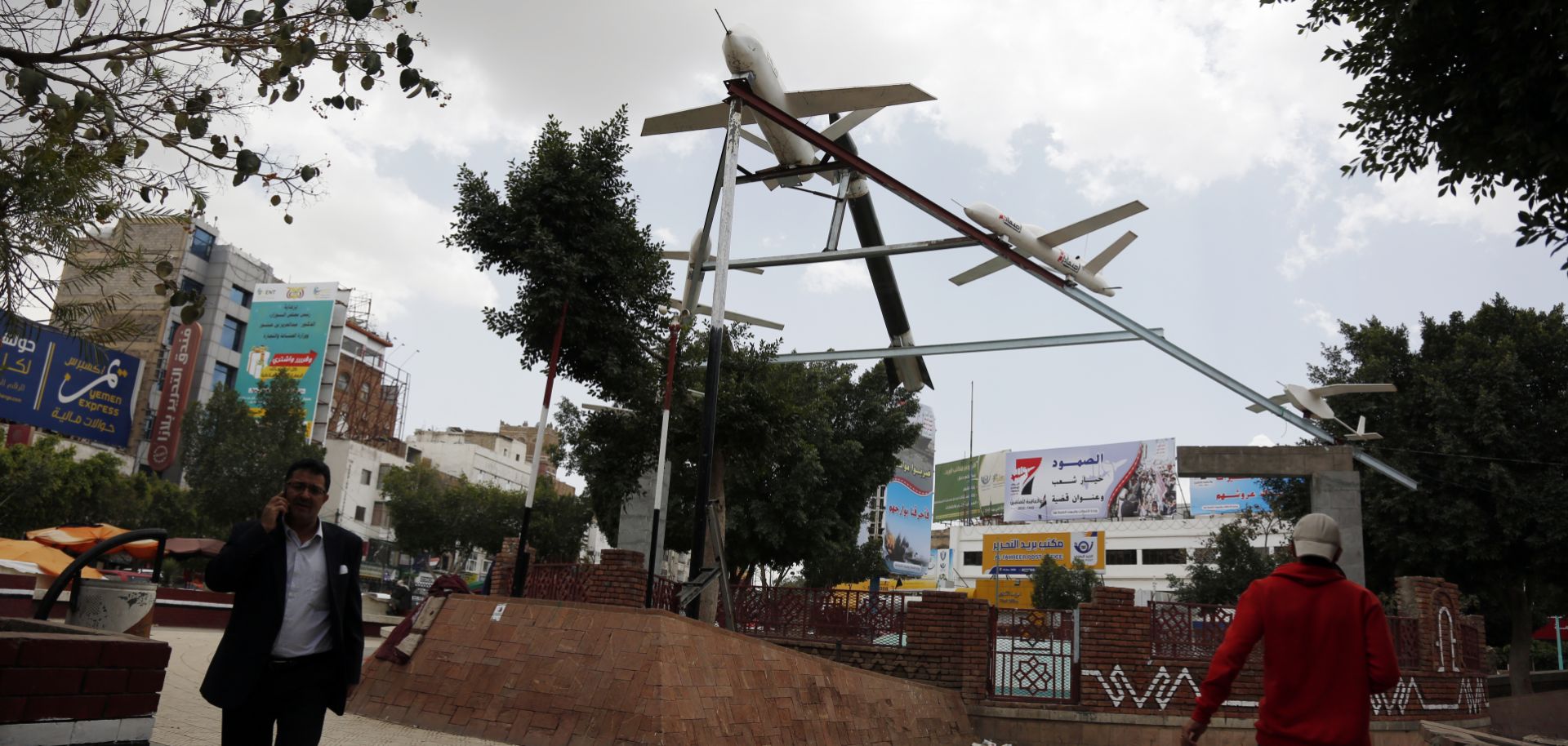
A photo taken in Sanaa, Yemen, on March 21, 2022, shows people walking under mock drones and missiles set up by supporters of the country's Iran-aligned Houthi movement, which earlier conducted attacks against Saudi energy facilities.
Waning U.S. interest in Saudi security issues will eventually compel Riyadh to find other arms suppliers and reduce the United States' influence over the oil-rich Arab Gulf state. On March 19-20, Yemen's Iran-aligned Houthi movement hit Saudi Arabia with a fresh barrage of drones and missiles, targeting energy-related facilities in Jizan, Yanbu, Dhahran Al-Janub and Khamis Mushait. The attacks caused no casualties but nonetheless highlighted the substantial threat Houthi rebels pose to Saudi Arabia. The attacks also came not long after a reported resupply and redeployment of U.S. Patriot antimissile interceptors to the kingdom. Yet Saudi Arabia appeared unsatisfied, urging the international community (in an oblique reference to the United States) to do more to stop Houthi aggression in the wake of the latest strikes, while also saying that Saudi Arabia could not be held responsible for oil price fluctuations that resulted from such attacks.
- The Patriot batteries the United States recently sent to Riyadh were not new, but instead redeployed from an undisclosed location elsewhere in the Middle East.
Modest U.S. reactions to future threats will reinforce Saudi Arabia's perception that Washington is disinterested in protecting the kingdom. Saudi Arabia is concerned that U.S. interest in the kingdom's security is waning as Washington inches closer to inking a possible nuclear deal with Iran and draws U.S. forces back to Europe amid the ongoing Russia-Ukraine war. And such concerns are valid, as the United States is unlikely to deploy forces potentially needed in Europe and Asia to help Saudi Arabia mitigate threats emanating from the kingdom's intervention in Yemen's civil war and rivalry with Iran. Ongoing U.S.-Iran nuclear talks, for example, have focused on securing a narrow deal that only restores the terms of the original 2015 agreement (which saw Iran scale back nuclear activity in exchange for Washington lifting sanctions), and does not address the security threats posed to Saudi Arabia through Iran's proxies, allies, ballistic missiles and other means of unconventional warfare. Meanwhile, the United States wants to avoid being pulled into the civil war in Yemen, where its mission remains focused on counterterrorism and revitalizing the diplomatic process to produce a cease-fire between Houthi rebels and their enemies.
- The signing of the original Iran nuclear deal in 2015 spurred Saudi concern that Washington was trying to disengage from the region at the expense of its allies' security due to the agreement's narrow focus on only the threats posed by Tehran's nuclear development.
- U.S. politicians, including President Joe Biden, have regularly criticized Saudi Arabia's intervention in Yemen's civil war, which has exacerbated the war-torn country's dire humanitarian crisis and caused civilian casualties with U.S.-made arms.
- The United States has been involved in counterterrorism missions in Yemen since 2002, but has stayed largely aloof from the overall civil war beyond providing logistical and intelligence support to Saudi forces and pressing Riyadh to restart negotiations between Yemen's rival factions.
This perceived disregard for its security will also make Saudi Arabia less willing to help the United States balance the global oil market in response to shocks like those created by Russia's Ukraine invasion. Saudi Arabia has, on occasion, acted as a force to maintain price stability in oil markets and as part of its close relationship with the United States. In 2011, for example, the kingdom ramped up oil production after the Libyan civil war interrupted global energy supplies. But Riyadh appears increasingly unwilling to serve as a source of stability in oil markets on Washington's behalf. To temper the market amid the current Ukraine-related sanctions on Russian energy exports, the United States has tried to convince Saudi Arabia to increase oil production, but Riyadh has yet to signal any plans to do so.
In the near term, Saudi Arabia will increasingly look to countries like France and Turkey to offset declining U.S. security support. Saudi Arabia has commercial ties with U.S. defense industry rivals in France, the United Kingdom and China, as well as a growing indigenous arms industry in the state-owned SAMI (Saudi Arabian Military Industries). However, the kingdom remains heavily reliant on U.S. defense companies, which provide most of the Saudi military's current equipment. The United States will remain best-positioned to deter a full-scale war against or invasion of Saudi Arabia, though these are distant threats for Riyadh. To help protect against the more pressing threats of Houthis and Iranian attacks, the kingdom will seek to purchase more arms from other countries in the meantime. Saudi Arabia is reportedly interested in purchasing Turkish-made Bayraktar TB2 drones, which have experienced a reputational boost in Ukraine where they're serving as an effective lethal weapon against Russian invaders. Riyadh could follow in neighboring United Arab Emirates' footsteps by purchasing high-end NATO equipment instead of U.S. arms.
- In December, the United Arab Emirates announced the purchase of French-made Rafale fighter jets and said it was freezing a planned purchase of U.S.-made F-35 fighter jets. Abu Dhabi also recently placed an order for Chinese-made fixed wing trainer aircraft, becoming the first Arab Gulf state to purchase such jets from China.
In the long run, the kingdom may also be tempted to deepen its defense ties with China and potentially even Russia. Saudi Arabia could expand the ballistic missile program that it's developing with China's help, while also potentially purchasing Chinese aircraft or drones instead of U.S.-made ones. Compared with Chinese weapons, Russian arms purchases would be much more likely to run afoul of Western sanctions following the Ukraine invasion. However, Riyadh might eventually consider some defense cooperation with Moscow if relations with the West further deteriorate. But it will nevertheless take years before Saudi Arabia is able to purchase and integrate enough equipment into its armed forces to strategically shift away from the U.S. defense umbrella. In the near term, Saudi Arabia will thus seek to avoid high-end Russian or Chinese arms purchases that could incur U.S. sanctions, like purchasing the Russian S-400 missile system.
