
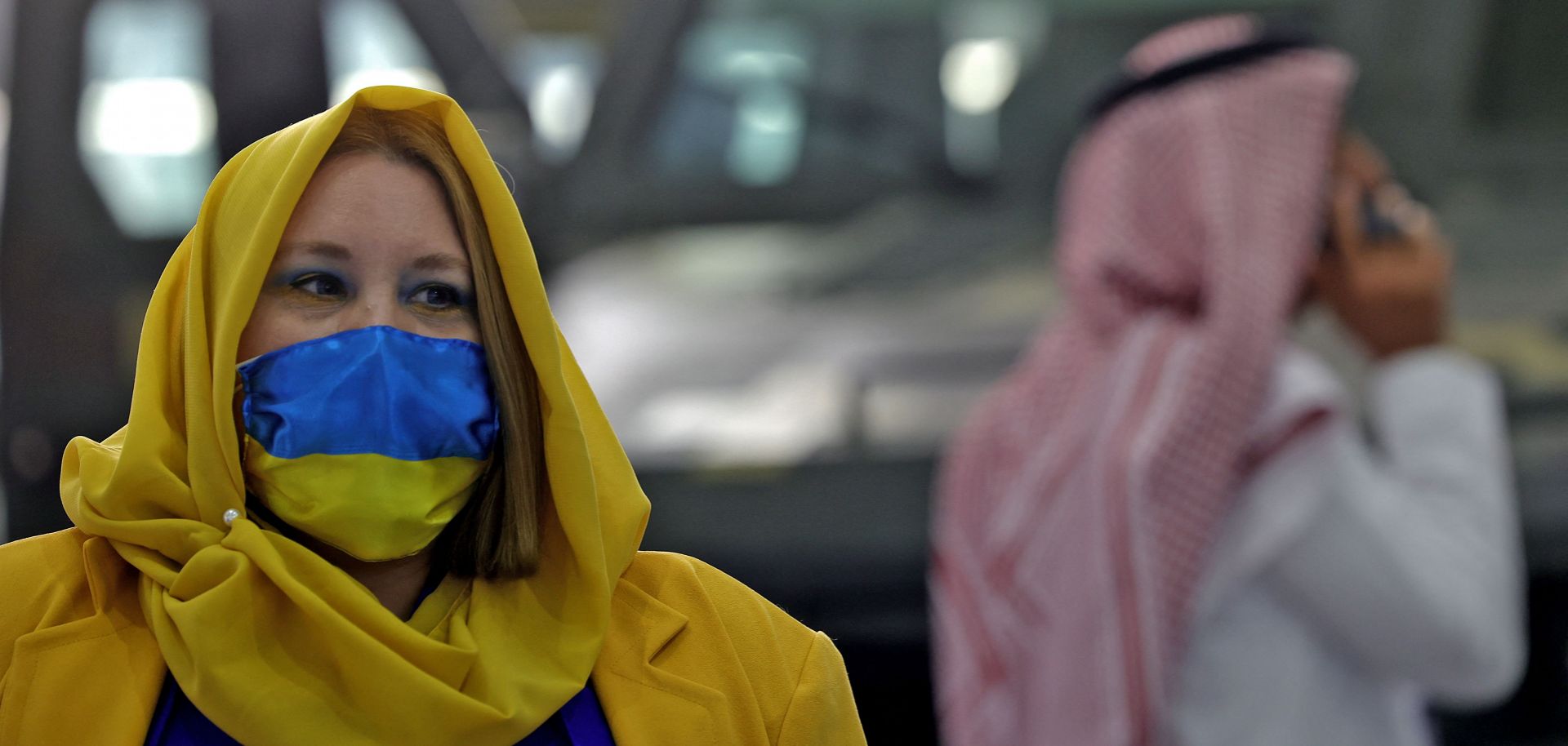
A worker at one of the stands at Saudi Arabia's first World Defense Show in Riyadh is seen wearing clothes in support of Ukraine on March 8, 2022.
For Saudi Arabia, the fighting in Ukraine is a distant European war, but the fallout is nonetheless reaching Riyadh by upending oil markets and the post-Cold War world order. In addition to potentially expediting the global transition to renewables, the West's sweeping economic sanctions on Russia are rapidly drawing new lines in the sand that could complicate Saudi Arabia's push to gain more strategic independence from the United States and its allies. And as a result, the oil-rich Arab Gulf country will be forced to quickly update its playbooks, from Vision 2030 to its defense and diplomatic diversification plans.
A Vision Built on a Post-Cold War Future
Since the ascension of Crown Prince Mohammed bin Salman in 2017, Saudi Arabia has embraced change as it raced towards the post-Cold War globalized world order. Economic and social reforms at home have sought to modernize the mindsets of Saudis, making the kingdom a more attractive place to live, work and invest. Abroad, Saudi Arabia has developed greater independence from its superpower patron, the United States, amid waning U.S. interest in the Middle East. But both of those strategies were built on assumptions rooted in the post-Cold War global order — assumptions that are being crushed by Russia's escalating war against Ukraine, with Russian troops now circling in on the country's capital of Kyiv.
Vision 2030, the kingdom's economic transformation plan, assumed that the primary obstacles to a post-hydrocarbon economy were domestic, not geopolitical: If Riyadh could mitigate investors' long-held concerns about the country's stifling Wahhabi lifestyle, rentier state attitude to work and state dominance of industries, investment surges from a globalized financial system would follow. But Vision 2030 does not have a contingency plan for a scenario where the world's financial system begins to fracture, which is what appears to be happening as Russia is walled off from the West.
Abroad, Saudi Arabia saw the United States' declining interest in the Middle East and increasing focus on China and recognized that at some point or another it would be left to fend for itself in protecting against regional threats. But Saudi Arabia also believed it had time to adjust, as there was little sign the U.S. pivot to Asia would be immediate. In the meantime, Riyadh could build up its own defense industry, find new or revitalized regional allies, and sign fresh military contacts in places like China, Russia and Turkey to serve as supplements to receding U.S. power. The strategy was not to break with the United States, but rather to declare independence from its interference, be able to act in Saudi Arabia's own interests and, if regional pushes came to shoves, defend itself without much U.S. aid.
But both of these plans required time and a relatively stable global system to come to fruition. The social and economic changes of Vision 2030 were generational, and the security changes were slated to come from slow and steady developments. Saudi Arabia couldn't purge its rentier attitudes any faster than it could rapidly retrain its armed forces to use non-U.S. military equipment. But the United States' pivot out of the region, promised since 2010, seemed glacial — pulled back in again and again by crises in the Middle East that demanded Washington's attention. The global economy, though disrupted by COVID-19, also appeared like it merely needed time to recover, not that it would restructure.
Enter the Unexpected: Ukraine
But in the wake of the Russian invasion, these assumptions are now up in the air. The United States and NATO have revitalized military interest in the security of Europe; already almost 40,000 extra U.S. troops have rushed to the region, rising from 63,000 at the end of 2021 to now over 100,000. And those U.S. soldiers may be there for the long haul, especially if Russia succeeds in seizing control of Ukraine, as Washington's European allies race to rearm and build credible conventional deterrence against further Russian aggression.
This is all the more remarkable given that only a few years ago, the United States was planning to withdraw 12,000 troops stationed in Europe. Now such plans, already frozen, are probably dead. Meanwhile, the war in Ukraine has done little to dent the United States' desire to confront China in East Asia, where 82,000 more U.S. troops remain (primarily in Japan and South Korea) to monitor Beijing. That doesn't leave Saudi Arabia unprotected, as U.S. forces also remain in the United Arab Emirates, Qatar, Kuwait, Iraq, Bahrain and elsewhere. But it does signal to Riyadh that Washington may lose focus on the Middle East faster than previously believed, giving a new sense of urgency to Saudi military and defense reforms. There's also economic change afoot. It's not clear just how long Russia will be isolated from the global economy, though it will probably depend on how far it goes to defeat Ukraine (with the use of chemical weapons or a brutal occupation, for example, likely prompting the West to maintain or even deepen its current sanctions campaign against Moscow). But what is clear is that Russians are already racing to Arab Gulf states as a way to offset asset freezes and commercial sanctions in Europe, the United States and other countries that have joined the West's sanctions campaign. While the West has yet to impose secondary sanctions on countries for doing business with Russia, that could very well change, which would present a major challenge to Riyadh. In other words, the world of unrestricted capital Vision 2030 was designed to take advantage of could be gone. Indeed, Russia is poised to repeat in Ukraine the scorched-earth tactics it has used since intervening in Syria's conflict in 2015; Syria's behavior during the civil war caused the U.S. to impose a still-strict sanctions regime on Damascus that has prevented it from trading freely.
Additionally, the fresh global energy shocks created by the sanctions on Russia may change the timeline of peak oil demand. In the short term, this is a financial windfall for Riyadh, as countries seek to replace Russian energy exports with Saudi exports — demonstrating the value of the kingdom's oil across the world. But the global energy disruptions are also incentivizing countries to race faster towards peak oil demand. The Germans have moved up their date to generate most of their power from renewables up to 2035 from 2050. With oil prices high, other countries, including the United States, might follow with more investment in electric vehicles and renewables; after all, the first major push for alternative energy came after the last great energy shock in the 1970s. But unlike the 1970s, this time the world is replete with commercially available alternatives, and many Western countries are already focused on combating climate change in part by reducing hydrocarbons and their emissions.
Grappling With a Disjointed World Order
Even with this urgency, however, the Ukraine war creates complications for Saudi Arabia to adapt. For example, part of its defense diversification is driven by a desire to reduce U.S. leverage over Saudi Arabian behavior — and the countries that ask the fewest questions about the use of their weapons, Russia and China, are increasingly out of reach. Acquiring Russian weapons at any scale at this point would alarm the United States to the point where it might risk sanctioning Saudi Arabia, which would effectively derail the kingdom's Vision 2030 plans. Purchasing Chinese defense systems might not quite trigger such a harsh reaction. That, however, will also depend on how China behaves as the Russian invasion grinds on, as the closer China's actions align with Russia's, the more likely Washington will also demand that Riyadh avoid Chinese arms. The loss of both China and Russia as arms providers would effectively keep Saudi Arabia reliant on the Western partners. These parts would continue to sell Riyadh weapons, but would also criticize the kingdom's human rights record and the way Saudis use their military systems. Riyadh's military and diplomatic policies will thus be left partially constrained by Western human rights policies while its main regional rivals in Iran and the Yemeni Houthis will not.
Meanwhile, Vision 2030 — already heavily reliant on the West's technology and trade links — may be unable to develop the diplomatic backup partners the plan foresees as necessary to fortify Saudi political independence from its allies. Originally, Vision 2030 envisioned a post-hydrocarbon Saudi Arabia able to trade with countries like Russia and China, where they would face little pressure from businesses or investors to reform their political system. Now, Riyadh may be unable to trade with Russia at all and may also face pressure to reduce trade with China. As a result, Saudi Arabia's repressive governance could continue to be pressured by both Western governments and Western commercial interests, which might withhold investment and/or diplomatic support unless Riyadh changes its human rights policies. This becomes especially true if the West moves into a phase of secondary sanctions against Russia that apply to China, forcing Saudi Arabia to be more sanctions-wary of deepening commercial ties with Beijing.
Finally, one of the more wildcard implications of the Russia-Ukraine conflict is its impact on Saudi Arabia's own national identity projects. Saudi national identity has been anchored on independence from the West rather than being anti-Western. But if the West tries to corral Saudi Arabia into its own anti-Russian isolation campaign, Riyadh might be tempted to take a page out of Turkey's rhetorical playbook and indulge in more anti-Western rhetoric to justify standing up to Western pressure. That could create a type of Saudi nationalism more ready to absorb Western sanctions in pursuit of national sovereignty, thus reducing the West's economic influence over the kingdom. This is precisely what Turkey did when it purchased the Russian S-400 system in 2017, deciding that the country's defense independence was more important than the economic impact of resulting U.S. sanctions.
Staying Neutral — For Now
With these considerations in mind, Saudi Arabia will strive to do the easiest thing possible: remain neutral in the Russia-Ukraine conflict and, in the meantime, adjust policies as needed in lieu of larger strategic shifts. But the Russian invasion of Ukraine is continuing to break apart the sinews that held together with the world's diplomatic and economic system. As a middle power with outsized strategic importance to the global economy and ambitions of a major domestic economic and defense transformation, Riyadh will likely be called on to pick a side, forcing it to accelerate the kingdom's plans for the future.
