
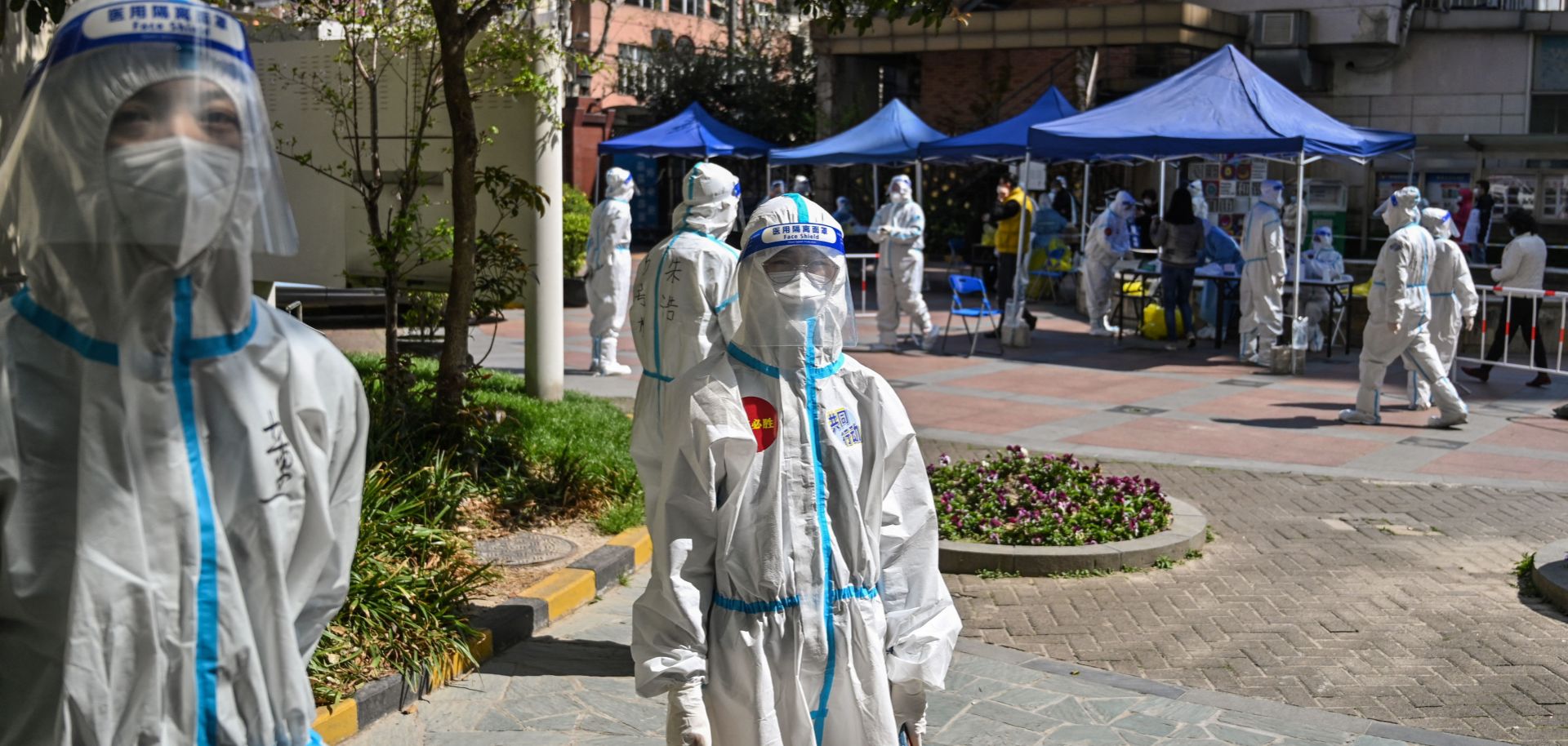
Workers are seen outside a compound where residents are being tested for COVID-19 in the Jing'an district in Shanghai, China on April 4, 2022.
The Shanghai lockdown has renewed questions about the sustainability of China's ''zero-COVID'' strategy, but most signs suggest the policy will persist until late 2022. As a result, ongoing travel and customs restrictions along with sudden logistics bottlenecks will continue to impede global trade and hinder China's already dim economic growth prospects for 2022. Shanghai's COVID-19 lockdown, which was supposed to end on April 5, has been extended indefinitely. Between April 5 and 11, Shanghai recorded 156,277 new COVID-19 cases, surpassing the total number of cases China recorded nationwide between the original Wuhan outbreak in December 2019 and March 18, 2022. In many other countries in the region, similar caseloads in recent weeks have not prevented governments from lifting restrictions; Vietnam, for example, has 7% of the population of China and recorded 383,000 cases between April 5 and 11, but is completely reopening its economy. For China, however, Shanghai's caseload is a major red flag, given Beijing's primary focus on preventing transmission under its so-called ''dynamic clearing'' strategy (often called ''zero-COVID''), which aims at extinguishing new clusters of infections as soon as possible. This zero-tolerance approach is wreaking havoc on businesses and people in the densely populated financial hub of Shanghai, causing shutdowns of major production lines, including Tesla's Gigafactory Shanghai, as well as port delays, with the April 11 waiting line at Shanghai's port 15% higher than a month earlier. Chinese social media, meanwhile, has shown stories of food deprivation, death due to medical neglect, a spate of suicides, and protests in locked-down residential compounds in Shanghai. Amid the economic and humanitarian fallout from the ongoing Shanghai lockdown, a growing number of companies are cutting their growth forecasts for China and asking when Beijing's ''zero-COVID'' policy will end.
- China's state-owned Bank of Communications recently dropped China's GDP growth forecast for the first quarter of 2022 from 5% to 4%
While Chinese authorities will try to protect economic growth, infection mitigation remains their primary objective and heavy-handed social restrictions their tool of choice. Following the original outbreaks across China that spawned from Wuhan, authorities quickly implemented citywide lockdowns across the country, including requiring residents to remain indoors, blocking traffic between cities, and instituting mandatory testing in cities with tens of millions of people. Subsequent outbreaks hit northern Hebei (near the capital of Beijing) in January 2021, the central rail hub of Zhengzhou and the port city of Ningbo in Aug. 2021, and the southern manufacturing center of Guangdong in January 2022, all prompting similar responses. As time has passed, Chinese authorities have given lip service to mitigating economic damage caused by lockdowns, but they have also made it abundantly clear in national policy statements that protecting human life by maintaining its ''zero-COVID'' policy remained first priority. This trend has persisted amid the ongoing outbreak in Shanghai.
- In a March 31 editorial published in state news outlet Xinhua, President Xi Jinping reiterated that China ''must adhere to a zero-COVID strategy that is scientifically precise and dynamic to suppress the spread of the epidemic as soon as possible.'' China's foreign ministry confirms this narrative daily, with spokesperson Zhao Lijian stating on April 12 that ''all these [zero-COVID] efforts are worthwhile to protect people's life and health.''
- Shanghai officials announced on April 11 that residents of low-risk areas would be allowed to leave their residential compounds, but the next day they clarified that this only applied to compounds not adjacent to high-risk areas (which still make up 43% of all neighborhoods).
- On April 12, Caixin news announced a pilot policy in eight cities that will reduce quarantine requirements for international arrivals from 14 to 10 days, plus a week of at-home observation. But on April 14, the Caixin story was taken down and state news outlet Xinhua published President Xi's words that ''the global pandemic is still severe, so we cannot relax the controls now.''
- On April 13, the Chinese Center for Disease Control and Prevention released new guidelines for at-home isolation, but it appears the measures only apply to certain populations, like close contacts and asymptomatic patients who have already completed central isolation. In addition, the plan requires mandatory supervision by local neighborhood committee managers, but these managers have already lapsed on their duties during current lockdowns since they are under-resourced and ill-trained.
Logistical and political issues will constrain the Chinese Communist Party's (CCP) ability and willingness to drastically change its current approach to pandemic management. For decades, the CCP has responded to threats to public health or political stability with an all-of-government approach that leaves little room for localized policymaking, from the Tiananmen Square Massacre in 1989 to the SARS outbreak in 2003. This is partly due to China being run by a single political party that is consumed by self-preservation and paranoid of threats to its power. It's also partly due to the Chinese people's traditional arms-length relationship with the government after centuries of having little to no input into political processes, which makes voluntary policies nigh impossible to enforce. Over the years, Beijing has punished local officials that deviate from central media narratives or policy agendas as well. The CCP's response to the COVID-19 outbreaks has been no different, with Beijing firing or disciplining 37 high-level local officials in five cities in the last month alone for failing to prevent viral spread.
- President Xi, for his part, has praised the zero-tolerance approach to COVID-19 as a success story for China, for the CCP, and for himself, making it difficult for Beijing to change trajectory in a year when Xi aims to begin an unprecedented third term as the General Secretary of the CCP.
- From a purely logistical perspective, Beijing is likely genuinely concerned about the potential for COVID-19 to spread in the country given the inefficacy of China's domestically-manufactured vaccines compared with the global gold standards produced by the U.S.-based pharmaceutical companies Pfizer and Moderna, which China has largely excluded from domestic vaccination plans in an ill-fated bid to boost China's national prestige in health science.
Most signs point to China maintaining its ''zero-COVID'' policy at least through late 2022, though the government could ease restrictions earlier depending upon the evolution of the pandemic and advancements in China's response capabilities. China will probably maintain its zero-tolerance approach to containing the virus through at least October or November, when Xi's third five-year term is secure and he feels free to make significant policy changes. Though authorities have made some recent policy changes, such as those regarding home isolation and hospitalization procedures, local authorities seem poorly motivated to ease restrictions and local enforcers are ill-equipped to take over health supervision from hospitals. It is possible, though unlikely, that a spate of major city lockdowns along China's industrialized coast could prompt an accelerated easing of Beijing's zero-COVID strategy, but this would depend upon the public stability impacts of such a broader outbreak. If Beijing feels that the economic restrictions and continued lockdowns are pushing the national populace to a breaking point – due to growing unemployment, lack of food or access to medical care, rapid and long-standing restrictions on movement – then leaders may opt for more flexibility in pandemic management. But China's security forces and CCP cadres are highly adept at dealing with public unrest, so this tipping point would involve unrest at more than the neighborhood level (as commonly witnessed in Shanghai) and in many more major cities.
- Local Chinese officials' conservative strategy toward COVID-19 management, despite expert advice, has shown that President Xi's decrees matter more than the guidance of medical professionals. On March 14, the director of China's National Center for Infectious Diseases, Zhang Wenhong, published a list of six preconditions for retiring the country's zero-COVID policy, including better-differentiated hospitalization strategies. On March 22, China's National Health Commission also announced new differentiated hospitalization strategies. But authorities in Shanghai have nonetheless continued to hospitalize asymptomatic COVID-19 patients in the latest outbreak, showing a relative disregard for these changes.
- The evolution of COVID-19 outbreaks in nearby countries will also influence how fast China transitions to a ''live with COVID'' strategy. If new, more severe variants hit East Asia or Southeast Asia, and/or if a new wave of global outbreaks emerges in June-July as some analysts have projected, China will be even more hesitant to ease its zero-tolerance approach.
As Beijing holds onto its ''zero-COVID'' policy and other countries open up, China's economy will suffer, as will global supply chains and the international tourism industry. China's preference for citywide lockdowns and lengthy quarantine periods has worsened business and investor sentiment about China, particularly as alternative manufacturing destinations like Vietnam and Malaysia reopen their economies — making Beijing's goal of achieving 5.5% GDP growth in 2022 even more difficult in a year already plagued by China's real estate crisis, as well as the ongoing war in Ukraine.
- Global supply chains for electronics and machinery, two of China's top export categories, will remain fragile as sudden citywide lockdowns continue to take factories and businesses offline for two to four weeks at a time. This will prompt foreign companies to diversify their suppliers, though many will remain over-reliant on China. Likewise, global shipping delays will proliferate for all manner of goods, given China is home to seven of the top 10 ports in the world by container traffic and China's city lockdowns often involve travel restrictions that block freight trucks from servicing ports.
- Chinese citizens are largely foregoing international travel, due to the 3-4 week quarantine times required upon their return to China. This means the global tourism industry will also struggle to recover as long as China's zero-COVID strategy continues, especially given the sheer number and spending capacity of Chinese visitors for many tourism-dependent countries like Thailand and Australia.
- Countries that depend upon China as an export market for fresh produce and meat products, like Vietnam and Taiwan, will continue to experience abrupt and sometimes long-lasting customs delays as well, as Chinese port authorities persist in testing inbound goods for COVID-19 and wielding import restrictions against suspected food-based vectors of the virus.
- Whenever China does transition from a zero-COVID strategy, local governments will be slow to adopt more lax preventative measures and social restrictions, given persisting fears of being fired for poor virus containment. Likewise, widespread fears of catching the virus from any number of vectors, stoked by years of state propaganda, will also leave citizens hesitant to adopt more flexible COVID-19 measures that could increase their risk of exposure.
