
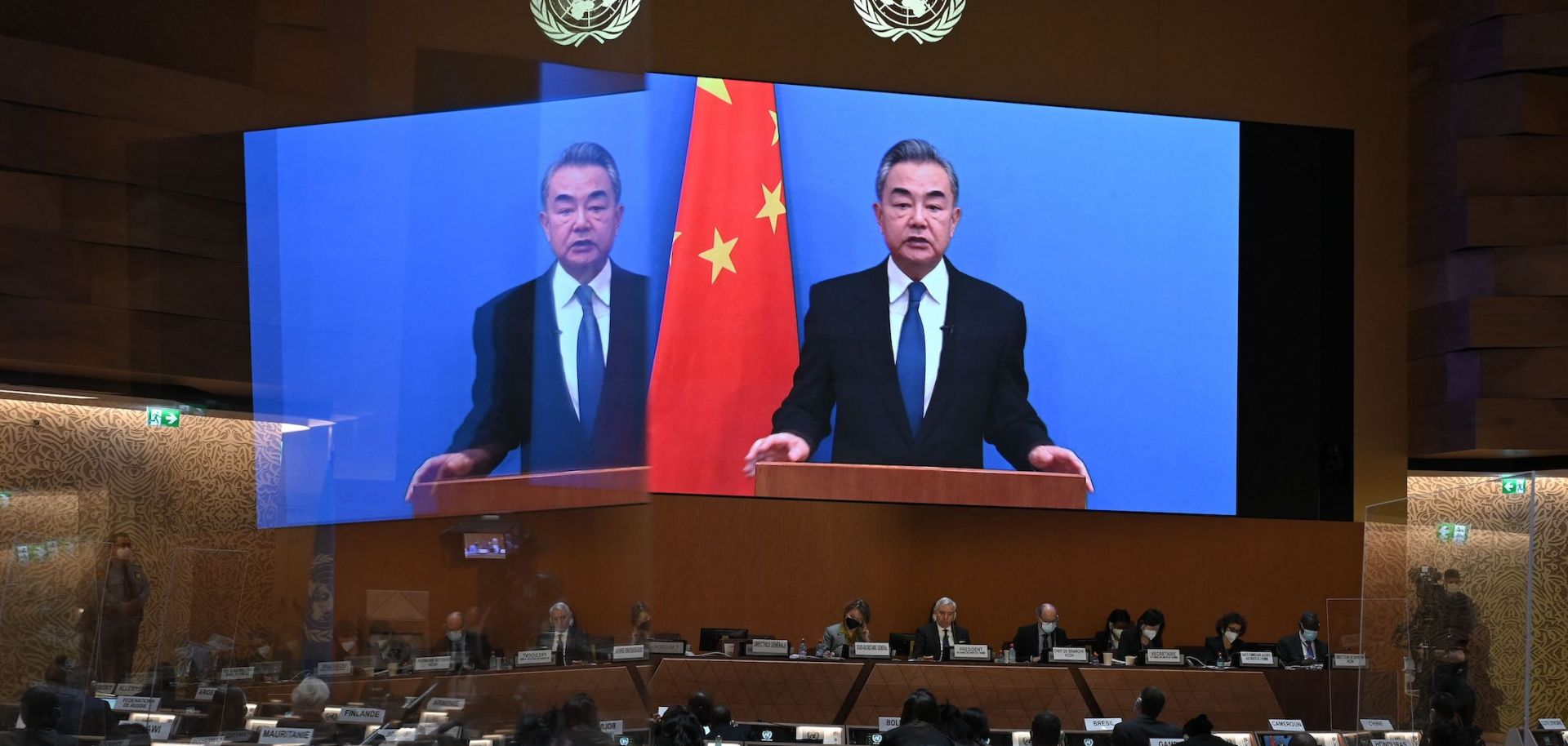
Chinese Foreign Minister Wang Yi speaks Feb. 28, 2022, during the opening of a session of the U.N. Human Rights Council after the Russian invasion of Ukraine.
While ideological and strategic reasons mean China is likely to continue its tacit support for Russia in the war in Ukraine, Beijing will also seek to improve ties with the West and comply with sanctions against Moscow in order to protect its economic growth. Since Russia's invasion of Ukraine began Feb. 24, China has given rhetorical backing to Russia's security concerns about NATO expansion and Chinese news outlets have repeated Russian claims of Western responsibility for Russian-Ukraine tensions, such as unsubstantiated accusations of U.S. support for chemical weapons use. For the first few weeks after the conflict started, China refused to call the invasion a war and amplified Russia's claim that its incursion in Ukraine was not a war, but a special military operation. Beijing has also dismissed as "fake news" Western allegations that China might assist Russia militarily or help Russia dodge financial and technological sanctions, and Chinese officials have reiterated the importance of the Russian partnerships while clarifying that the two countries do not necessarily support each others' every move.
China's political support for Russia's campaign in Ukraine is based on the Chinese Communist Party's anti-Western ideology as well as on its pragmatic need to support China's few diplomatic partners, including Moscow. The CCP's support for so-called "alternative democracies" — aka authoritarian regimes that claim to be the guardians of their citizens and defenders of national power — and opposition to so-called "Western liberal democratic hegemony" go back to the founding of the People's Republic of China in 1949 and Mao Zedong's ideas of a worldwide Communist revolution. These doctrines gained renewed vigor under President Xi Jinping, who views the Western world led by the United States as bound for civilizational decline and China as destined for "national rejuvenation" as China evolves into the world's leading superpower. Thus, whenever an opportunity presents itself to contradict Western claims of peaceful liberal governance and beneficial regional security partnerships, Beijing avails itself of them, especially when they bolster the relative national strength of a key security partner like Russia.
Beijing will maintain its political support for Moscow even if it contradicts Beijing's position on other territorial disputes, given the strategic need to ensure policy continuity as General Secretary Xi seeks to begin his third term. Since its inception, the CCP has claimed to champion nonintervention in the internal affairs of other countries, support for national sovereignty and rejection of separatist movements, given China's 19th and early 20th century history of imperial subjugation by Western powers and its ongoing dispute with Taiwan. While Beijing's tacit support for Russia's invasion of Ukraine contradicts this foreign policy principle, Beijing is willing to permit this in order to maintain its partnership with Moscow at a time of heightened U.S.-China strategic competition. In addition, the Sino-Russian relationship is highly personal: Xi has met with Vladimir Putin 38 times since coming to power in 2012, more than Xi has met with any other world leader. Thus, a repudiation of the Russian partnership would be a repudiation of Xi's judgment in a year when he plans to begin an unprecedented third term as general secretary of the CCP at the 20th Party Congress in late 2022. Xi is unlikely to change this support for Russia after his third term begins because competition with the United States, and thus China's need for strategic partners, will persist.
Despite ongoing U.S.-China competition, Beijing will attempt to mend diplomatic relationships with Western governments as the short-term need for trade partners outweighs its long-term desire for greater supply chain self-sufficiency and domestic consumption. As the war in Ukraine drags on, Beijing's tacit support for Moscow will further erode China's international reputation as a responsible global power. This may prompt Chinese diplomats to attempt to repair frayed trade relationships, particularly with Europe regarding the stalled negotiations over an EU-China Comprehensive Agreement on Investment and with Australia regarding China's unilateral trade war against Australian commodities that followed Canberra's 2020 support for an international investigation into the origins of COVID-19 in China. Beijing will also attempt to bolster relations in sub-Saharan Africa and Latin America to nurture emerging future trade partnerships and maintain venues for China to pitch its alternative democracy governance model as superior to Western liberal democracy. China will continue advocating for a peaceful solution in Ukraine, and may even opt to facilitate one or more side negotiations regarding cease-fires or peace accords as a means of restoring China's image as a responsible global power. But if Russia's negotiating position remains strong, as determined by the momentum of the war, China is unlikely to pursue the lead role in mediating the conflict because such negotiations could put Beijing in the position of explicitly justifying a foreign invasion, helping Russia consolidate seized territories or supporting separatist movements. Furthermore, these negotiations would inevitably include discussions about the fate of Crimea, a former autonomous region seized by Russia, and China would be unwilling to support a pro-Russian settlement on this front as it could rhetorically justify similar aggressions against China's restive autonomous regions, including Xinjiang.
China's need to support economic growth means that Beijing is likely to comply with Western financial and technological sanctions against Russia. Beijing will maintain its media narrative that Western sanctions are unilateral (e.g., not based on international consensus), ineffective and a symbol of U.S. financial hegemony. But major Chinese banks and companies, both public and private, will largely abide by Western sanctions to avoid secondary sanctions in a year when the CCP is already projecting global demand for Chinese exports will fall as major global economies reopen and foreign consumer demand shifts from products to services. Furthermore, Chinese authorities are attempting to secure ample supplies of fuel, food, and agricultural and industrial inputs amid a global commodities squeeze. The CCP also aims to avoid a real estate collapse, local government debt crisis, worsening unemployment, and the widespread closures of small- and medium-sized enterprises, all while Beijing remains committed to its zero-COVID strategy of strict infection prevention. These economic constraints suggest the CCP will have little leeway in its attempts to reach an ambitious 5.5% GDP growth target for 2022 — and so at all costs will avoid precipitating Western retaliation in the form of additional sanctions. For the same reasons, China will likely avoid giving significant financial or military aid to Russia, aid that recent U.S. intelligence suggests Russia has directly requested. Though Chinese authorities have threatened to use China's Anti-Foreign Sanctions Law in response to any Western sanctions, doing so would inhibit China's business and investment environment, complicating Beijing's economic growth plans.
