
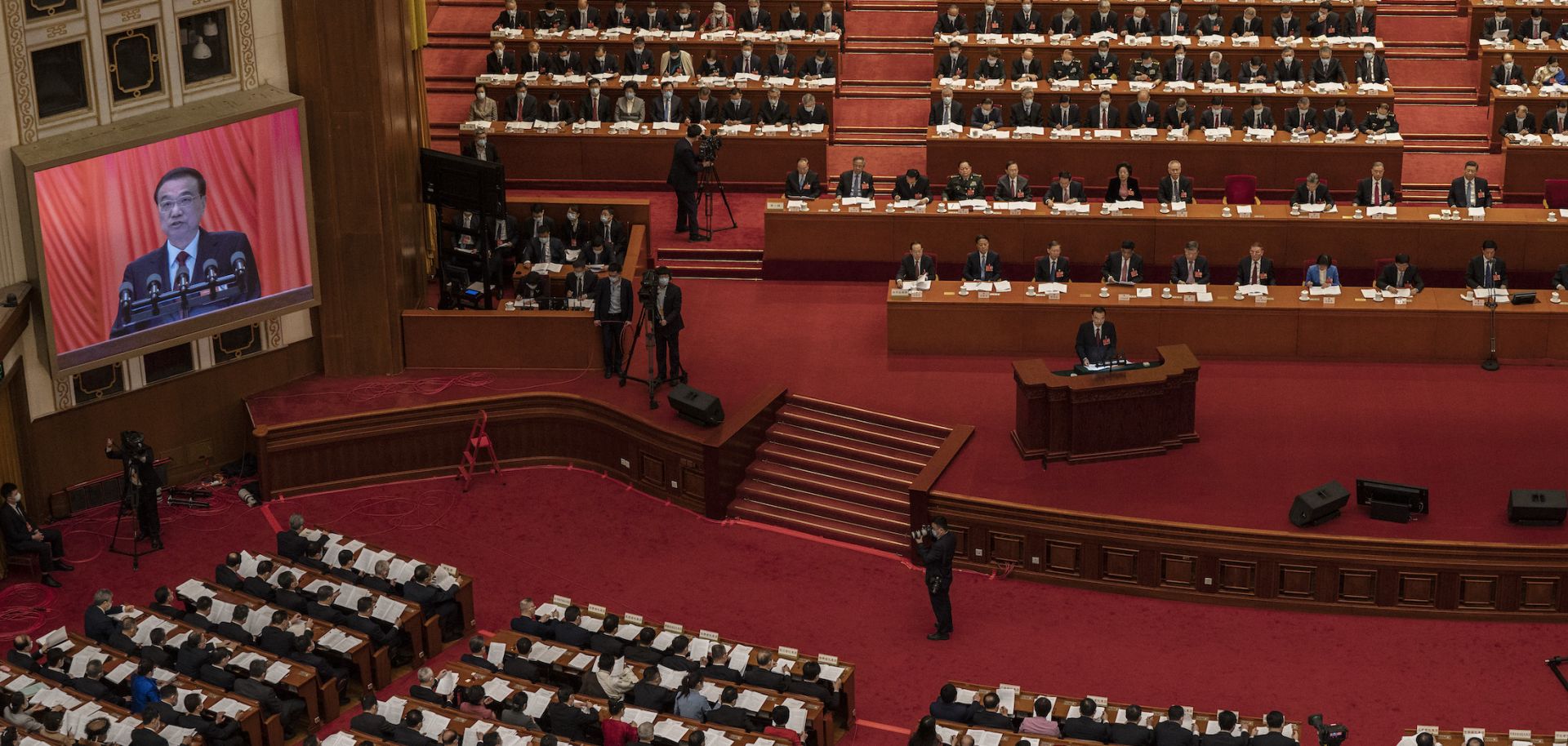
Chinese Premier Li Keqiang speaks on a podium and is seen on a large screen at the opening session of the National People's Congress at the Great Hall of the People on March 5, 2022, in Beijing.
Beijing will focus on economic stability in 2022, leveraging moderate fiscal support to jump-start economic growth in a politically sensitive year and deprioritizing long-term development goals. Chinese Premier Li Keqiang released China's Government Work Report on March 5, 2022, at the meeting of the National People's Congress, part of China's annual Two Sessions legislative event. The report focused on China's accomplishments last year, but it also laid out economic goals for 2022, including quantitative targets and general policy focuses, and described Beijing's chief economic concerns.
- Economic targets for 2022 include a 5.5% gross domestic product growth target and the allocation of $101 billion in central government funds for investment, especially to construction projects like energy pipelines and civil infrastructure. The report also increased central government transfers to local governments by 18% to $1.5 trillion; estimated overall tax cuts and rebates at $400 billion and made it clear that local governments should not reduce tax breaks; projected consumer price inflation will hit 3% in 2022 (compared to 0.9% in 2021); and noted that Beijing would again leverage the surplus profits of China's state-owned enterprises to help government budget expenditures surpass those of 2021 by $320 billion.
- Broader economic goals for the year include securing supplies of energy, food, chemical fertilizers and other raw materials (especially industrial inputs) and protecting the productivity, access to loans and employment levels of small- and medium-sized enterprises.
- The report listed China's chief economic concerns for 2022 as declining global demand for Chinese exports, unstable global commodities markets, insufficient progress toward state innovation goals, persistent domestic systemic risks (e.g., real estate) and excess bureaucracy in implementing the state economic agenda.
China's clear focus on economic stability, policy continuity and fiscal support suggests the supply chain disruptions of 2021 related to COVID-19 and domestic export policies will continue in 2022. Beijing's economic goals and concerns come amid a year of myriad challenges posed by the COVID-19 pandemic, the war in Ukraine and its effects on commodities markets, and domestic issues like high unemployment and lagging consumption. Through all of this, General Secretary Xi Jinping plans to maintain strong economic growth as his unprecedented third term as General Secretary of the Chinese Communist Party approaches in late fall 2022.
- The 5.5% gross domestic product growth target is at the high end of most global estimates for China, including those of Chinese think tanks, with Li admitting the goal was ambitious. The high inflation forecast suggests authorities will let significantly more producer price inflation pass through in 2022, potentially helping offset dipping demand for Chinese exports.
- The heightened fiscal support — bolstered by state-owned enterprise reserves and targeted at small- and medium-sized enterprises — is intended to give China's economy a booster shot in Q2 to ride out current geopolitical uncertainties. Meanwhile, the report's focus on "ahead of schedule" infrastructure investment confirms earlier suspicions that infrastructure will be used to help recover China's flagging fixed asset investment, a major driver of the economy.
- The report's emphasis on stable supplies for key commodities (such as grain, key minerals, oil and gas) suggests China will again heavily purchase on international markets to replenish stockpiles and prevent a repeat of the fuel and food shortages of 2021, driving international prices up further. This may also see China impose additional restrictions or bans on imports of key agricultural and industrial inputs, like fertilizers, causing acute goods shortages in Asia similar to those seen in October 2021.
- Furthermore, National People's Congress spokesperson Zhang Yesui on March 4 lauded China's "zero-COVID" approach to handling the pandemic, claiming China's path was "correct and good" and that "compared to protecting people's lives and health, these costs [of prevention and control measures] are worth it." Though the work report described methods to alleviate the excesses of city lockdowns, Beijing looks set to maintain zero-COVID despite its concomitant supply chain difficulties.
With this short-term focus on economic stability, Beijing will deemphasize certain long-term goals such as the energy transition, the Belt and Road Initiative, and local debt resolution. The work report emphasized obtaining energy security — by expanding global contracts for oil and gas and developing more efficient technologies for fossil fuel consumption in industry — before switching to alternative fuels, urged local officials not to pursue emissions reductions goals "heedless" of economic impacts, and did not mention energy consumption intensity targets for 2022, instead pointing to China's five-year goals for 2026.
- The Belt and Road Initiative and outbound foreign investment in general was given short shrift in the report, which focused on reducing risk for overseas investments and pushing western "land-sea access" projects, but with few other details. Greater focus was given to inbound foreign investment, with authorities aiming to mobilize private and public investment for infrastructure projects as well as advanced manufacturing and modern services. This further solidifies a long-term trend of decreased Belt and Road Initiative funding, and may worsen foreign debt crises and infrastructure deficits in sub-Saharan Africa and Southeast Asia.
- Though transfers of funds to local governments increased, authorities urged local governments to spend early and liberally in 2022 on infrastructure projects. And the report did little to address high local government debt or allay local government concerns about significantly reduced land sale revenues in 2021-2022. Thus, after the spending binge of Q1 and Q2, local governments may find themselves once again mired in debt and short on cash to implement Beijing's many unfunded mandates for keeping the local economy humming (e.g., minimum employment and tax rebate targets).
