
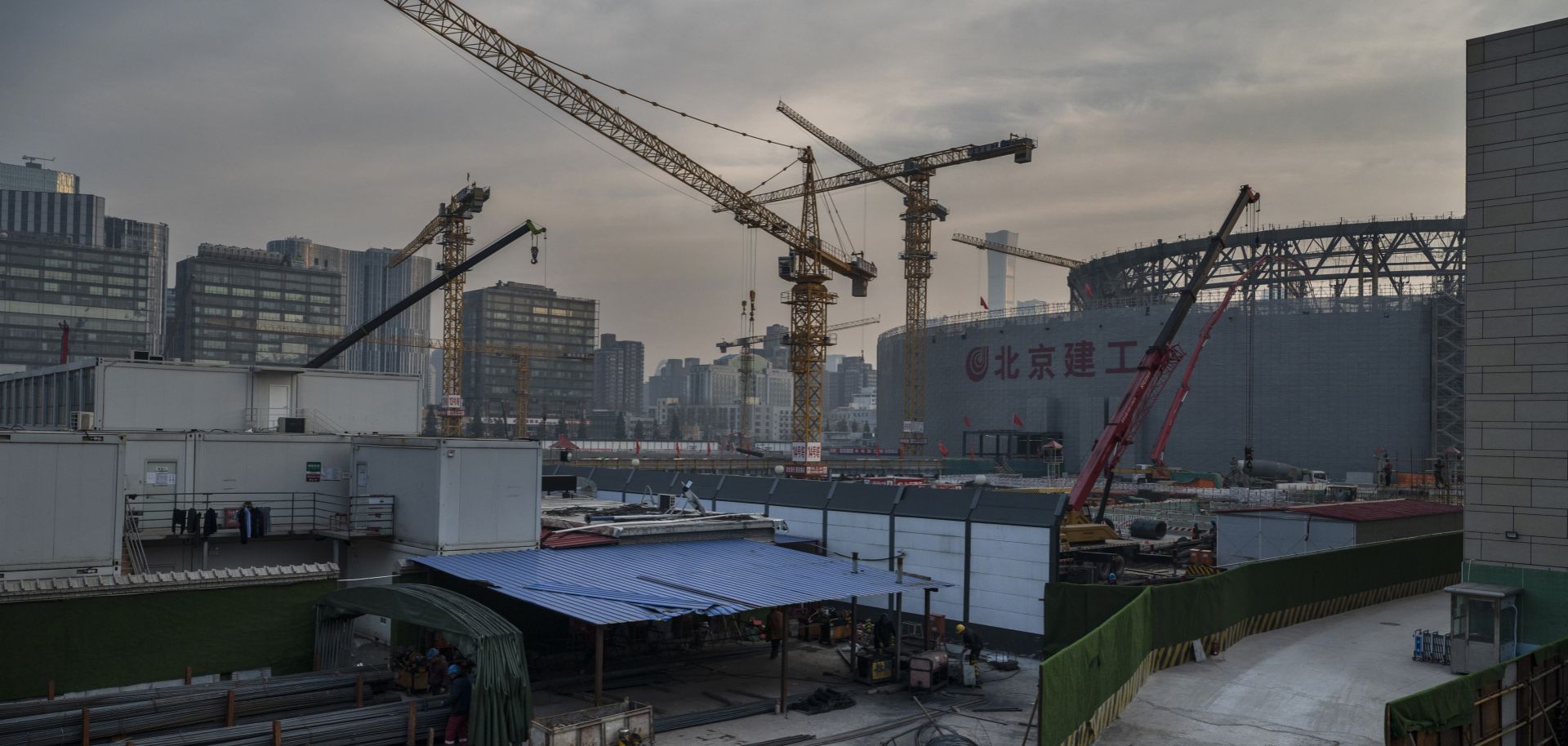
A photo shows the construction site of a new stadium project being built in Beijing, China, on Dec. 15, 2021.
China’s economy faces significant headwinds in 2022, including recurrent COVID-19 outbreaks, weak domestic demand, and constraints on the country’s state-led investment model. This will force Beijing to provide stimulus by potentially increasing government and state-owned enterprise (SOE) infrastructure investment, relaxing its financial deleveraging campaign and intervening in the foreign exchange market, which could result in a slowdown in economic reforms and a falloff in long-term potential output. As Chinese President Xi Jinping starts his third five-year term as General Secretary of the Chinese Communist Party (CCP) and head of state, political stability will depend on the government delivering continuous growth. Slower growth in the world’s second-largest economy would slow the aggregate global economy, as well as potentially challenge the social contract in which the CCP provides Chinese citizens economic prosperity in return for political legitimacy.
China probably met its growth target of an above 6% increase in GDP in 2021, but may have sacrificed long-term growth by relying on traditional drivers of export-oriented manufacturing and state-directed infrastructure investment. Growth slowed dramatically starting in the third quarter of 2020 after rebounding in the second quarter from a 6.8% decline (year-over-year) in the first quarter. Yet a 10% quarterly increase has since given way to what appears from base effects to be impressive annual growth, but in reality, are weak quarter- over-quarter outcomes, with third-quarter growth of only 0.2%. Against this backdrop, the Chinese government announced a $314-billion dual city plan to fund 160 projects in the Chengdu and Chongqing joint economic zone on Dec. 15 — suggesting that China is still relying on state-directed infrastructure investment, which has been a significant growth driver for decades. Net exports have been the strongest growth driver with high demand abroad, even in the face of supply constraints.
- China’s economy may have slowed further in the fourth quarter. Net exports were the bright spot in GDP expenditure categories as the value of exports rose by 21.4% (y-o-y) in November, marking the 14th consecutive month of double-digit growth, but also a slowdown from 27.1% growth in October. Fourth quarter and 2021 GDP data will be reported on Jan. 17. China does not report export volume data, but higher global prices suggest there may have been a slowdown.
- Monthly data for retail sales, fixed asset investment and industrial output in China also serve as rough short-term proxies for GDP. But of those figures, only industrial output increased by more in November compared with the previous month, with booming export valuations from high external demand and an easing of energy shortages accounting for the increase of 3.8% (y-o-y) in November from 3.5% in October. Retail sales were up by only 3.9% (y-o-y), compared with a 4.9% increase in October, depressed by the zero-tolerance COVID-19 policy and a rise in precautionary savings by households as housing price declines resulted in wealth effects and slower consumption. Fixed asset investment was up by 5.2% (y-o-y) in the first 11 months of 2021, down from 6.1% in the first 10 months as it fell in monthly terms for three consecutive months in September-November.
Economic hurdles moving forward include Beijing’s zero-tolerance for COVID-19 outbreaks, restrictions on lending to private development firms, provincial and local governments’ struggles to raise revenue, and a regulatory crackdown on several sectors of China’s economy. The Chinese government’s risk-averse approach to the country’s latest COVID-19 wave has caused localized lockdowns and depressed consumption. In addition, Beijing’s ongoing restrictions on lending to private development firms are retarding private investment and depressing provincial revenues. The property slowdown also makes it more difficult for provincial and local governments to raise revenue from land sales and to keep up infrastructure investment, which requires adding debt. Finally, a regulatory crackdown on technology, entertainment and private education firms has increased uncertainty, dampening private sector demand and investment.
- The recent COVID-19 outbreak in China’s Zhejiang province, a manufacturing and export center that accounts for 6% of the country’s total economic output, put more than half a million people in quarantine and shut down hundreds of factories.
- The deleveraging of real estate investment and construction is long overdue, but the sector still accounts for between 25-30% of China’s GDP. Real estate investment was down by 5.4% (y-o-y) in October. And according to the China Real Estate Information Corp., real estate sales in the country were reportedly down nearly 38% (y-o-y) in November, depressing property prices in a country in which more than two-thirds of household wealth is in real estate given the lack of a fully developed financial system.
- Land sales were down by 13.1% (y-o-y) in October and off by 11.2% (m-o-m) from September, which affected fixed asset investment.
While policy has caused much of the downturn, China’s leadership is now stressing economic expansion at the possible expense of higher inflation. Drives for “common prosperity” and “dual circulation” that stresses greater self-reliance can generate conflicting objectives for Chinese policymakers, with an officially-directed and primarily state-led socialist economy crowding out private sector innovation and development.
- During the annual Central Economic Work Conference that ended on Dec. 10, members of China’s Politburo Standing Committee prepared the economic agenda for the March session of the National People’s Congress, which will then set goals and targets for 2022. This year’s meeting emphasized “ensuring stability” of China’s economy in 2022 amid a triple threat of ‘'demand contraction, supply shocks and weakening expectations,” coupled with a tough international environment. CCP leaders also urged the continuation of regulated capital, pursuing common prosperity, keeping monetary policy flexible and appropriate, and keeping fiscal policies appropriate and targeted — implying a return to a reflexive GDP target that is self-fulfilling regardless of whether it increases production capacity.
In contrast with the aggressive stimulus policies of previous economic downturns, China will this time adopt a more cautious approach, opting for targeted easing of economic policy rather than opening the credit spigots to drive debt-fueled investment. The leadership’s tolerance for a slowing economy will become fully apparent during the National People’s Congress session in March, where Chinese lawmakers are expected to announce a 2022 growth target of 5-6%.
- China’s augmented public sector deficit, which includes provincial spending, is believed to have been down slightly in 2021, which suggests that Beijing is trying to be more discriminating in choosing projects and controlling provincial borrowing. Meanwhile, the government is extending deadlines for tax payments by small businesses, which account for 60% of GDP and 80% of employment. Beijing is also encouraging banks to provide cheaper credit at a time when business sentiment is at its lowest level since 2020-Q1, according to the China Association of Small and Medium Enterprises. Part of the fiscal burden is probably being passed on to SOEs, which were reported to have provided 13.5% of new jobs in October, up from 8% a year ago.
- Monetary policy has included easing restrictions on mortgage loans and the People’s Bank of China (PBOC) adding liquidity to the financial system through open market operations, along with two cuts in the required reserve ratio (RRR) for banks of 50 basis points each and a minor cut in the benchmark one-year loan prime rate (LPR) of 5 basis points. Further cuts in the RRR are likely, which would make it easier for banks to lend, and additional reductions in policy rates are also possible, including the five-year LPR, which is a reference rate for mortgage loans.
- The PBOC is setting the daily fix for the exchange rate at levels consistently below what markets anticipate based on movements in the underlying basket against which China’s currency is valued, among other moves to slow appreciation that is happening despite the economic slowdown, with capital inflows into China still strong from a current account surplus in the balance of payments and Chinese stocks appreciating. By doing this, the PBOC is trying to avoid an export slowdown with an appreciating currency affecting export competitiveness.
In the coming months, the main risks facing the Chinese economy include a financial system that is still exposed to the default of the real estate giant Evergrande Group, asset bubbles that could burst, and a high reliance on infrastructure building and exports for growth.
- The slow-motion default of Evergrande Group, with $300 billion in liabilities, resulted in late payments or issuance of IOUs to small companies. And with Evergrande’s complex web of financing and contingent liabilities still unknown, there is still the possibility of state intervention being required to bail out the financial system. Real estate accounts for 40% of collateral for all loan transactions and one-third of all domestic investment.
- Producer price inflation has yet to pass through fully to consumer prices (likely due to weak consumer demand), affecting profit margins that could manifest in slower hiring and investment. The consumer price index was at a 15-month high in November, increasing by 2.3% (y-o-y), while producer price inflation cooled slightly from a 26-year high of 13.5% (y-o-y) in October to 12.9% in November.
- High real estate and financial asset prices could be further inflated, which would defeat long-term goals of reducing debt and purging the economy of speculative behavior. Aggregate social financing, or credit to the economy, increased in November for the first time since February — a significant part of which may have been from increased fiscal support which was up by 14.4% (y-o-y), including from government bond financing, which accelerated sharply. However, about 90% of annual provincial bond quotas had been used by the end of November, up from only 63% in the first three quarters. Recent reports have also indicated that provinces could be allowed early access to 2022 quotas. The central government has been trying to control provincial borrowing, especially for off-budget spending, and a stepped-up issuance could defeat that goal.
- Reliance on building infrastructure as a source of quality growth, especially if debt-financed, may have reached a limit as the return on such investments has been diminishing. China has not improved its capital efficiency in more than a decade, with total factor productivity declining with the amount of investment required to produce the same amount of GDP (the incremental capital output ratio) increasing significantly. That alone reduces China’s potential output.
- Another source of risk is China’s renewed emphasis on state-owned enterprises over private sector firms, including in bank lending. This risks shifting growth from more dynamic companies to more rigid and state-directed enterprises in the traditional parts of the economy. A 2021 study released by the International Monetary Fund estimated that Chinese companies in which state investors had majority control were 30% less efficient than private counterparts, and that the return on assets of SOEs was one-third that of private firms.
- Reliance on exports as the primary source of growth is not sustainable as China faces greater economic competition from abroad. Shutdowns in Southeast Asian nations during the pandemic removed alternatives to Chinese exports. But with the increasing value of China’s currency against the U.S. dollar, the reopening of these nearby countries will make Chinese goods decreasingly competitive. In the absence of a change in economic fundamentals, including smaller trade and current account surpluses, China will continue to draw in foreign capital, which will further appreciate the exchange rate.
