
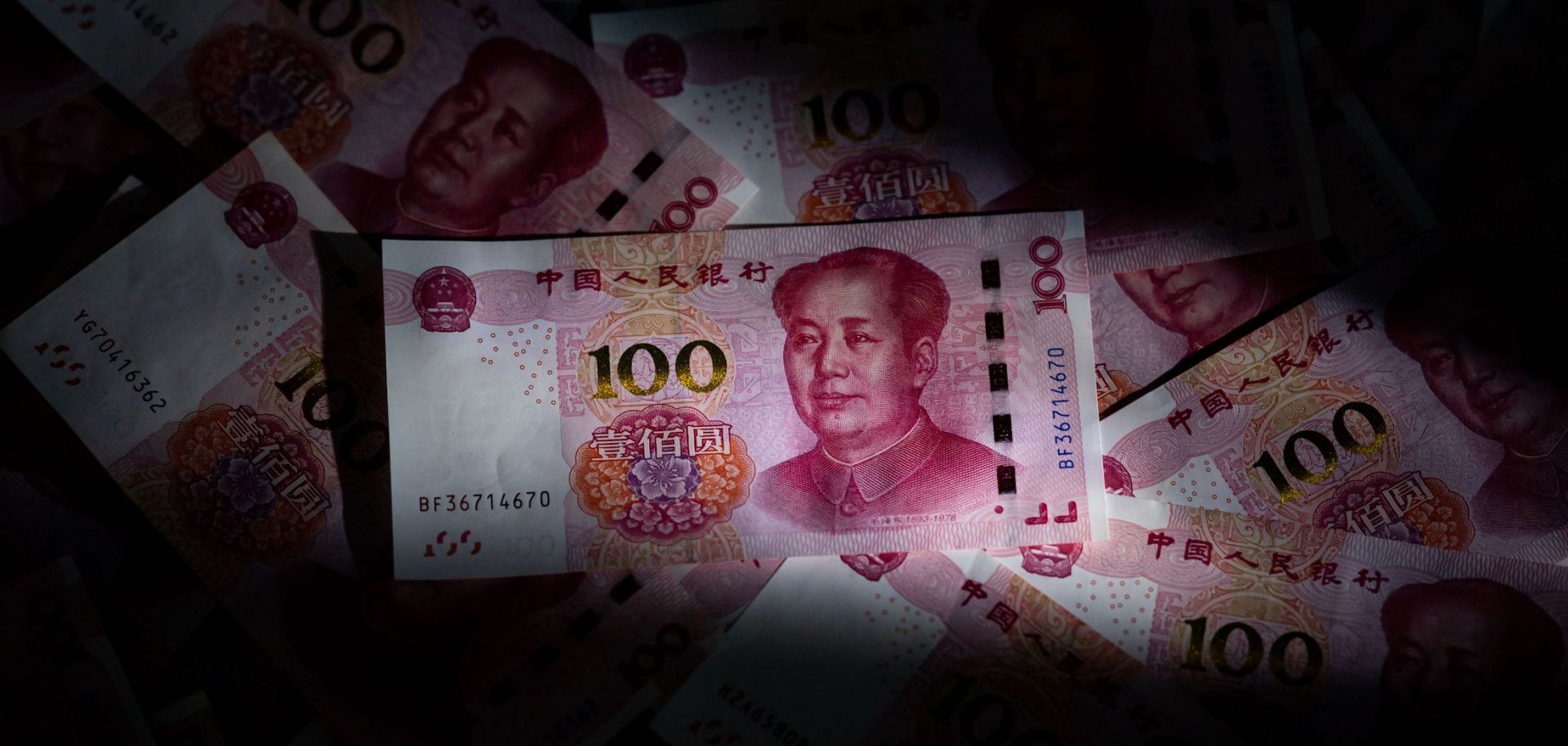
A photo illustration shows Chinese 100 yuan notes in Beijing on Jan. 14, 2020.
China’s economic growth slowed in April and continued the unbalanced pattern that it has shown for most of the past year. With a decelerating economy led by infrastructure and real estate investment, and with manufacturing held up by exports, consumption in China is lagging. As such, China’s recovery will not exert as strong a pull on global recovery as currently forecast and may, in fact, stall world growth. China’s National Statistics Service (NBS) reported broad numbers on a sectoral basis in April. The new data does not map directly into GDP, but provide a summary view of an economy that might have peaked in the first quarter of 2021 when growth increased by 18.3% year-over-year (y-o-y).
In the latest data:
- Retail sales in April were up by only 0.32% compared with the month prior. And although the annual y-o-y number increased by 17.7%, it was also down from 34.2% in March due mainly to base effects. The two-year average was 4.3%.
- Industrial production slowed to 9.9% (y-o-y) behind March’s annual growth of 14.1% and only 0.6% higher month-over-month (m-o-m). Continued strong exports, with the dollar value up by 32.2% (y-o-y) helped boost industrial output.
- Fixed asset investment also decelerated from the first quarter, increasing by 2.4% (m-o-m) with the aggregate increase for the first four months falling to 19.9% from 25.6% in January-March. Private investment picked up steam, growing faster than state-led investment, but had further to climb back and its two-year average growth was 2.9%.
- Urban unemployment dipped from 5.3% to 5.1%. But this is not indicative of overall employment levels.
These latest numbers indicate that China’s economic recovery continues to be uneven, unbalanced and ultimately unsustainable. Growth may have peaked in the first quarter of 2020 at 18.3% (y-o-y). There may be some seasonal factors at play in the April numbers. It's also difficult to draw conclusions from high-frequency data, although monthly changes and the two-year averages for 2020-2021 give greater clarity on economic strength given the sharp drop in China’s GDP in the first quarter of 2020 amid the onset of the COVID-19 pandemic. China can probably meet its objective of over 6% annual growth, though that pace is still slower than most current projections and will hold back the global economy. NBS admitted challenges to economic growth remain due to an uneven global recovery and a “not yet solid” recovery at home. Base effects from last year’s cratering of China’s economy, which remains reliant on exports and state-directed investment, will begin to fade with May data. New clusters of COVID-19 infections in at least two Chinese provinces could also affect consumer sentiment, even if there are no widespread outbreaks.
- Retail sales may have been held back by consumers deferring purchases until retailers offered discounts during China’s five-day Golden Week holiday at the beginning of May.
- Individual investment components are not reported on a monthly basis, only year-over-year, so it’s not possible to decompose trends.
- Infrastructure and real estate investment in April increased at a rate exceeding that of the overall category, with two-year averages of 2.4% and 8.4%, respectively. The uptick in real estate investment was probably driven by increased housing prices in China, which were at the highest level in five-and-a-half years in April. That, however, may moderate as China’s central bank tightens liquidity in an attempt to restart deleveraging.
- Manufacturing investment, including by state-owned enterprises (SOEs) was up by 23.8% on an annual basis, but its two-year average declined by 0.4%.
A growing Chinese economy, rebalanced with domestic consumption playing a greater role, would create tailwinds for the global economy, including primary commodity exports. On the other hand, factors that could further slow down the world’s second-largest economy and affect the global outlook include:
- Slowing exports, as chip shortages disrupt production lines in the high-tech sector. Consumers in industrial countries may also start spending less money on electronics and more on services that are not tradable goods across international borders.
- A resurgence of COVID-19 outbreaks in emerging markets and developing countries, which would reduce demand for Chinese exports further.
- Higher global commodity prices, which would push up input costs and deter demand.
- The deleveraging of real estate and local government debt levels, which would slow investment.
- More eco-friendly policies to achieve carbon emissions targets, which could affect coal mining and usage in China.
