
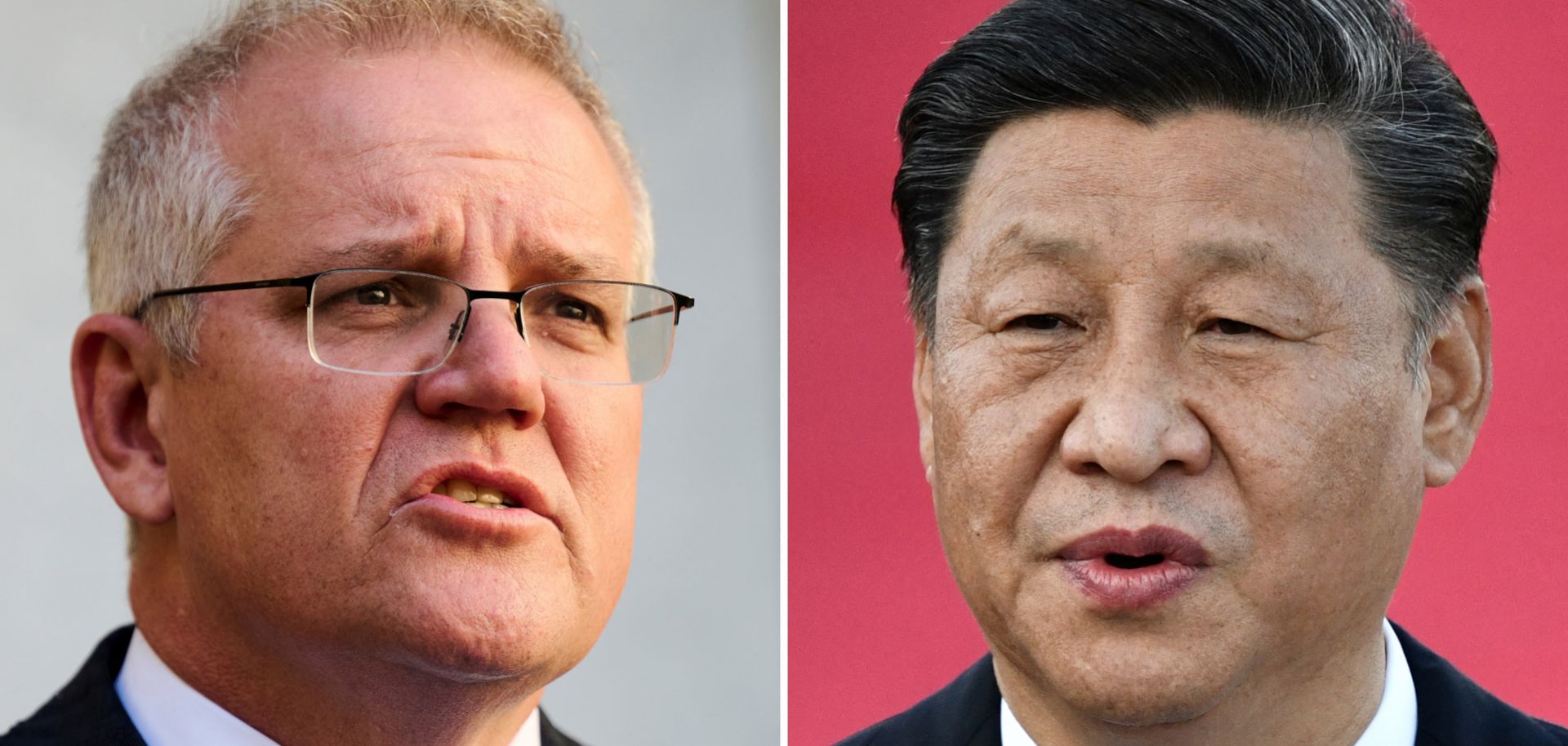
A combination of file photos shows Australian Prime Minister Scott Morrison (left) and Chinese President Xi Jinping (right).
Despite a recent diplomatic statement suggesting that China wants to improve ties with Australia, relations between the two Asia-Pacific powers will remain tense due to Beijing's threatening activities in the Pacific Islands and growing anti-China political sentiment in Australia. On Feb. 25, China's new ambassador to Australia Xiao Qian said Beijing was willing to go “halfway” to repair relations with Australia, and that his government considers its relationship with Australia to be very important. This is a stark contrast to Beijing's consistent stance that the onus was on Canberra to repair bilateral relations, which have soured in recent years.
- Australia banned Chinese telecommunications giant Huawei from its 5G network over security concerns in 2018, prompting an outcry from China with accusations of discrimination. Despite numerous protests from Beijing, the ban still stands.
- In early 2020, Australia was one of the first nations to call for an investigation into the origins of COVID-19, prompting Beijing to issue trade sanctions on key Australian exports like barely, wine, red meat, cotton and coal.
- On Feb. 10, the Australian Security Intelligence Organization foiled the plot of a wealthy individual with ties to Chinese intelligence to fund unsuspecting Australian political candidates in an upcoming election in New South Wales. Chinese authorities have denied any involvement in or knowledge of the plot.
Australia's suspicion over recent Chinese activities in the region will hamper Beijing's attempts to improve bilateral ties. China will face an uphill battle in repairing ties with Australia, which has aligned closely with the Western coalition aimed at constraining Beijing's expanding territorial claims in the Asia-Pacific region. A reduction in China's sanctions on goods from Australia would be the logical starting point, though the two countries' opposing security concerns will still limit the scope of any reconciliation. Beijing's efforts to project its power in the Pacific Islands, including by constructing a military base on Papua New Guinea, is leading Australia to reassess the security threat China poses to Australian territory. Additionally, Beijing is seeking to repair relations with regional players to find ways to disrupt the growing coalition of nations trying to constrain China's rise.
- Beijing's continued naval activities near Australian borders, including a Chinese naval vessel's recent laser-targeting of an Australian aircraft, have confirmed Canberra's choice to accelerate its military modernization and increase its tactical capabilities. In September, Australia brokered a military deal with the United States and the United Kingdom to purchase nuclear-powered submarines. The deal has substantially upgraded Australia's military capabilities and creates a new tactical threat to the Chinese navy. It also indicates the current Morrison administration will continue viewing China with suspicion.
These challenges mean that Australia and China will continue to be at odds over security issues. Australian public sentiment and political atmosphere remain anti-Beijing, which will make it difficult for politicians to respond to the recent Chinese overture to repair bilateral relations — especially ahead of Australia's upcoming federal election in May. Additionally, Australia's security concerns will come in direct confrontation with Chinese regional territorial ambitions. The current Morrison administration has little incentive to improve diplomatic ties with China, given the limited impact Beijing's trade sanctions have so far had on the overall Australian economy, as well as the aforementioned security concerns surrounding China's nearby activities in the Pacific Islands.
- Australia's May election is expected to be a tight race between incumbent Prime Minister Scott Morrison's Liberal-National Coalition and the opposition Labor Party. Morrison, who has taken a more hard-line stance on Beijing, has called the Labor Party “soft on China” in reference to the party's campaign platform, which advocates for more cooperation with Beijing (including by repairing trade relations). If the Labor Party wins the upcoming election, Australia may be more willing to negotiate with China and restart trade discussions to potentially lift current sanctions.
- Despite Beijing's recent moves to limit and cut-off Australian imports, China remains one of Australia's largest trade partners. Industries affected by Beijing's trade sanctions lost roughly $4 billion in exports to China since 2020. But increased exports of iron ore and other Australian products to China have helped to mitigate these losses, with the value of Australian exports to China growing by 24% in 2021 compared with the previous year.
- Australia has joined the global community in sanctioning Russia over the war in Ukraine, whereas China has not. Morrison has called out Beijing for its hesitancy in condemning Moscow, further suggesting Australian leaders' diminishing trust in their Chinese counterparts. On Feb. 25, Morrison also criticized China for "throwing Russia a lifeline" in reference to China removing import restrictions on Russian wheat amid the sanctions Moscow is facing following its invasion of Ukraine.
