
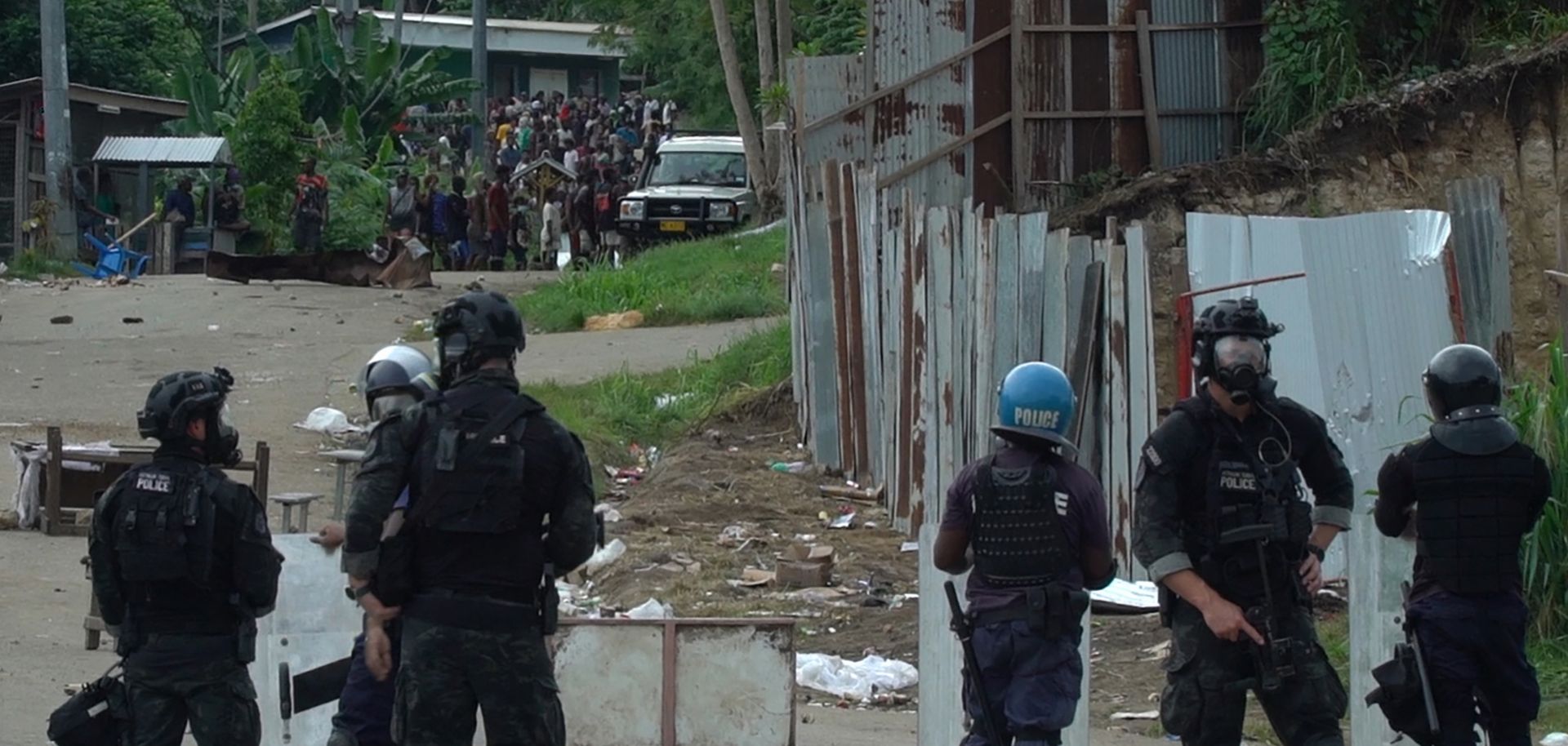
A frame grab from video footage shows Australian Federal Police officers and local police monitoring a crowd in Honiara, the capital of the Solomon Islands, on Nov. 26, 2021.
Australia’s weekend intervention in the Solomon Islands highlights the importance of the Pacific Islands to Australia’s national security, as well as the complex challenges Canberra will face in asserting itself in a region where local issues are so often intertwined with great power competition. Nearly 100 Australian Federal Police and Defense Force personnel arrived in the capital of the Solomon Islands on Nov. 26 at the request of the government after peaceful protests turned violent and overwhelmed local police forces. Protesters — predominantly from the more populous but less developed Malaita Island — called for Prime Minister Manasseh Sogavare’s resignation and attempted to storm his compound. Demonstrators also set fire to several government and police buildings, as well as shops in the city’s Chinatown.
- Malaitans have longstanding grievances against neighboring Guadalcanal, where the capital is located; Malaitan rebels carried out a brief coup in 2000. Tensions were compounded when Sogavare shifted diplomatic recognition from Taiwan to mainland China in 2019, undermining several economic developments and aid projects that benefitted Malaita.
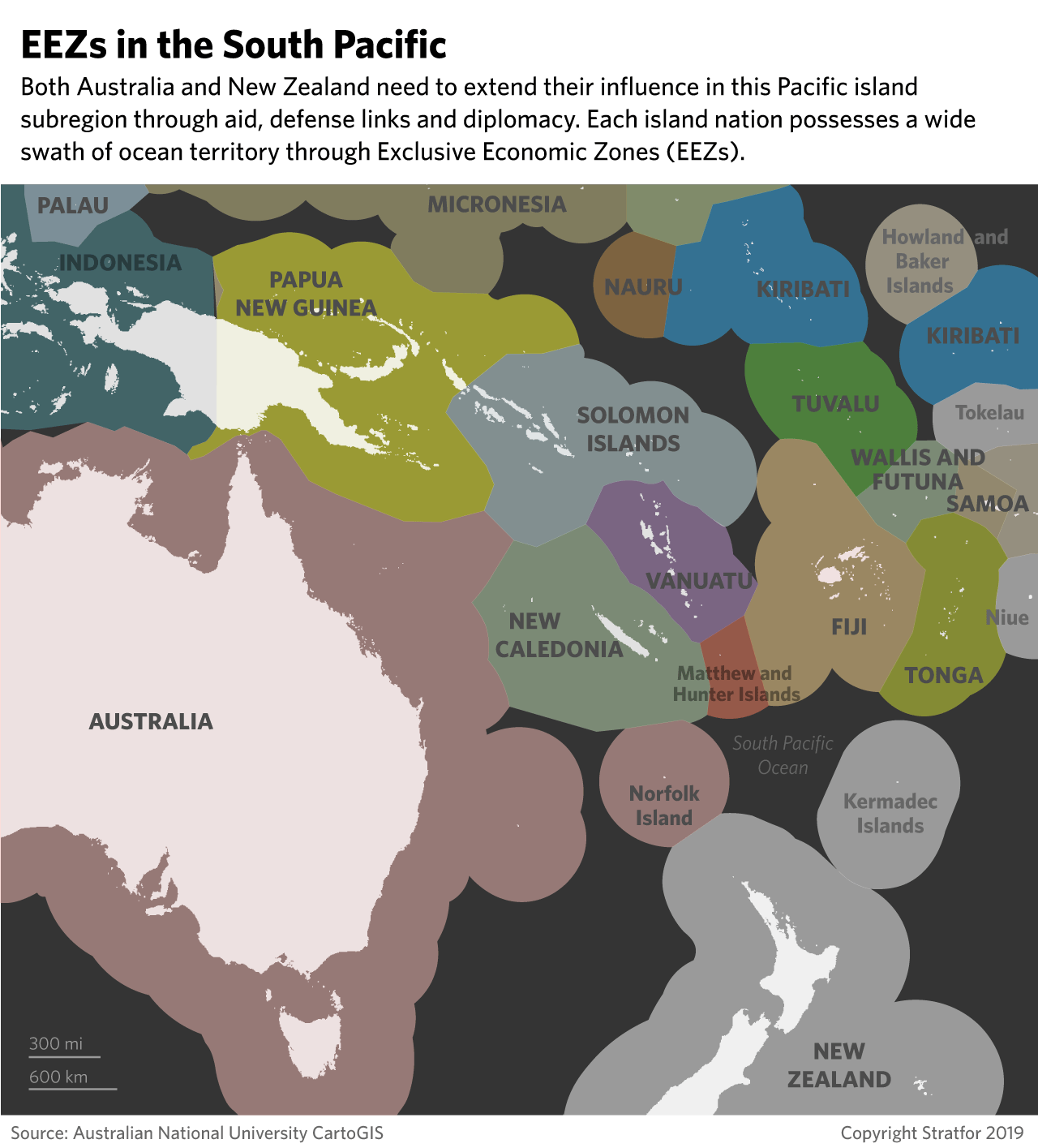
For Australia, the intervention presents a short-term contradiction of two strategic priorities. On the one hand, Australian security forces rapidly restored relative calm to the Solomons’ capital — something Canberra sees as important to avoid refugee flows and general regional uncertainty. On the other hand, the intervention drew critical remarks from Malaitan leaders, who accused Canberra of siding with Sogavare, who is responsible for the islands’ recent diplomatic shift to China. When the Solomon Islands broke ties with Taiwan in 2019, it was the last of the Melanesian states to do so. Stretching from Papua New Guinea through the Solomons to Vanuatu and Fiji, Melanesia is one of three subregions of the Pacific Islands and has long been seen as part of Australia’s defensive shield. But over the past 20 years, Beijing has been steadily encroaching on the subregion, strengthening economic and political ties and potentially challenging Australia’s interests and relations with its Melanesian neighbors.
In general, the Pacific Islands are not significant economic partners for Australia, the United States or China. The islands have, however, once again emerged as strategic locations in the broader regional and global competition. The island nations have large economic exclusive zones (EEZs), often with fishing and potential subsea mineral resources. The Pacific Islands also play an important role in international fora by bolstering their allies’ and partners’ votes. But what is perhaps more significant is the islands’ strategic location. Much of Australia’s trade from its more populous east coast also passes through Melanesian states. The Pacific Islands also sit along key routes between Australia and its top strategic partners, including the United States and Japan. The balance of influence in Pacific Island nations can alter the ease and speed with which the United States and its regional partners can coordinate during crises and collaborate on regional security issues. While no longer the likely staging grounds for military action between competing Pacific powers as they were in World War II, the islands remain critical components of any regional security framework, especially with the hardening of U.S.-Chinese competition.
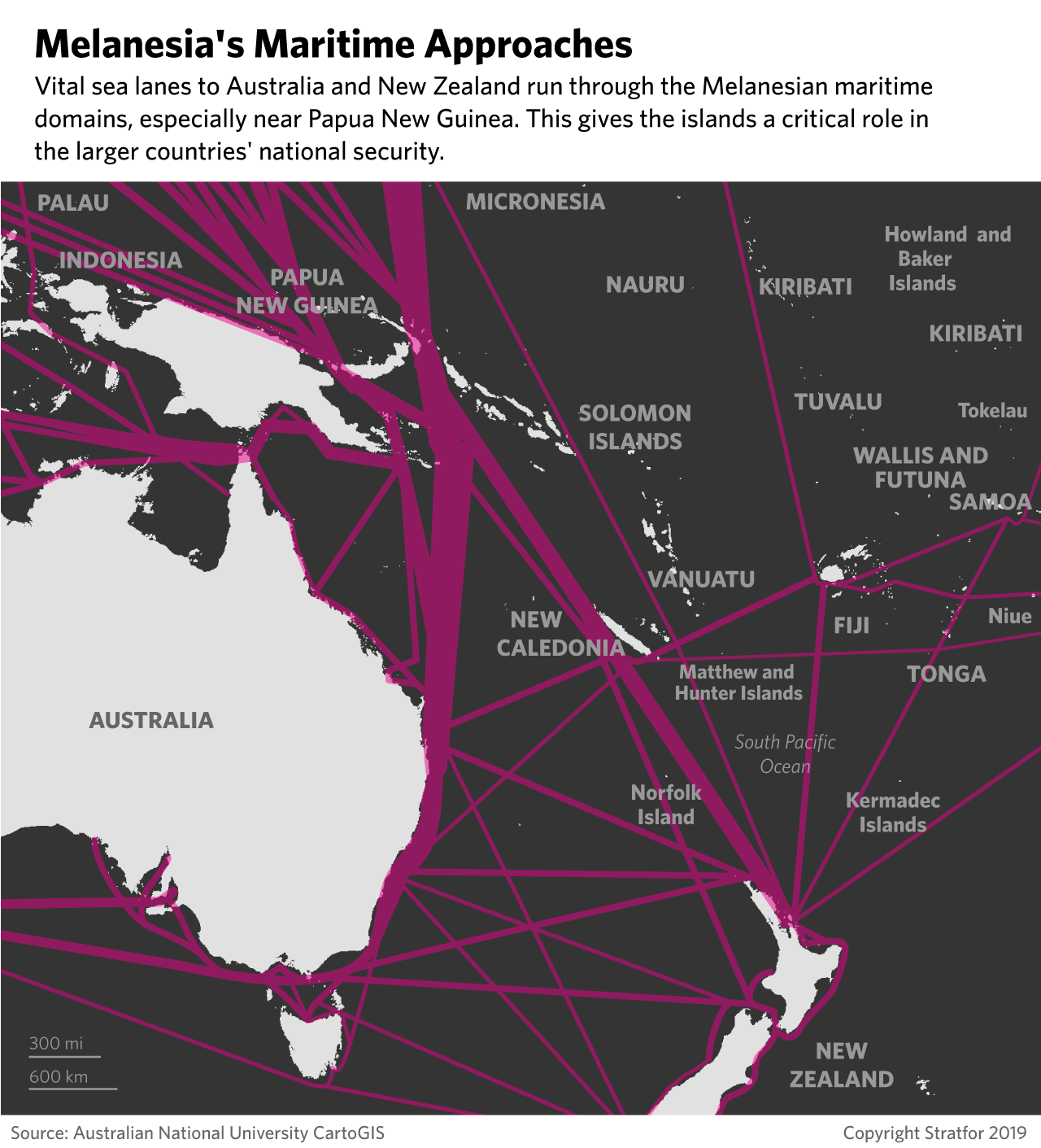
Australia is reevaluating its security posture in the Indo-Pacific, with signs it plans to take a more active role in the region. Canberra has already focused on its Pacific Island neighbors, offering support amid the COVID-19 pandemic while using economic incentives and political pressure to counter Chinese construction and management of new subsea telecommunication. In addition, Canberra has been working with the United States and regional partners to offer development assistance and investments, though not to the scale that China has committed in the past. But the recent reinvigoration of the strategic “Quad” dialogue between the United States, India, Japan and Australia, along with the establishment of AUKUS — an even closer trilateral security arrangement between the United States, Australia and the United Kingdom — suggest Australia is seeking to take a more active role in securing its backyard. This will likely see Canberra try to reinforce ties with the Pacific Island nations and push Australian political, economic and military influence well beyond its protective “shield” of near neighbors. The recent intervention in the Solomon Islands, however, showcases the complexity Australia faces in rebuilding its regional influence, with Canberra simultaneously seen as supporting the pro-China government of the Solomon Islands while quietly working with the United States and Taiwan to provide economic assistance (and by default political support) to Malaita.
