
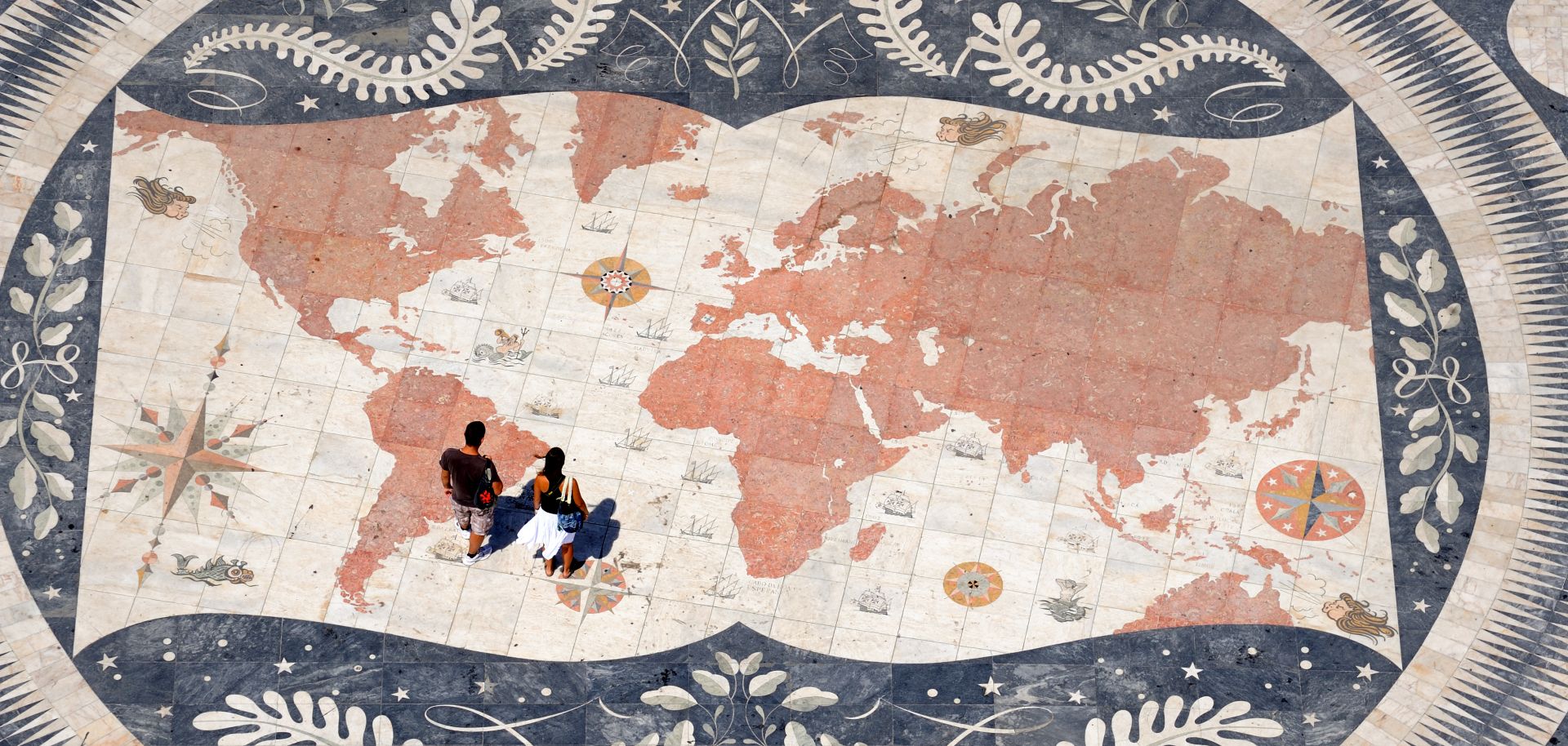
Pedestrians stand on top of a world map at a monument commemorating the Age of Exploration in Lisbon, Portugal.
“Each century has had its own geographical perspective.” Sir Halford J. Mackinder, Democratic Ideals and Reality: A Study in the Politics of Reconstruction (1919) The geographical perspective of the 21st century is just now being formed. And at its heart is a rivalry between China and the United States to succeed Europe’s 500-year centrality in the international system, which will be framed by a shift in global economic activity and trade, new energy resource competition, a weakening Europe and Russia, and a technological battle to control information. The new map of the next century will extend to the ocean floor for resources and subsea cables, to space where low-Earth orbit satellites drive communications, and into the ill-defined domain of cyberspace. Who Sits at the Pivot to the New Geography?
