
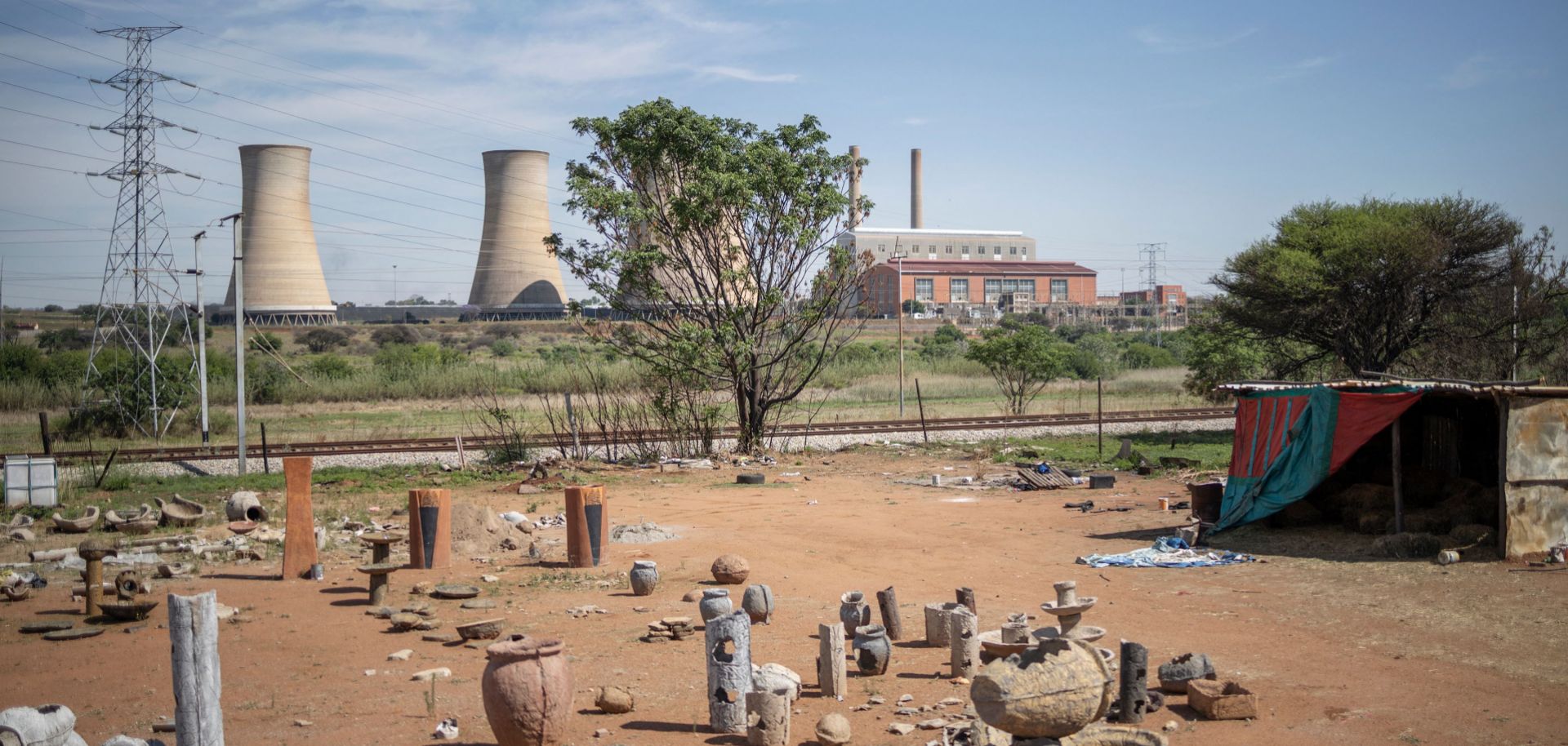
The towers of a coal-fired power state are seen on the outskirts of Pretoria, South Africa, on Oct. 13, 2021.
South Africa’s transition away from coal will be slower than what it outlined at the U.N. climate summit due to a lack of funding and domestic political support. Ahead of the ongoing U.N. conference (COP26), South Africa announced it now plans to reduce the country’s yearly emissions to 350-420 million tonnes of carbon dioxide equivalent (Mt CO2e) by 2030, down from its current 480 Mt CO2e per year. Hitting this new target on that timeline, however, will be no small feat: South Africa is the largest greenhouse gas emitter in Africa and the 12th largest in the world. It’s also home to the world’s fourth most carbon-intensive economy — largely due to its reliance on coal, which generates more than three-quarters of the country’s electricity grid.
- As part of the new push to cut emissions, President Cyril Ramaphosa said the country aims to cut coal’s share of electricity production to 60% over the next decade, while increasing wind and solar power’s share to 25%.
The ongoing U.N. conference and overall elevated international attention to the climate crisis have helped garner more foreign investment interest in South Africa’s energy transition. But current investor commitments will not alone be enough to fund the country’s shift from coal-powered energy. On Nov. 4, during the fifth day of COP26 talks, the European Union, Germany, France, the United Kingdom and the United States pledged approximately $8.5 billion over 3-5 years in grants, concessional loans, investments and risk-sharing instruments to help finance South Africa’s transition from coal to renewable energy sources. On Oct. 31, South Africa’s environmental minister Barbara Creecy also told reporters at the COP26 that she was hopeful talks with the global Climate Investment Funds (CIF) could unlock an additional $500 million. Such pledges, however, will only make a small dent in the estimated $560-$750 billion the country is expected to need over the next 20 years to transition from coal, according to estimates released by South Africa’s energy ministry and the International Renewable Energy Agency.
- Government energy officials and executives from South Africa’s indebted state-owned power utility, Eskom, have also been courting foreign donors and investors, often emphasizing the perceived responsibility held by high emitting wealthy countries to contribute to the long-term transitions of poorer countries.
In addition to massive funding gaps, economic mismanagement and deteriorating infrastructure will further impede South Africa’s ability to follow through on its ambitious new climate commitments. One of the major costs of transitioning South Africa to renewable energy sources is updating the country’s electricity grid, which has suffered from Eskom’s years-long debt crisis. More broadly, economic mismanagement and corruption at all levels of government reduce the odds of tangible changes to the energy and power sectors and will likely delay — or blunt — South Africa’s adoption of emissions reduction policies.
- Eskom has accumulated massive debt in recent years, leading to a lack of assets necessary to improve South Africa’s electric grids, which are overloaded, underperforming and built on aging infrastructure.
- The state-run utility company’s ongoing financial woes have resulted in skyrocketing electricity prices in South Africa (which have quadrupled since 2006), disruptive rolling blackouts and major shortages in generation capacity. Delays on major projects and municipal payment defaults for electricity supplied have become commonplace as well.
Fears of provoking unrest and political backlash, meanwhile — along with pressure from South Africa’s powerful labor unions — will compel Ramaphosa to prioritize jobs and near-term economic stability over sweeping energy policy changes. Ramaphosa’s aggressive new plan to cut carbon emissions threatens the 90,000 jobs South Africa’s coal sector provided in 2020, placing it at odds with domestic calls for economic relief. Living conditions in South Africa have steadily worsened in recent years, with frequent power outages, poor service delivery, inadequate roads and sanitation, and high food, water and fuel prices. This has made South Africa ripe for political unrest, as evidenced by Ramaphosa’s move to authorize the deployment of 10,000 troops to secure polling locations nationwide ahead of the Nov. 1 municipal elections. Support for his ruling African National Congress (ANC) party has also continued to erode, as evidenced by the ANC’s poor performance in those elections. Within this context, any job loss or further hardship created by Ramaphosa’s energy policies would risk increasing social and economic instability and, in turn, further harming his party’s political prospects. Implementing the new climate commitments will also face resistance from South Africa’s powerful unions like the National Union of Mineworkers of South Africa (Numsa) and the Congress of South African Trade Unions (Cosatu), which have expressed concerns that the energy transition would trigger a larger labor crisis and exacerbate the country’s economic struggles. Near-term economic growth is thus likely to remain the ANC’s top concern over international climate commitments and long-term environmental consequences. Combined with the funding and economic challenges outlined above, this means South Africa is highly unlikely to hit its new carbon emissions targets by 2030.
- As of Nov. 3, the ANC was projected to win 46% of the vote in Nov. 1 municipal elections, with more than half of the ballots counted. The party hasn’t earned less than 50% of the vote in a national election since 1994.
- The city of Vereeniging was an ANC stronghold for years. But support for the party in the city has fallen sharply amid blackouts, pollution and sanitation issues — dropping from 76% in 2006 to 56% in 2016.
- 1000 jobs and 500 contractor posts were lost when the multinational mining company Glencore closed the Mpumalanga coal mine in 2015, triggering unrest and protests.
