
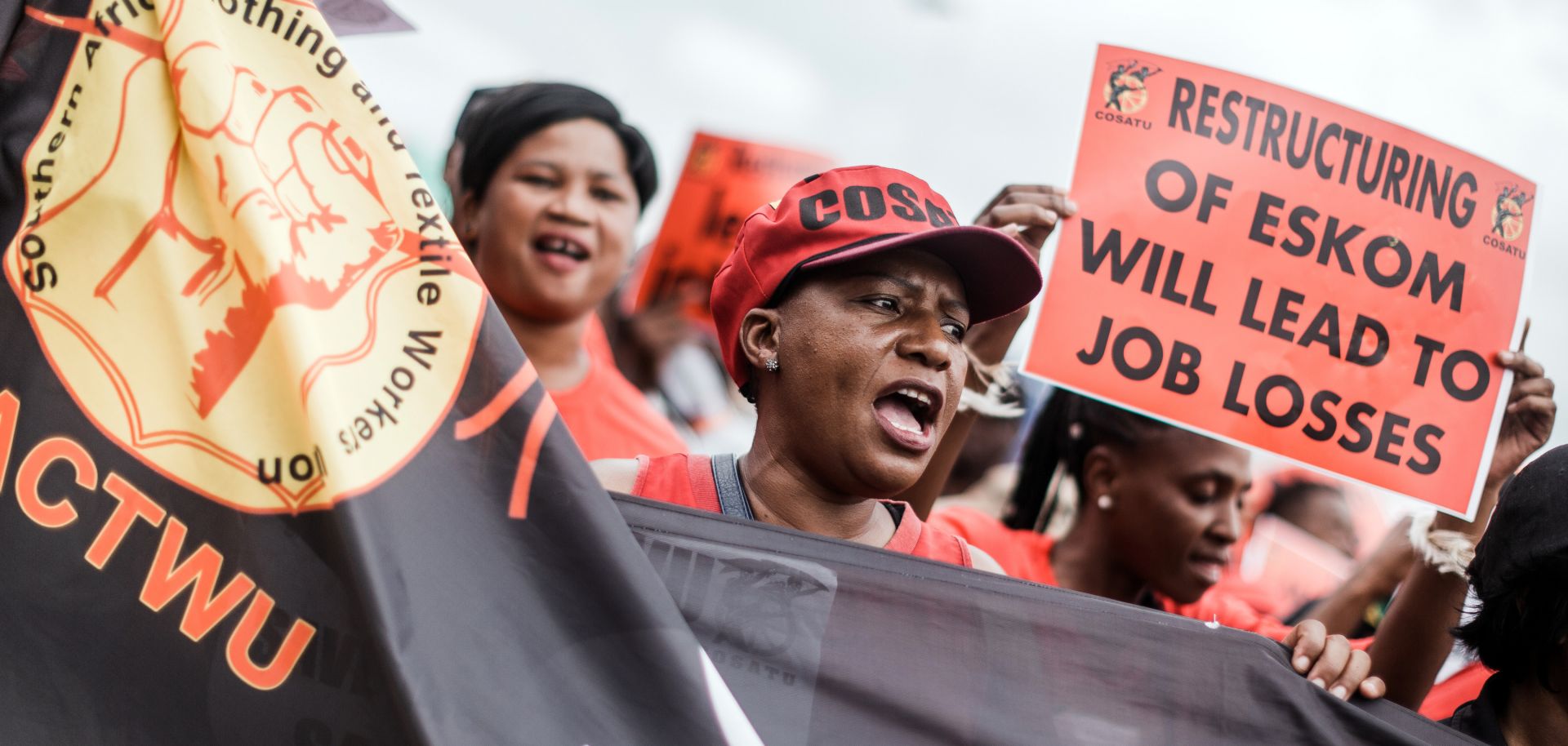
A nationwide strike by members of the Congress of South African Trade Unions on Feb. 13, 2019, came in response to a government plan to restructure the state-owned electric utility.
Editor's Note: This assessment is part of a series of analyses supporting Stratfor's upcoming 2019 Second-Quarter Forecast. These assessments are designed to provide more context and in-depth analysis on key developments over the next quarter.
More than a year after assuming South Africa's presidency, Cyril Ramaphosa is still trying to balance the twin pressures of populism and business as his government strives to address some of the long-term economic problems that have plagued the country for years. However, with its economy still in the doldrums and general elections approaching on May 8, the president faces a pressing dilemma: How to reform key sectors of the economy to spur a wider economic improvement while also pursuing policy choices that will appease the traditional bases of support for his ruling African National Congress party, such as labor unions.
Stratfor has long tracked South Africa's drift into corruption and mismanagement, especially during the nearly decade-long tenure of President Jacob Zuma. Yet even a year after Ramaphosa and his ANC allies took over from Zuma — with a pledge to clean up the mess — evidence of continuing trouble in the government-controlled sector is ongoing. Most troubling, in early February, the country's public power utility, Eskom, instituted rolling blackouts, the first since December 2018, which lasted for nearly a week. The measures came as demand climbed in the midst of the South African summer, putting a strain on the country's electrical grid.
Company leaders said the load-shedding maneuver, which is a way to match supply with demand to help head off a systemwide failure, was forced upon them by the breakdown of several plants. Regardless of the reasons the rolling blackouts were instituted, however, their effects will undoubtedly put a drag on the overall economy, considering the number of businesses and households deprived of electricity. The incidents, which raise questions about the reliability of South Africa's electrical supply, also underscore longer-term risks to foreign investment.
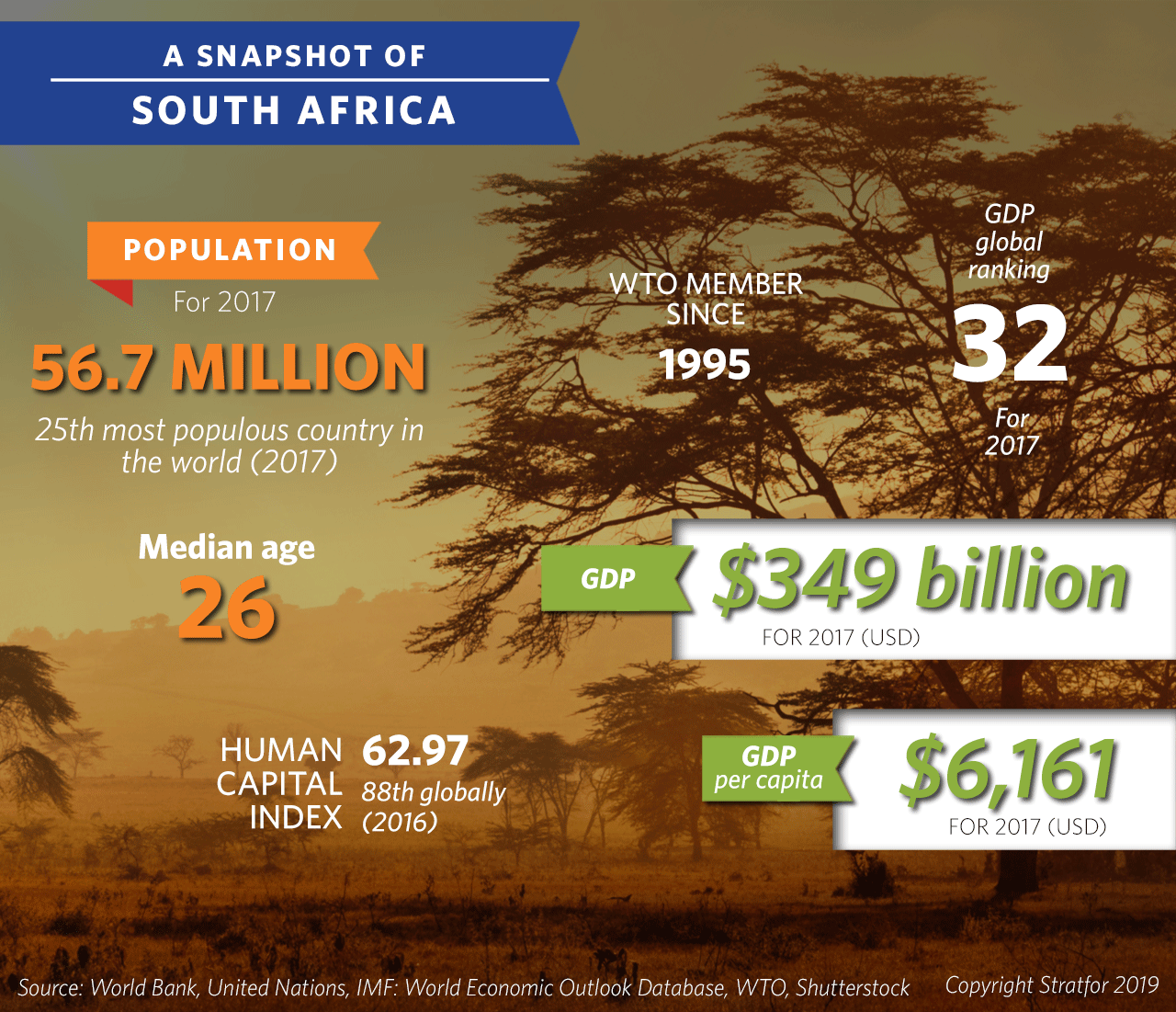
The Ramaphosa administration has stated its intent to split the electric monopoly into three distinct companies (albeit under one large holding company) that would be separately responsible for power generation, distribution and transmission. Ramaphosa also said the government would "step in to support Eskom's balance sheet." The utility is saddled with more than $31 billion in debt (a figure representing some 15 percent of South Africa's total sovereign debt).
However, while the reform plan is intended to improve the woefully inefficient utility company, there is cause for concern. First, credit rating agency Moody's said in a recent report that while the Eskom reform plan might introduce more transparency surrounding the company, in its estimation it fails to more fundamentally address its debt problem and the risks it poses to the broader economy. By the end of March, Moody's, which is re-examining the status of South Africa's debt, could match the evaluations of other rating agencies such as S&P and Fitch, which already categorize South African bonds as junk. If this happens, South Africa would be delisted from the Citi World Government Bond Index, forcing asset managers to offload hundreds of millions of dollars' worth of its bonds. The timing of a credit downgrade, should it come to pass, would not be worse for the Ramaphosa government. As part of his strategy for reinvigorating the South African economy with more than $100 billion in foreign investment, the president has been promoting the country as an opportunity for business.
Besides the debt risks, powerful unions like the Congress of South African Trade Unions (COSATU) are mobilizing against the president's plans. Indeed, COSATU, which is a member of the ruling African National Congress' tripartite alliance, previously warned it would not tolerate job losses or future privatization at Eskom. In fact, on Feb. 13, the union called on its more than 1.6 million members to join a nationwide strike to send a message to Ramaphosa's government amid the reform talk. More protests are in the offing.
This puts Ramaphosa firmly between a rock and a hard place. He must find a way to reform the woefully broken and mismanaged power utility to prevent it from posing more serious dangers to the wider economy. But his options for doing so without stoking the ire of powerful unions that help underpin his party's power are limited. While it's unclear whether this can be done in the current political climate — if anything, the labor blowback makes it appear likely the issue will not be fully addressed in the near term — one thing is clear: a long-term failure to turn around state-owned enterprises like the power utility giant will restrict any growth the South African economy might achieve, thus limiting the influence it will be able to wield beyond its borders in the long run.
