
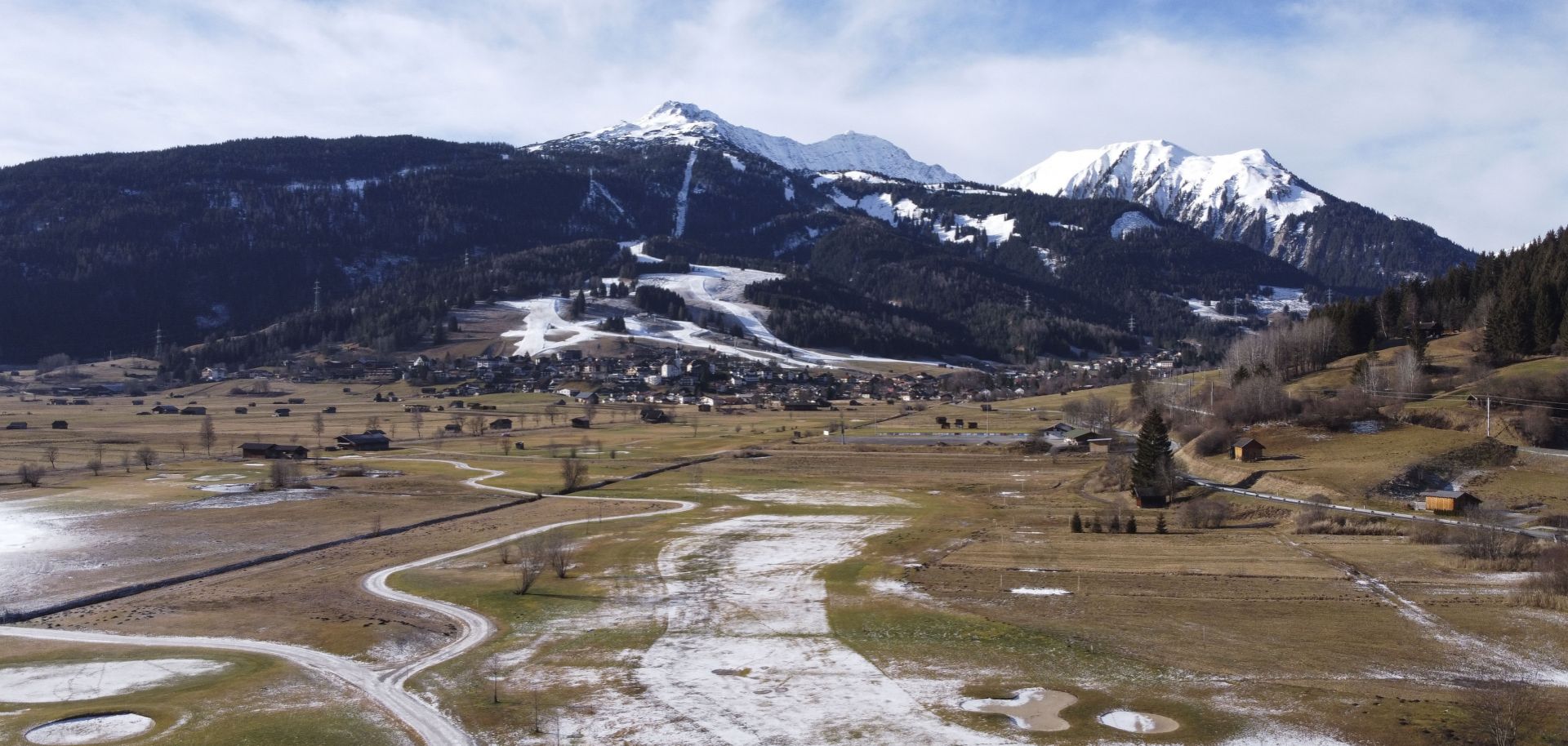
An aerial view of a ski resort near Ehrwald, Austria, is seen on Jan. 16, 2023. Warm weather in much of the European Alps has led to a lack of snow across the region.
A mild winter will not only help Europe withstand the rest of the season with low levels of Russian natural gas, but will also reduce the risk of an energy crisis next winter by leaving the Continent with larger-than-usual gas stockpiles. According to data from Gas Infrastructure Europe, European gas storage was 81.49% full as of Jan. 15 — the highest recorded level for this time of year since 2011. The ten-year median for Jan. 15 is historically about 63% full. Germany's storage levels actually increased from 87.2% to 91.4% between Dec. 20 and Jan. 8. These high storage levels, combined with relatively low demand, saw Europe's main gas benchmark — the Dutch Title Transfer Facility (TTF) — dip under 55 euros per megawatt hour in mid-January for the first time since late 2021 (and trade below that level on Jan. 17).
Several factors have contributed to Europe's gas storage levels declining at a slower-than-normal pace this winter, including:
- An unseasonably warm start to winter: The weather across Europe has been unusually warm since November, which is the start of the Continent's winter heating season. In the first ten days of January, a number of European countries saw record-high temperatures. On Jan. 1, temperatures in the Polish capital of Warsaw reached 19 degrees Celsius (66.2 degrees Fahrenheit), far surpassing the city's previous record for the hottest day in January by 5 degrees Celsius (9 degrees Fahrenheit). Since Oct. 1, Germany's average temperature has been nearly 3 degrees Fahrenheit above normal levels. Northwestern Europe is expected to experience cooler-than-normal temperatures by mid-January, but due to milder temperatures elsewhere, weather forecaster Maxar Technologies is still projecting next week's total heating-degree days to be below the ten-year average across the Continent.
- Gas-saving measures: The European Union agreed to target a voluntary 15% decline in gas demand between August 2022 and March 2023. This has been backed up by individual EU governments lowering the thermostats in their buildings, which has prompted many companies in Europe to follow suit. Gas prices across the Continent also remain relatively high (even if partially subsidized by various EU governments and lower than the record levels seen last summer), which has helped further dampen demand. The European economics think tank Bruegel estimated that demand for natural gas among the 27 EU member states was 13% lower in December compared with the 2019-21 average.
- Lower industrial demand: High prices have led to an increase in feedstock costs for industrial consumers of natural gas. This led to a number of gas-intensive industries, such as zinc smelting, to cut back or suspend their output, especially after being hammered with record-high prices over the summer. In an effort to cut costs, power generators and other industrial consumers of natural gas have also shifted some consumption to other fuels where possible, such as coal and crude oil. As a result, European industrial natural gas demand is also down more than 15% from normal levels.
- Increased LNG and piped natural gas capacity: In recent months and weeks, several new pieces of infrastructure to boost the Continent's access to natural gas have also come online. In October, the BalticPipe pipeline — which connects Poland to Europe's biggest natural gas producer, Norway — came online. On Dec. 17, Germany's first import facility for liquified natural gas (LNG) opened up after the arrival of a floating storage regasification unit (FSRU) that the German government and companies contracted earlier in 2022. On Jan. 13, energy giant TotalEnergies announced the start-up of another FSRU in Germany.
The slow start to the winter will alleviate concerns about Europe entering a gas crisis-induced economic recession over the next three months, which will undermine what little leverage Russia has over the Continent with low amounts of Russian gas still being piped to European countries. The European economy is still at risk of slowing due to rising interest rates designed to choke off inflation. But warm weather and lower-than-normal gas demand have reduced the likelihood of severe shortages and/or sustained sky-high energy prices triggering a gas crunch in Europe that exacerbates inflation and forces companies to either declare bankruptcy or conduct massive layoffs. Lower gas prices, as well as relatively low oil prices compared to mid-2022, will also reduce political pressure on European governments and the potential for demonstrations like those seen in Vienna last month, where participants called on the Austrian government to weaken sanctions on Russia in response to high energy prices. This reduced risk of political backlash makes it even less likely that European governments will consider offering Russia concessions in the coming months. It will also give governments more confidence to authorize weapons transfers to Ukraine without concerns about natural gas and energy price consequences. Over the course of 2023, some European leaders may slowly start pressuring Ukraine to negotiate a peace deal with Russia that ends the war, but the lack of a major gas crisis won't force European leaders to do so prematurely.
- A Russian kinetic attack or a cyberattack on Europe's gas infrastructure, while unlikely, could result in a crisis. As high gas stockpiles eat away at its leverage over Europe, the Kremlin could opt for more drastic measures to directly sabotage the Continent's infrastructure this winter.
A mild winter will make it easier for Europe to withstand the next winter without an energy crisis. But natural gas prices will remain above pre-2021 levels, which will continue to undermine the Continent's industrial and manufacturing base. Europe will likely enter this spring with near or at record levels of gas storage, barring a series of major winter storms that quickly exhaust its stockpiles by increasing demand and/or disrupting supply. Typically, the Continent's gas storage levels fall below 40% full during the winter; in 2022, they dropped to 27.5%. But during the winter of 2020 (which is so far the most comparable to this winter in terms of gas storage levels), total European gas storage never fell below 70% full. If inventories remain relatively high, Europe will thus have an easier time filling storage back to above 95% in preparation for the 2023-24 winter compared with last year, even with limited amounts of Russian natural gas (which was still flowing through the Nord Stream I pipeline for much of the first half of 2022 uninterrupted). This will, in turn, mitigate the risk of greater global gas shortages this year by reducing the number of LNG cargoes Europe will have to import to replenish its stockpiles. China's LNG needs are slated to rebound substantially in mid-2023 amid the recent easing of the country's strict ''zero-COVID'' policy, which had depressed demand in 2022 due to occasional lockdowns. High Chinese demand and high European demand to refill storage could overwhelm global LNG supplies, which are relatively inelastic since no major LNG export facilities are expected to come online this year. But Europe's high gas reserves will reduce the chances of this happening by lessening its need for imports. However, despite the lower risk of European and Chinese demand-induced LNG price spikes later this year, gas and electricity prices in Europe (and around the world) will likely remain at abnormally high levels.
- Higher gas and electricity prices in Europe will undermine its industrial and manufacturing competitiveness vis-a-vis Asia and North America, even though an outright energy shortage is unlikely. While Asian consumers will pay similar prices to Europeans for natural gas, they will no longer be paying higher prices. This is because Europe previously imported Russian natural gas at lower prices, while Asian countries like Japan and South Korea paid what was described as the ''Asian premium.'' As a result, natural gas prices in Europe were relatively lower than in Asia before 2021. The continued period of high gas prices is thus more disruptive to Europe, where businesses and households had grown accustomed to cheaper gas. The United States, for its part, has been well-insulated from the global gas crunch thanks to its high levels of domestic shale gas production, which saw the country's major pricing benchmark, Henry Hub, trade at below $4 per million British Thermal Units (MMBtu) this month — or roughly a fifth of the European gas price.
- Europe's warm winter is sparking fears about lower levels of rainfall and snow cover, which in the summer could result in lower hydropower generation, drought conditions impacting agriculture and low river levels. Low hydropower generation could force power companies to rely more heavily on thermal power — coal or natural gas-fired — during the hot summer months. While this may not significantly impact Europe's ability to fill storage back to high levels, it could result in more LNG cargoes being needed to be imported. Low river levels can have a more drastic impact on some European economies if it disrupts river transport and/or increases river freight costs. In 2022, drought conditions in Europe forced shippers on the Rhine — Germany's critical river artery — to lighten their load so that they didn't run aground amid low water levels, with some vessels carrying just 25% of their normal tonnage in August.
