
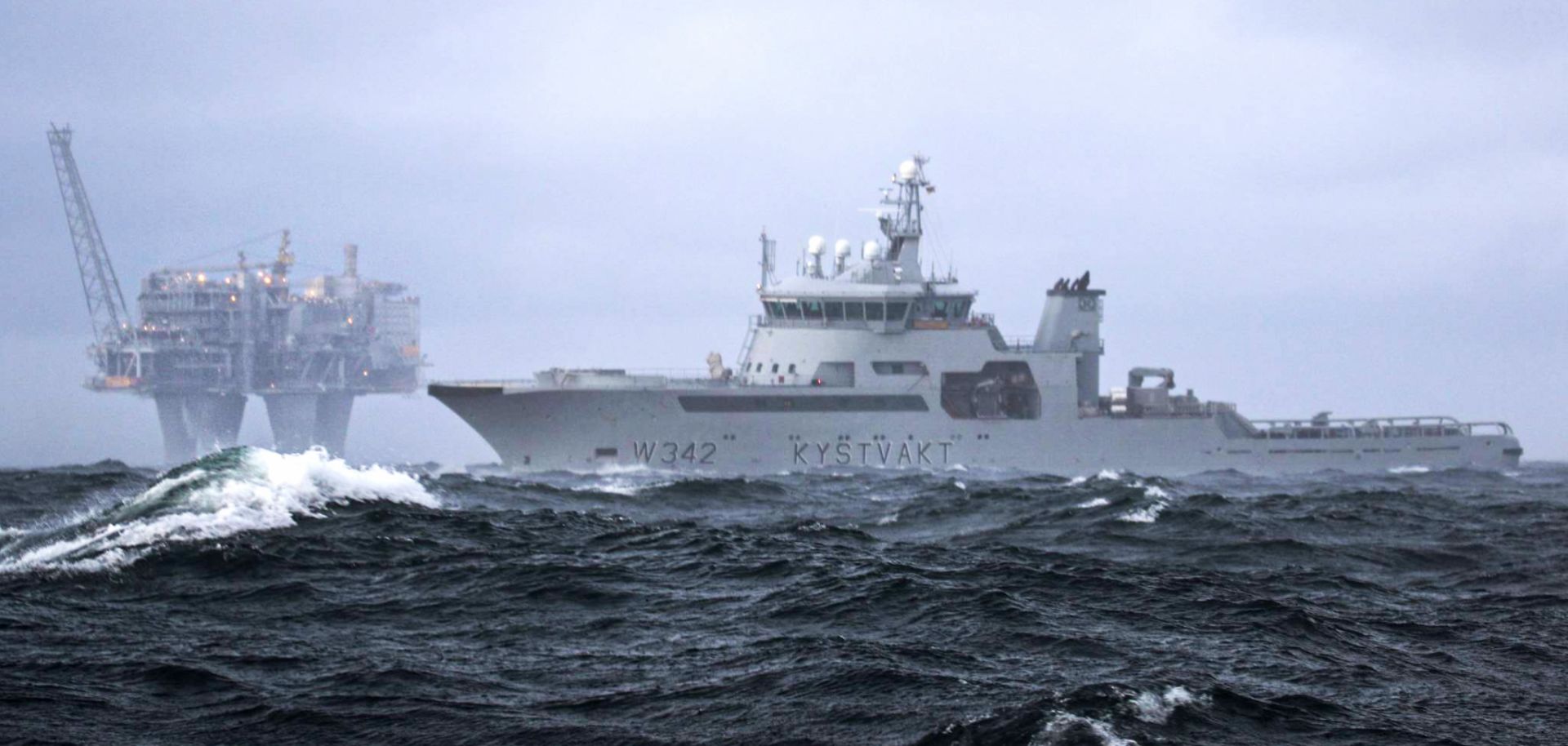
Russia could further undermine Europe's energy security long after it cuts off gas supplies, if Moscow begins to more aggressively target the continent's maritime oil and gas industry. On Sept. 26, the Norwegian Petroleum Safety Administration warned of potential ''deliberate attacks'' after energy companies reported multiple cases of unidentified drones flying near offshore oil and gas installations. Just a few hours later, officials in Denmark warned they had found a gas leak along a section of the Nord Stream 2 pipeline off the coast of the Danish island of Bornholm. The following day, the Swedish Maritime Administration announced it also detected two gas leaks on the Nord Stream 1 pipeline in a nearby area. Russia is widely believed to be behind the recent attacks on the Nord Stream pipeline systems, which are both operated by the Russian gas giant Gazprom. But while the Kremlin has not yet shown an intent to target foriegn-owned infrastructure, the gas leaks nonetheless set a dangerous precedent by showing that Russia is capable of attacking oil and gas infrastructure in its near periphery.
- On Sept. 28, Norwegian Prime Minister Jonas Gahr Store said Norwegian military forces were being deployed to help protect offshore installations. With Russia no longer shipping large volumes of natural gas to Europe, Norway is expected to supply about a quarter of the European Union's natural gas this year.
- Following a meeting with NATO Secretary-General Jens Stoltenberg, Danish Defense Minister Morten Bodkov warned that ''Russia has a significant military presence in the Baltic Sea region and we expect them to continue their saber-rattling.''
- Speaking on behalf of EU member states, EU foreign policy chief Josep Borrell said on Sept. 28 that ''any deliberate disruption of European energy infrastructure is utterly unacceptable and will be met with a robust and united response.''
- The U.S. CIA had reportedly warned the German government of possible attacks on Baltic Sea pipelines prior to the recent gas leaks on the Nord Stream pipelines.
A number of different factors — including the imposition of new sanctions — could drive Russia to adopt a more aggressive strategy to undermine Europe's energy security. In response to Western sanctions pressure, Iran has pursued an aggressive strategy of roiling global energy markets by covertly targeting regional oil and gas infrastructure. Russia could pursue a similarly aggressive strategy, as it shares many of the strategic drivers that have pushed Iran to adopt this approach — namely, the plausible deniability that covert attacks bring, a desire to impose a cost on rivals, interest in driving up energy prices in the short term to increase revenue, and using attacks as a way to gain leverage in negotiations. With its natural gas exports to Europe now nearing zero, Russia also appears to be exhausting its ''gas weapon,'' leaving attacks (or the threat of attacks) on oil and gas infrastructure as the primary way for the Kremlin to apply more pressure on European energy security, particularly for natural gas. In addition, the Russian government may assess that further provocative actions will have a negligible impact on its relationship with the European Union because it has already sunk to its lowest level. To this end, while Iran's attacks against tankers and Saudi oil and gas infrastructure in 2019 resulted in some additional sanctions on Tehran, the Western response was not decisive. This may lead Russia to assess the blowback risk in terms of military escalation and/or new sanctions is low because Western sanctions are already high and NATO countries have already demonstrated that they are seeking to avoid a NATO-Russia conflict. Finally, the Kremlin may even assess that occasional attacks against Europe's energy sector won't close the door to possible future peace negotiations with Ukraine to exit the war.
Should it adopt a more aggressive strategy against Europe's energy sector, Russia could physically attack more oil and gas infrastructure in the Baltic Sea, as well as potentially the Black Sea and North Sea. Russia would likely avoid any actions that could be construed as a physical attack on a NATO member's sovereign territory to avoid triggering a broader NATO-Russia conflict. But this does not necessarily extend to offshore oil and gas infrastructure (and other offshore critical infrastructure, such as submarine communications cables) outside the 12 nautical mile extent from the coast defined as territorial waters. Notably, the perpetrator behind the recent Nord Stream 1 and 2 gas leaks appeared to be extremely precise in terms of where it attacked the pipeline systems. The two attacks on Nord Stream 1 occurred in Denmark's exclusive economic zone but just before the pipeline entered Danish territorial waters, while Nord Stream 2 does not go through Denmark's territorial waters at all.
- There is no indication that the drones the Norwegian authorities warned about were Russian. There have also not been any reports of Russian operations beyond the Baltic Sea, such as in the North Sea, which would be far more operationally difficult due to the greater geographic distance from Russia and the fact that it'd entail operating in deeper waters. Most critical oil and gas infrastructure in the North Sea also lies outside the territorial waters of the United Kingdom, Norway and the Netherlands.
- The Nord Stream incidents occurred the same day that Poland and Norway were inaugurating the Baltic Pipe pipeline system, which carries natural gas from Norway to Poland, traverses through the Baltic Sea and goes through some international waters beyond the 12 nautical mile limit. Due to its proximity to Russia in the Baltic Sea and Poland's very pro-Ukrainian stance, the Baltic Pipe may be the piece of infrastructure that Russia is most likely to attack if it begins more aggressively targeting Europe's energy sector.
- Beyond the Baltic, Black and potentially North Seas, Russia's ability to target offshore oil and gas infrastructure is limited. It could still target Europe's energy security through attacks against LNG tankers and other vessels, or LNG terminals (such as regasification lines going back to the mainland). But such attacks would carry a greater risk of triggering a greater military conflict, as LNG terminals are typically in national territorial waters. Any attacks on LNG vessels would also raise the possibility of casualties. While Russia has not demonstrated such a risk appetite outside of Ukraine, this could change amid further battlefield setbacks in Ukraine.
Beyond physical attacks, Russia's cyber capabilities — including its prolific use of data wipers that can paralyze computer systems by deleting data on hard drives — could also cause significant damage to Europe's energy sector. While it could seek to physically disrupt the European gas market with cyberattacks targeting pipeline operators and industrial control systems operating the pipelines, such acts carry a higher risk of escalation if they cause explosions or loss of life. Attacks on less sensitive aspects of the oil and gas industry (such as information technology systems instead of operational technology systems) are less likely to trigger a greater conflict with the West, but can still create social unrest and cause major financial market swings. Cyberattacks can also lead to occasional infrastructure shutdowns, as evidenced by the 2021 ransomware attack on the U.S. Colonial Pipeline company, which took its pipeline in the southeastern part of the United States offline for a week. Finally, Russia could leverage its well-known links with cyber criminals, hacktivists and other cyber threat actors to conduct attacks on its behalf. Russia's recent military mobilization campaign could even potentially bring in new cyber recruits to whom Moscow could offer roles to carry out the same types of cyberattacks they were previously doing as criminals instead of being deployed on Ukraine's front lines.
