
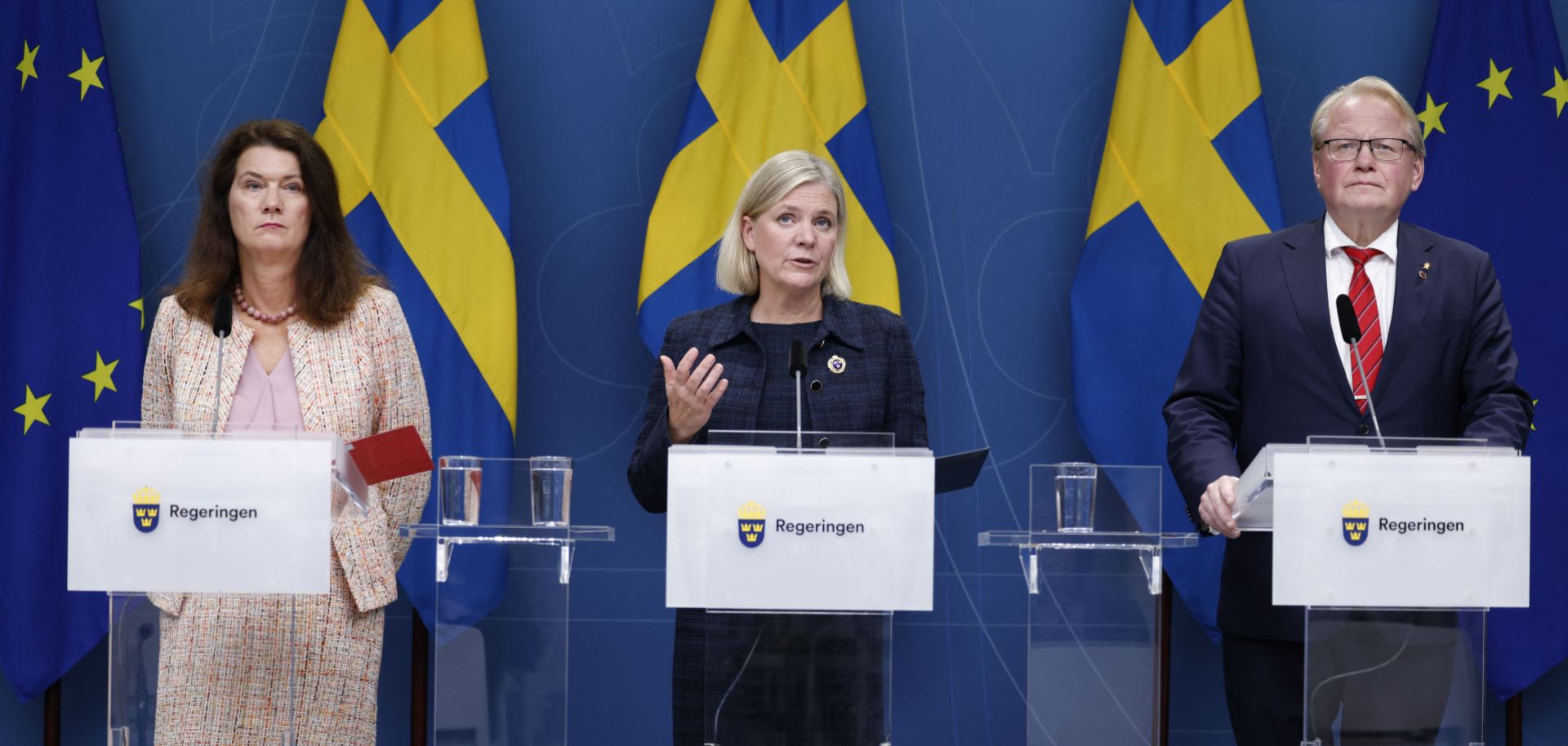
(L to R) Sweden's foreign minister, prime minister and defense minister hold a press conference in Stockholm on the gas leak found on the Nord Stream 1 pipeline in the Baltic Sea on Sept. 27, 2022.
Russia's apparent sabotage attack on the Nord Stream 1 pipeline signals Moscow's willingness to more drastically sever energy trade with Europe this winter. Even if Europe avoids widespread natural gas shortages, the economic fallout from the current energy crisis will be long-lasting. In a Sept. 27 warning, the Swedish Maritime Administration said that it detected two gas leaks on the Nord Stream 1 pipeline (which transports Russian gas under the Baltic Sea directly to Germany) off the coast of the Danish island of Bornholm. The previous day, officials in Denmark warned they had also found a gas leak along a section of the Nord Stream 2 pipeline in the same area. A number of EU officials have described the leaks as being caused by sabotage or a deliberate act — with Russia as the most likely culprit since Moscow has repeatedly disrupted gas flows to northern Europe in retaliation against the West's support of Ukraine amid the ongoing war. Neither of the Russia-owned Nord Stream pipelines was delivering gas to Europe at the time of the reported leaks, but both were being kept pressurized with natural gas. German media reported that prior to the gas leaks, the U.S. CIA had warned the German government of possible attacks on pipelines in the Baltic Sea.
- The Swedish National Seismic Instituted recorded two ''massive releases of energy'' in the vicinity of the leaks measuring magnitudes of 1.9 and 2.3 on the Richter scale overnight on Sept. 26-27 when the leaks were discovered.
- The Danish Energy Agency said that one of the leaks discovered on the Nord Stream 1 pipeline was not a ''small crack'' but a ''really big hole.'' This is leading to a bubble of gas in the Baltic Sea that has reached roughly 1 km (0.6 miles) in diameter. Danish authorities said that a proper investigation may take one to two weeks to begin due to the pipeline still being under high pressure.
- Kremlin spokesman Dmitry Peskov called the leaks ''alarming'' and that sabotage could not be ruled out, but called accusations that Russia was behind any sabotage ''stupid and absurd.'' Russian social media and disinformation campaigns have spun the narrative by saying the leaks were clearly an act of U.S., European or Ukrainian sabotage.
- German officials are concerned that the Nord Stream 1 pipeline may be permanently unusable if repairs are not carried out quickly due to the possibility of salt water seeping into the pipelines and causing corrosion.
Regardless of Russia's actual involvement in the alleged sabotage, the incident gives Moscow additional ammunition to halt natural gas deliveries through all the pipelines servicing Central Europe. Russian claims of sabotage in the Baltic Sea are not an isolated event. Thus far, Russia has yet not suspended gas shipments through the Brotherhood and Soyuz pipeline systems in Ukraine. But on Sept. 22, the Russian Federal Security Service (FSB) said it thwarted an attempted ''sabotage and terrorist act'' by Ukrainian special forces at an oil and gas complex that sends energy supplies to Turkey and Europe. The FSB statement, which did not specify what infrastructure was targeted, appears to be sending the message that the TurkStream pipeline to Turkey or the Ukrainian pipeline systems (all of which share some of the same infrastructure inside Russia) could also be shut down this winter. Moreover, on Sept. 27, Russia's state-owned gas giant Gazprom said Russia may sanction Naftogaz — the Ukrainian state-owned energy firm that operates transit pipelines in Ukraine — in connection to a long-running arbitration case. If carried out, the sanctions would prevent Russian entities from transacting with Naftogaz, thereby suspending the transportation of EU-bound gas supplies through Ukraine.
- In recent months, Gazprom and the Kremlin have used several different excuses to justify reducing or suspending gas flows through Nord Stream 1, including issues related to sanctions, maintenance and faulty equipment on the pipeline. With the flows now halted for nearly a month, sabotage on the pipeline could give Gazprom legal (albeit still dubious) grounds for a more permanent suspension of gas shipments by enabling the company to claim Nord Stream 1 is unsafe and invoke force majeure clauses in its supply contracts with European customs contracts
Europe will probably avoid widespread natural gas shortages this winter even if Russia stops all deliveries, but such an event would intensify intra-EU negotiations about gas sharing and rationing. Several factors should prevent widespread natural gas shortages in Europe during the winter. First, high energy prices have already curbed European residential and commercial gas demand by about 12% and industrial demand by 14% versus 2021, according to energy data platform service Enverus. Second, Europe has aggressively filled up natural gas storage, with storage sites across the European Union about 88% full as of Sept. 25. However, stockpiles in some of the countries most dependent on Russian gas (including Austria, Bulgaria, the Czech Republic, Hungary and Slovakia) are below the EU-wide average, which will intensify talks within the bloc around mandatory gas sharing requirements if there is a crisis or shortage. Some EU member states will likely also become more nationalistic about their natural gas stockpiles. Nevertheless, most European governments are likely to proactively manage domestic energy usage in preparation for continued disruptions to Russian gas supplies. And such government measures, coupled with price-motivated demand destruction in the industrial and commercial sector, will probably reduce European energy needs to the point where the continent is able to get through this winter without depleting its gas stockpiles, which will likely still be about a fifth full when Europe enters the spring
Even if Europe avoids widespread natural gas shortages this winter, the economic impact of halted Russian deliveries will be long-lasting. Even if EU energy market interventions successfully limit price volatility, the ongoing disruptions to Russian energy supplies will keep natural gas and electricity costs in Europe elevated past this winter, and likely longer. The ongoing price crunch will fuel inflation in the short term, and increase pressure on the European Central Bank, the Bank of England and other central banks to hike interest rates and put downward pressure on economic activity. European leaders will continue to face political pressure to extend relief measures (including social spending programs and tax suspensions) throughout next year as well, further straining government budgets. Meanwhile, lingering rationing measures for industrial and commercial energy usage will further dampen manufacturing activity in Europe, which sky-high energy costs have already reduced — creating additional supply chain disruptions, while raising the specter of eventual layoffs at factories. More broadly, the continued lack of Russian supplies also means that Europe is unlikely to ever return to having competitive natural gas (and thus electricity prices) compared with the U.S. market, which over time will prompt more European multinational companies to expand their investment plans and operations in the United States instead of Europe — adding to the greater economic toll of the continent's current energy crisis.
- Since Europe's energy crisis began last year, European governments have earmarked more than 500 billion euros in new spending packages and tax measures to shield the impact of high prices on consumers. Many European governments have already spent equivalent to 2-3% of their GDP on such measures — a figure that is only set to grow, putting all the more pressure on government fiscal policy.
- Most European governments' gas rationing programs are centered on reducing natural gas and electricity to industrial and manufacturing customers first, to ensure supply for households during the winter. Already, high prices have forced a number of energy-intensive plants to suspend or reduce their operations. Natural gas importers in Europe have also been forced to purchase their LNG supplies at extremely high prices, causing significant losses that have led to government bailouts and job-retention schemes.
