
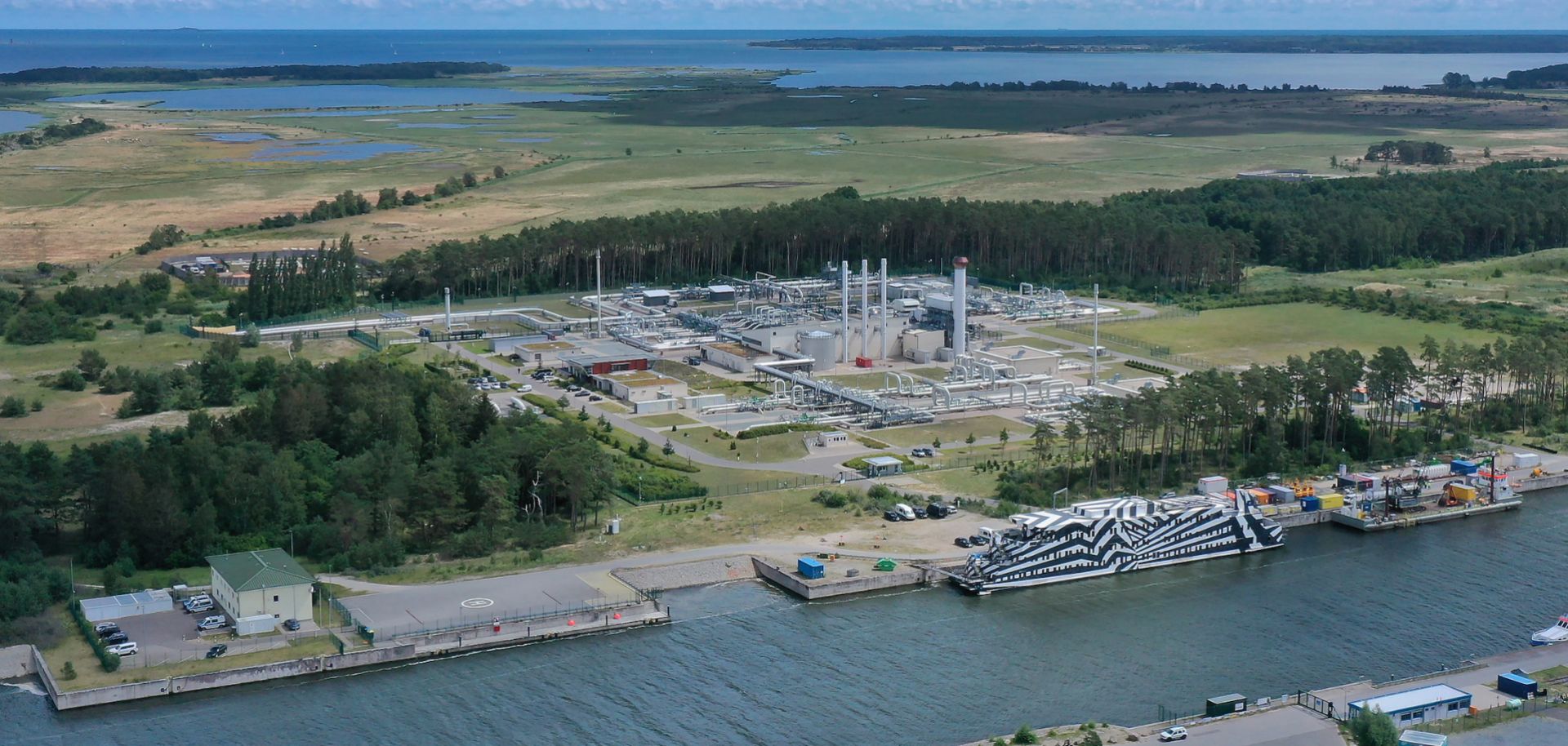
An aerial view shows a receiving station for the Nord Stream 1 natural gas pipeline near Lubmin, Germany, on July 11, 2022.
Russia’s reduced exports — and threat to end — natural gas supplies to Europe will persist because Moscow hopes they will increase the probability of economic recession on the continent and result in weaker European support for Ukraine. On July 11, natural gas flows on the Nord Stream 1 pipeline (which transports Russian gas under the Baltic Sea directly to Germany) dropped to zero, as the pipeline began an annual scheduled 10-day maintenance period. This year’s planned shutdown comes after Russia’s energy giant Gazprom cut flows on the pipeline to 40% percent of its normal capacity on June 14, citing technical issues including the failure of Germany’s industrial manufacturing conglomerate Siemens to return a turbine under maintenance in Canada. Now, concerns are growing in Europe that Moscow is preparing to blackmail or retaliate against the continent by preventing European states from sufficiently refilling their storage before the winter heating season. Moscow is likely to calculate that continuing to limit gas exports to Europe as a political and economic destabilization tool is of much greater value than the economic benefit of easing Europe’s energy crisis, as Russia does not need the extra gas export revenue because of high oil and natural gas prices.
- On June 30, Germany's Economy and Climate Minister Robert Habeck warned that Russia may not resume natural gas deliveries to Europe through Nord Stream 1 after planned maintenance and face a complete shutoff of Russian gas in July. On July 10, French Economy and Finance Minister Bruno Le Maire called on Europe to prepare for a total halt of Russian gas supplies, saying that, “today, this is the most likely option."
- Overall, Russian gas deliveries to Europe fell by around 60% in June, which sent prices near record highs and forced governments such as Italy and Germany to prepare emergency measures. Gazprom has shut off gas flows to countries that have refused to use the ruble payment mechanism required by the Russian government for piped gas, including Poland and Bulgaria on April 27 and Finland on May 21.
- At the German government’s urging, Canada agreed on July 10 to return a turbine for the Nord Stream 1 to Germany, despite Ukrainian objections. But the turbine will likely still take several weeks to ship and reinstall. This will continue to grant Russia an excuse to allow reduced flows well below capacity on the pipeline, a concern reinforced by a statement Gazprom issued on July 13 saying the Russian gas giant did not know if it could take the turbine or whether it had shipped.
- Russian natural gas transit to Europe through Ukraine was first disrupted on May 11, when Ukraine's state-owned gas grid operator GTSOU declared a force majeure and ceased transit of Russian gas entering the Ukrainian system at the Sokhranivka entry point. Gazprom did not significantly increase transit via other Ukrainian entry points to compensate.
Russia believes that a sustained threat of cutting off natural gas supplies, which in turn keeps European natural gas prices high, will drive a wedge between different EU member states over the sanctions policy — leading the bloc, on the whole, to moderate its support for Ukraine and appetite for more sanctions, thereby pressuring Kyiv to accept a cease-fire favorable to Moscow. Europe faces a rising risk of recession in the coming months amid rising food and fuel prices, which a Russian cut-off of gas supplies would exacerbate significantly. Germany, which imported 55% of its gas from Russia in 2021, is already preparing to institute rationing measures for gas, and the Bundesbank estimates that the country’s economy will shrink more than 3% in 2023 if Russian energy supplies stop. Because the European Union risks a recession regardless of whether Russia significantly lowers energy supplies, Moscow will likely manipulate flows as a political weapon to exert leverage over European governments, threatening them with social unrest, instead of allowing them to wean themselves off Russian gas at the pace they have planned. Moscow likely hopes that this will dissuade countries such as Germany and Italy from more robust military support for Ukraine in the coming months, and push them to advocate for a cease-fire favorable to Russia and coerce Ukraine to accept a diplomatic solution, instead of supplying Ukraine the weapons it would need for a counteroffensive to retake its lost territory. Moscow may also believe that low European gas storage levels would function as leverage for Russia in peace talks.
- Hungary’s opposition to the European Union’s Russian oil embargo was lifted only after receiving a carve-out, and the country continues to oppose weapons deliveries to Ukraine. Hungary’s position is indicative of internal divisions present in other European countries on key aspects of policy toward Russia.
- Russia's natural gas export strategy will likely also be adjusted in line with developments regarding the G-7's oil price cap proposal, as Moscow is likely signaling to Europe that the G-7 price cap would be grounds for a gas cut-off as a way to divide the G-7 and undermine European support for such a policy.
- In addition to Germany and Italy, Russia also reduced gas flows to Austria, the Czech Republic and Slovakia in June. Italy began working on plans to reduce consumption following Italian energy giant Eni’s July 11 announcement that it will receive around a third less natural gas from Russia's gas giant Gazprom. Austria, Denmark, the Netherlands and Sweden have also already activated the first early warning stage of a three-stage plan to cope with a gas supply crisis.
Moscow is highly likely to keep natural gas supplies to Europe low in the coming months, retaining the threat — and the fear in European capitals — of a gas cut-off that could come at any time. Russia’s plans are likely to become clearer once the scheduled maintenance ends on July 21, as Kremlin spokesman Dmitry Peskov said on June 20 that Russia is prepared to resume full flows on the pipeline, so long as Gazprom receives a turbine under maintenance in Canada. For the Kremlin, a cut-off later this year may be more desirable than a sooner one, because the former would come at the height of European demand for natural gas. Therefore, Moscow is likely considering sudden cuts later this year rather than in July or August. A failure to resume any flows on Nord Stream 1 in the summer, by contrast, would likely prompt European governments to implement rationing and conservation measures well in advance, mitigating the political potency of a shutoff by allowing European governments to prepare their citizens for consequences that will be felt more acutely in the winter, when the impact of economic recessions and war fatigue on Europe is likely to be stronger.
- There are numerous ways the war in Ukraine could — either deliberately or unintentionally — unexpectedly damage Ukraine’s remaining gas transit infrastructure to Europe at any point, causing a sudden and complete disruption in flows.
The European Union’s push to reduce its reliance on Russian natural gas and its embargo on Russian oil means that Moscow’s window to use natural gas exports to pressure European states is closing fast, which increases the probability of Russia taking more drastic actions. In the months leading up to and shortly after its invasion of Ukraine, Moscow sought to use high gas prices to pressure European states while maintaining minimum flows to avoid violating its lucrative European contracts and missing out on revenues amid Russia's economic crisis. But the European Union’s announcement of its REPowerEU plan on March 8, which seeks to drastically reduce the bloc’s reliance on Russian energy, has changed Moscow’s thinking on the issue. The speed at which Europe wants to cut its use of Russian natural gas (66% by the end of this year, followed by a tapering of the final 33% as early as 2027) means that the potency of Russia’s much-vaunted “energy weapon” will quickly dissipate following the winter 2022-23 heating season. Therefore, Russia could calculate that a sudden and near complete cessation of flows may be the best way to create economic and political challenges for Europe, as some European states likely cannot make it through this coming February, or even December, without continued Russian gas to fill storage or painful rationing measures. Were Moscow to commence a sudden and near-complete shutdown in the coming weeks, the dearth of alternatives to Russian gas would mean that some European states would have to implement highly unpopular rationing measures, possibly as long as through the winter 2023-24 heating season. Those rationing measures would likely focus on limiting supplies to European industrial consumers, likely resulting in a recession.
- The European Union has recommended that countries fill 90% of their storage capacity by an Oct. 1 deadline. Some countries are shooting to exceed the deadline, as France has said it is seeking to fill its storage near 100%.
- Russia could exacerbate Europe’s economic pain by also halting exports of its LNG to Europe and redirecting them to Asian buyers, but as Russian LNG only constitutes 8% of global LNG supply, the move would have a negative but limited effect on European markets.
A shutdown of gas sales to Europe would likely have an overall negative impact on the Russian economy. But Russia can survive without piped gas exports to Europe, and Moscow may still see some economic silver lining in ending them. The inability of Gazprom to find alternative buyers for its gas amid the lack of infrastructure options means that a near-total siphoning of gas supplies to Europe would risk irreversible damage to some of its assets and reservoirs in 2022 and 2023, including associated Russian oil assets. It would likely also put Gazprom in need of a domestic bailout and lead to infighting amongst affected business interests in the country. Alternatively, continued gas sales to Europe amid high prices could fund Gazprom’s capital-intensive plans to transition to buyers in Asia, which will require the construction of large amounts of new pipeline infrastructure. But since gas rents make up a much smaller percentage — typically less than 3% — of Russia’s GDP, their cessation would not be catastrophic for the Russian economy, which will undergo a massive contraction anyway in 2022 due to sanctions. Meanwhile, Russia continues to bring in large amounts of foriegn currency due to oil and gas prices, which are high and likely to stay so for the foreseeable future. But thanks to Western sanctions, Moscow cannot spend its record current account surplus on imports, causing them to collapse. This has given Russia an enormous trade surplus that has put undesirable deflationary pressure on the Russian ruble, increasing the cost of exporting non-energy goods in markets not subject to sanctions. This imbalance could be partially offset by the loss of export revenue from a sudden reduction of gas exports to Europe — helping the ruble to fall toward recent norms, which would make other Russian exports more attractive.
