
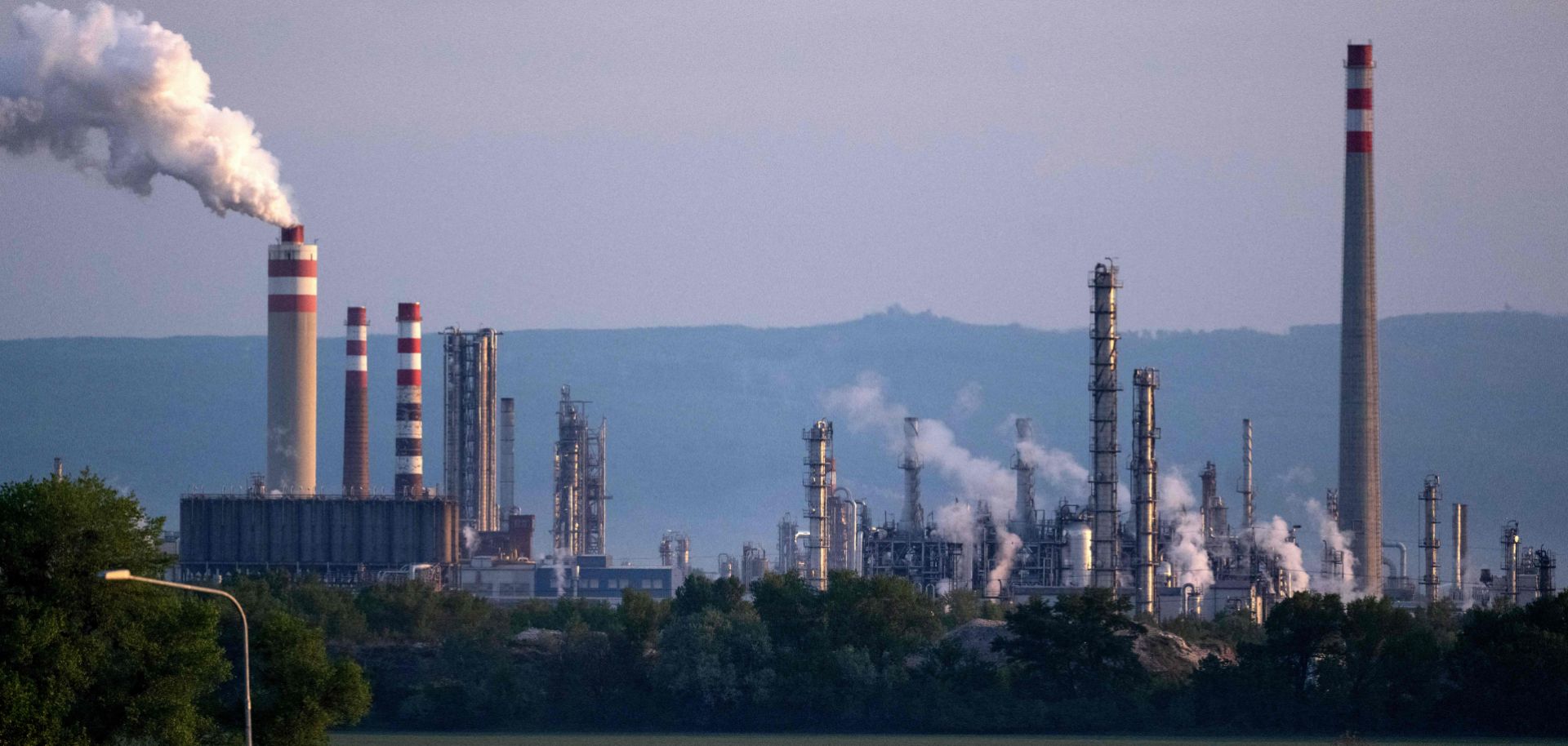
A photo taken on May 3, 2022, shows Slovakia's largest mineral oil refinery Slovnaft, which receives most of its supplies from Russia via the Soviet-era Druzhba pipeline.
While EU member states will have time to adapt to sanctions on Russian oil, the decision could further slow down economic activity across the bloc if energy prices surge or Russia cuts off natural gas supplies in retaliation. On May 4, European Commission President Ursula Von der Leyen unveiled proposals for the bloc's sixth package of sanctions against Russia, which include phasing out imports of Russian crude oil within six months and refined oil products by the end of the year. Von der Leyen said it will ''be a complete import ban on all Russian oil, seaborne and pipeline, crude and refined,'' and will happen ''in an orderly fashion, in a way that allows us and our partners to secure alternative supply routes and minimizes the impact on global markets.'' Notably, Brussels also wants to ban European companies from providing services (ranging from shipping to insurance) connected to the movement of Russian oil. If implemented, this would make it harder for Russia to ship oil to other parts of the world because of Europe's dominant position on tanker insurance. The European Commission is also proposing to cut off Russia's biggest bank, Sberbank, and other banks from the international SWIFT payment system.
- The European Commission's proposals will require unanimous approval from the 27 member states of the European Union. Representatives from EU governments discussed the plan on May 4 but failed to reach an agreement.
- According to EU diplomats, Hungary and Slovakia (which are heavily reliant on Russian oil and have limited options to diversify their suppliers) will be given until the end of 2023 to enforce the sanctions in order to secure their support for the plan. However, Hungary's foreign minister said Budapest's concerns about its energy security remained unresolved. The governments of Slovakia, the Czech Republic and Bulgaria also expressed concern about the negative impact of the oil ban on their economies. This means that the commission may need to provide additional reassurances and exemptions to some member states to obtain their support
- The European Union imports around a quarter of its oil and around 45% of its natural gas from Russia. The war in Ukraine has accelerated the European Union's push to improve its energy security. In early March, the European Commission presented REPowerEU, a plan to make the European Union independent from Russian fossil fuels by 2030. The plan includes proposals to diversify natural gas supplies via higher liquefied natural gas (LNG) and pipeline imports from non-Russian suppliers, increase production of biomethane and renewable hydrogen, and accelerate a reduction in the use of fossil fuels in buildings, industry and the power system by boosting energy efficiency, increasing the use of renewables and electrification, and developing new infrastructure to eliminate energy bottlenecks.
While the progressive phasing out is meant to give EU countries time to adapt, some will struggle to replace Russian oil. Most Russian oil reaches the European Union by ship rather than by pipeline, which gives EU countries some degree of flexibility when it comes to finding new suppliers (by contrast, replacing Russian natural gas, most of which reaches the European Union by pipeline, would be much harder because it would require constructing new physical infrastructure). Still, the European Union's oil infrastructure is designed for east-to-west flows, which means that EU countries may have to find alternative and less efficient ways to move oil from west to east (such as by rail, trucks or boats, all of which are more expensive). In addition, some EU refineries are optimized to use Russian oil, which could impair their efficiency if they have to refine oil from other countries. Large refineries in countries like Germany, Poland, the Czech Republic, Austria, Hungary and Slovakia are particularly exposed to this problem.
Germany, in particular, exemplifies the opportunities and challenges connected to reducing reliance on Russian oil:
- According to the German government, Russian oil currently represents 12% of the country's oil imports, down from 35% before the beginning of the war in Ukraine. Berlin is currently looking for deals to further reduce this reliance. In late April, for example, Germany reached a deal with Poland to increase oil imports through the Polish port of Gdansk, which is equipped to handle supertankers and has a pipeline that can send crude oil to a German refinery in Schwedt on the German-Polish border.
- Despite this progress, several of Germany's refineries are designed to handle Russian crude oil imports, with limited alternatives to import seaborne crude oil inventory. The Schwedt refinery, for example, can import some crude oil from the German Rostock oil terminal, but the Rostock terminal is not equipped to handle supertankers and the capacity of the pipeline connecting the terminal to the refinery is lower than the refinery's capacity. TotalEnergies' Leuna refinery is another main German refinery with limited alternatives because it receives Russian crude through the same pipeline infrastructure connected to Schwedt. TotalEnergies said in March that it would terminate all Russian supply contracts for the Leuna refinery by the end of 2022 once it reached deals with Poland on using Polish infrastructure to import crude.
More expensive energy supplies due to sanctions against Russia could further impede economic growth and increase inflation in Europe, putting pressure on governments to expand public spending at a high fiscal cost. If approved, the EU sanctions against Russian oil will arrive at a time when Russia is threatening to cut natural gas supplies for countries and companies that fail to accept a Moscow-created mechanism to pay for gas in rubles. Even EU countries that do not import energy from Russia could be negatively impacted by the sanctions if they result in higher global oil and natural gas prices. The continuation of the war in Ukraine, EU sanctions against Russian energy, and potential shortages of natural gas and oil in some parts of Europe mean that growth will remain very low, or could even contract, in the second quarter of 2022 and beyond. In fact, large economies like France (which experienced zero growth in the first quarter) and Italy (which experienced a contraction in the first quarter) may enter recessions. This will increase the likelihood that EU governments introduce additional welfare measures and subsidies for households and companies to contain the rise in energy prices and the cost of living as much as possible and, in turn, reduce the probability of social unrest. But such increased public spending will come at a high fiscal cost right after the COVID-19 pandemic, which resulted in a worsening of debt burdens across Europe. In extreme cases, EU governments may be forced to introduce measures to reduce energy consumption, which would further undermine economic activity — especially if such measures curb industrial production. Finally, slowing economic growth and rising inflation will deepen the European Central Bank's dilemma. In recent weeks, the bank has indicated that it may hike interest rates as early as July to fight inflation, but a slowing economy could reignite the debate over whether to postpone such a decision.
- According to a flash estimate by the European Union's official statistics office, Eurostat, GDP in the eurozone rose by 0.2% in the first quarter of 2022, down from a 0.3% expansion in the fourth quarter of 2021. The German economy grew by 0.2%, while the Spanish economy grew by 0.3%. In the meantime, the French economy stagnated (0%) while the Italian economy contracted by 0.2%.
- Separately, Eurostat also reported that inflation in the eurozone reached 7.5% in April, up from 7.4% in March. The surge in energy prices was the main driver of inflation in April, followed by the increasing costs of some food products and industrial goods.
