
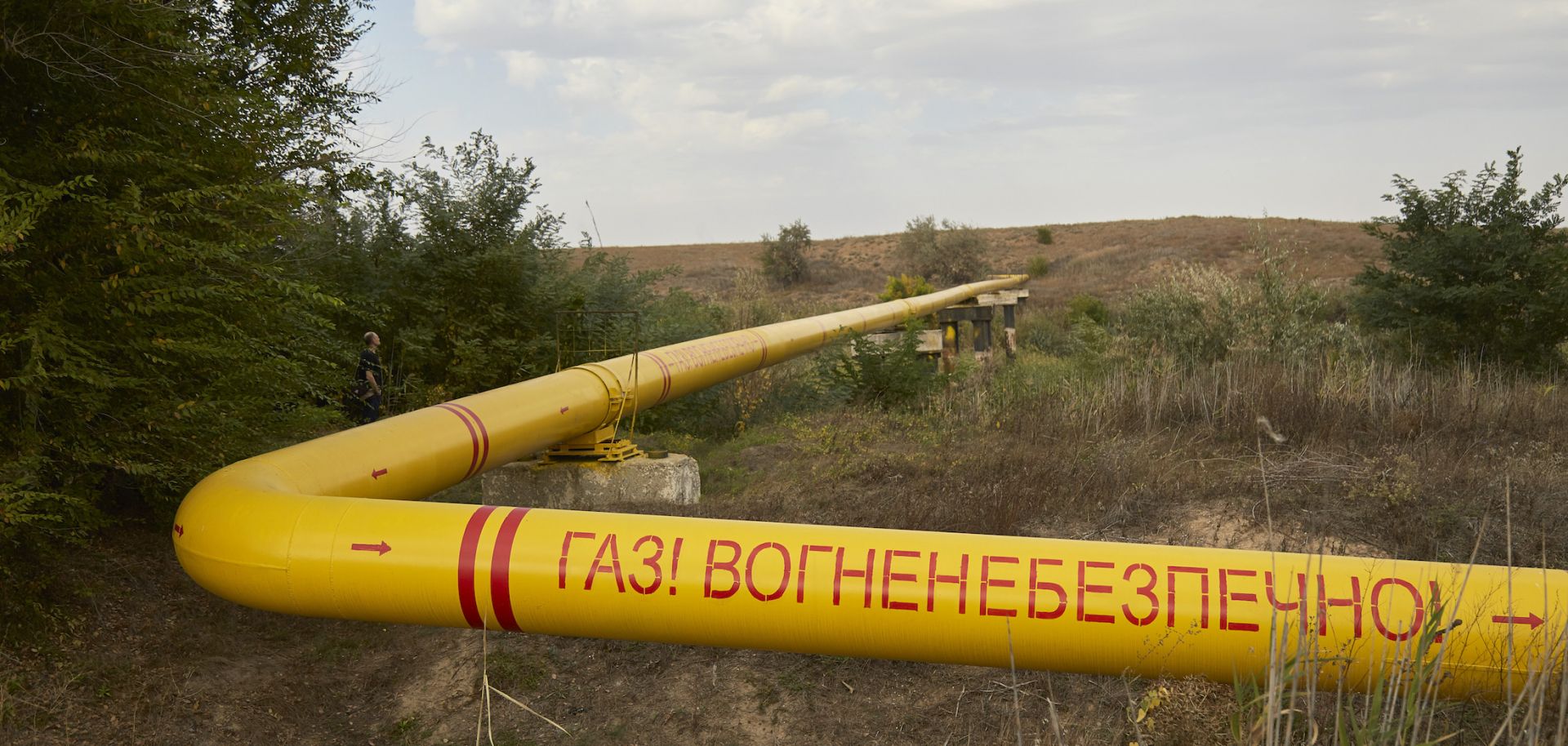
A gas pipeline is seen on the North Crimean Canal in Kalanchak, Ukraine, on Sept. 29, 2020.
Record-high energy prices in Europe may initially help Russia convince the European Union to accept the Nord Stream 2 pipeline and pressure European utilities to sign long-term contracts with state-run gas giant Gazprom. But the crisis ultimately risks encouraging European states to further reduce their reliance on Russian gas. In recent months, calls that Russia has been manipulating the European gas market by withholding supplies for political ends have increased in tandem with European electricity and gas prices. While Europe’s historic energy crunch is the result of numerous factors, reports suggest that a Kremlin-coordinated effort by Gazprom to withhold supplies is part of the problem. Indeed, European governments have made similar accusations several times over the past two decades. But regardless of the merits of the current accusations, Gazprom will seek to exploit the high price environment and is well-positioned to benefit from the gas shortage.
- Benchmark European gas futures traded at $1,150 per thousand cubic meters on Oct. 26, down from more than $2,000 per thousand cubic meters earlier this month.
- Gazprom hasn't sold its gas in Europe at over $400 since 2013.
- The European Union imports approximately 40% of its natural gas from Russia. Gazprom has not booked significant additional gas transit to Europe since the spring, despite record prices.
Natural gas prices are likely to remain high in Europe through most of the winter, helping Gazprom achieve its immediate goals. Liquified natural gas (LNG), which usually balances the European market during high prices, is currently going to Asia for even higher prices. Gazprom, meanwhile — the largest traditional supplier to Europe — is declining to significantly increase transit through Ukraine or Poland, the two of the main routes to Europe through which volumes can be significantly increased. Against this backdrop, historically low storage volumes across Europe, which have contributed to the price spike, could be drained even more rapidly if Europe experiences a particularly cold winter this year. In this scenario, even if Gazprom eventually increases deliveries to Europe, there would be little room for error due to high demand — making the threat of a lack of heating fuel and power outages possible (though still unlikely). Russian officials have repeatedly communicated that the best way to balance the market is to conclude long-term contracts with Gazprom and approve the operation of the Nord Stream 2 pipeline between Russia and Germany. Gazprom will likely eventually begin increased gas transit to avert a freeze in Germany that would severely damage its reputation as a reliable supplier. However, the Russian gas company is unlikely to do so at sufficient volumes to allow the market to return to previous prices, unless it achieves its goals. Utility companies may be subject to public and political pressure to conclude long-term contracts as European governments use whatever levers they have to avoid a crisis in the middle of winter.
- On Oct. 27, President Vladimir Putin said that Russia would finish filling domestic storage on Nov. 8 and would begin filling its European storage facilities then. Such verbal interventions by Putin and other high-ranking officials have capped European gas prices and somewhat reduced volatility in the market. Putin did not say how much Gazprom would increase deliveries to Europe or which transit systems would be used to move the gas to its storage facilities. Gazprom also has yet to book pipeline capacity to boost deliveries to the continent next month via Poland or Ukraine.
- Analysis of European gas industry data shows the largest storage shortfalls are at sites controlled by Gazprom, which critics say increasingly points to a deliberate attempt by the company to squeeze European energy supplies. European natural gas inventories are about 14 billion cubic meters (bcm) below normal, including 8 bcm in Gazprom-linked facilities.
- On Oct. 13, Putin said that Russia can increase gas supplies to Europe as soon as Germany approves the new Nord Stream 2 pipeline, emphasizing one of Moscow’s conditions for help to resolve the Continent’s energy crisis. Putin said Gazprom could increase flows by an extra 17.5 bcm via the new pipeline if regulators approved it. How much Gazprom will increase exports before the Nord Stream 2 pipeline is certified, which is expected no earlier than January, remains unclear.
- Poland’s state-run gas company PGNiG, which is critical of Nord Stream 2, welcomed a German court decision last month that declined to recognize Gazprom’s pipeline as exempt from amended EU gas market regulations. PGNiG’s participation in the certification of Nord Stream 2 will likely prevent the project from operating above 50% capacity as long as Gazprom remains the projects’ majority shareholder.
In the long term, Gazprom’s attempts to capitalize on the current energy crisis could end up hurting its bottom line by only strengthening calls among European governments and institutions to reduce the Continent’s reliance on Russian energy. European states’ climate goals, longstanding geopolitical antipathy toward Russia, and the realities of an increasingly global gas market pose major challenges to Gazprom’s long-term profitability by pushing European countries to reduce their Russian gas imports. Gazprom will try to leverage shorter-term realities — namely, the push away from coal to gas as a transition fuel, and the generally low price of Russian gas — to lock-in European demand for its exports. However, the tactics needed to achieve this involve coercion and brinkmanship, and therefore risk backfiring. As market manipulation accusations persist, more European political actors will call for reduced energy dependence on Russia and explore concrete investments and mechanisms to do so. But for Gazprom, these negative consequences are likely to manifest only over the course of many years, and their risk is outweighed by the urgency of getting Nord Stream 2 approved and locking in long-term contracts with European states to give the Russian company a predictable market. Without such contracts, new resources from the Black Sea and Eastern Mediterranean, along with the expected overall increase in global LNG production over the next five years, will further relegate Gazprom to lower margins in the gas market, which it will go to great lengths to avoid — even if that means engaging in risky behavior.
- On Oct. 20, Putin said that Gazprom is not interested in capitalizing on high European gas prices for fear of reducing long-term demand for its gas, thus risking demand destruction in Russia’s biggest export market. While the comment is mostly an attempt to deflect market manipulation accusations, it expresses an underlying truth that Gazprom’s failure to stabilize the market risks making alternative green energy sources more competitive — the very thing Gazprom seeks to avoid.
- On Oct. 22, Ukraine took the unprecedented step of offering Gazprom a 50% tariff discount for any additional gas transit to Europe via its territory. Gazprom utilizing Ukraine's vast unused transit capacity would demonstrate that the Ukrainian pipeline system is adequate for Europe’s needs. Therefore, Gazprom is likely to largely decline the offer, which Kyiv will show to European partners as yet another example of Gazprom’s unresponsiveness to market forces.
- Russia’s coercive tactics this year will embolden Nord Stream 2 opponents who argue the pipeline will grant Russia illicit leverage over Germany’s energy policy. This threat will likely also convince U.S. lawmakers to pass more sanctions on the project, exacerbating the major obstructions to operation already plaguing Nord Stream 2.
