
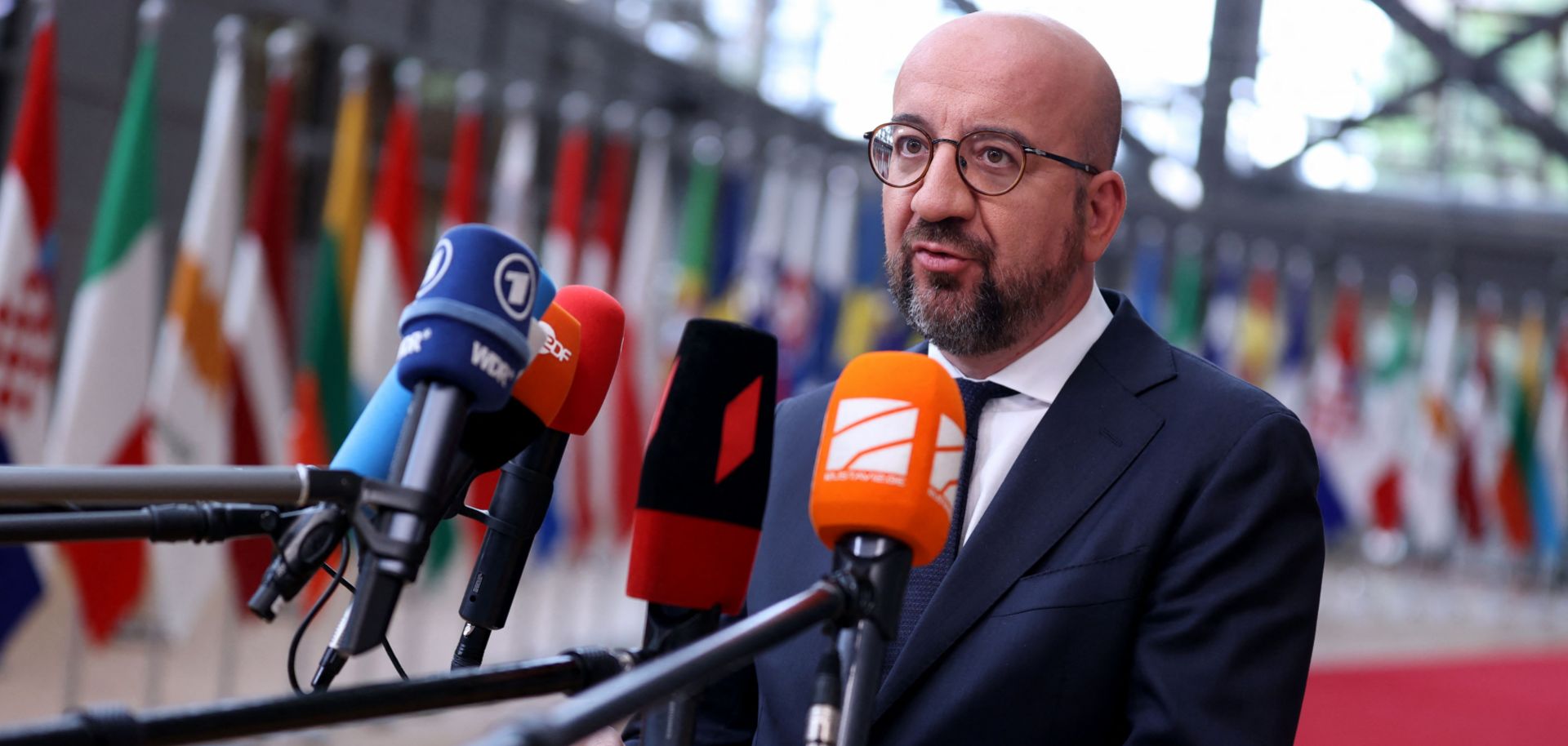
European Council president Charles Michel talks with the press on May 30, 2022, after arriving for a special EU meeting in Brussels, Belgium, focused on the war in Ukraine and sanctions against Russia.
The European Union's caveated ban on Russian oil imports shows the bloc is reaching its limit in how much more sanctions pressure it can impose on Moscow amid the ongoing war in Ukraine, as the embargo will risk stymying economic growth in EU countries for months to come. On May 30, EU leaders approved a sixth package of sanctions against Russia that includes a ban on most Russian oil reaching the bloc. The sanctions cover crude oil and petroleum products entering the European Union by sea, but exclude crude oil delivered by pipeline. While Brussels will announce the details of the sanctions in the coming days, officials said that the oil ban will cover roughly 70% of Russian oil imports in the immediate term and around 90% by the end of the year. The sanctions also ban EU companies from providing insurance services to Russian tankers, which is meant to undermine Russia's oil exports to non-EU countries as EU companies are the key players in the tanker insurance sector. EU governments also decided to expel Sberbank, Russia's largest bank, from the Brussels-based SWIFT international payments system and blacklist additional Russian individuals involved in alleged war crimes in Ukraine.
- Most shipping insurers are based in Europe. The EU ban on providing insurance services for Russian tankers may thus have a larger impact on Russian oil exports than the embargo itself by potentially curbing Russia's ability to sell oil to China, India and other countries that have not imposed oil embargos.
The protracted debate over the oil embargo suggests that the European Union will struggle to impose additional sanctions against Russia as the economic impact on member states increases. The European Commission initially proposed the oil ban on May 4, but Hungary objected to it due to the country's almost complete dependence on Russian oil. The May 30 announcement is a political victory for the European Union because it allowed the bloc to send a message of unity, but it's also a political and economic victory for Hungary because Budapest was granted a ''temporary'' exception from the ban (in theory, the exemption will end once Croatia has developed the necessary infrastructure to supply oil to Hungary but no official timeline was announced). Slovakia, Bulgaria and the Czech Republic were also given more time than the rest of the EU member states to implement the ban because of their heavy reliance on Russian oil and limited infrastructure to import oil from other sources. This suggests that, barring a major escalation in Ukraine (such as the use of tactical nuclear weapons), EU sanctions on Russian natural gas will remain elusive due to the significant economic impact such measures would have on most Central and Eastern European countries. Even if the European Commission eventually proposes banning Russian natural gas, Hungary has created a precedent for countries to demand exemptions, which would limit the scope of the embargo.
- While some EU member states like Lithuania have announced their total independence from Russian natural gas, others — including larger states like Germany and Italy — remain heavily reliant on it. This means that while Berlin and Rome will continue to look for alternative natural gas suppliers in the coming weeks and months, they are unlikely to support a ban on Russian natural gas in the short-to-medium term.
- Russia's decision to cut natural gas supplies to EU member states and private companies that refuse to adopt a Kremlin-designed system to make payments in rubles is already driving divisions between EU countries. Energy companies in some countries (like Germany and Italy) have complied with the ruble payment system, while companies in other countries (like Poland, Bulgaria, Finland, the Netherlands and Denmark) are facing supply cuts because of their decision not to use it. The European Commission, meanwhile, has sent mixed signals over whether the system complies with EU sanctions.
- EU officials have said that, should Hungary or any other member states fail to implement the embargo on Russian oil, the European Commission will seek to impose tariff hikes on Russian oil, which would make it less competitive and reduce exports to Europe.
Because of the oil sanctions, households and companies in most European countries are likely to face higher energy prices, which will further drive up the overall cost of living in Europe, force governments to keep fiscal spending high and increase the risk of social unrest. While energy prices have been on the rise since late 2021, Russia's Feb. 24 invasion of Ukraine has since injected greater uncertainty into global energy and food markets by creating more supply chain disruptions. The new EU embargo could further drive up international oil prices, at least temporarily, which means that even if European countries find alternative suppliers, energy costs for EU households and companies will remain high. Populations in most of Europe will, in turn, continue to see their overall cost of living go up. In fact, a day after the announcement of the oil ban, Eurostat announced that inflation in the eurozone reached a record 8.1% in May, up from 7.4% in April, which the EU statistics office said was driven mostly by rising energy prices, followed by rising food prices. Most EU governments have adopted multiple measures to mitigate the impact of high energy and food prices on households, but these measures have come at the cost of higher fiscal spending. In the probable case that the European Central Bank hikes interest rates during the third quarter, governments will find it more expensive to borrow in debt markets to pay for their high public spending. Most governments will likely also keep public spending high, which will reduce but not eliminate the possibility of social unrest. This policy will expose them to debt crises in the future, especially if their borrowing costs keep escalating.
- The EU oil embargo announcement — combined with the recent announcement that Chinese authorities would begin easing COVID-19 restrictions in Beijing and Shanghai, which will boost oil demand — caused the price of Brent crude oil to surge above $120 per barrel on May 30 for the first time since late March. Moreover, futures contracts for immediate oil are much higher than futures contracts for oil a few months from now, which suggests that traders are concerned about a future supply crunch so there's high demand for oil now.
- The record-high inflation in the eurozone will solidify the European Central Bank's decision to raise interest rates in July and September for the first time in more than a decade. However, the ECB's executive board is internally divided over how aggressive interest rate hikes should be. Some board members have noted that a half-point increase may be necessary, in line with a recent move by the U.S. Federal Reserve. But others have defended smaller quarter-point increases, arguing that a sudden spike in interest rates would create too much volatility in debt markets.
- Some EU countries may resort to higher taxes to increase state revenue and, in turn, avoid an escalation in borrowing. But this would worsen the business environment in those countries and potentially deter private sector investment. In recent weeks, EU members like Italy and Hungary, as well as non-EU countries like the United Kingdom, have introduced windfall taxes on large energy companies in order to finance some of their crisis-relief measures.
- So far, Europe has not seen any significant bouts of social unrest connected to the recent rise in living costs, mostly because of the mitigation measures imposed by national governments and EU institutions. But with the eurozone now facing unprecedented levels of inflation, the chance of protests and political instability will increase the longer prices for basic goods and services in European countries remain elevated.
