
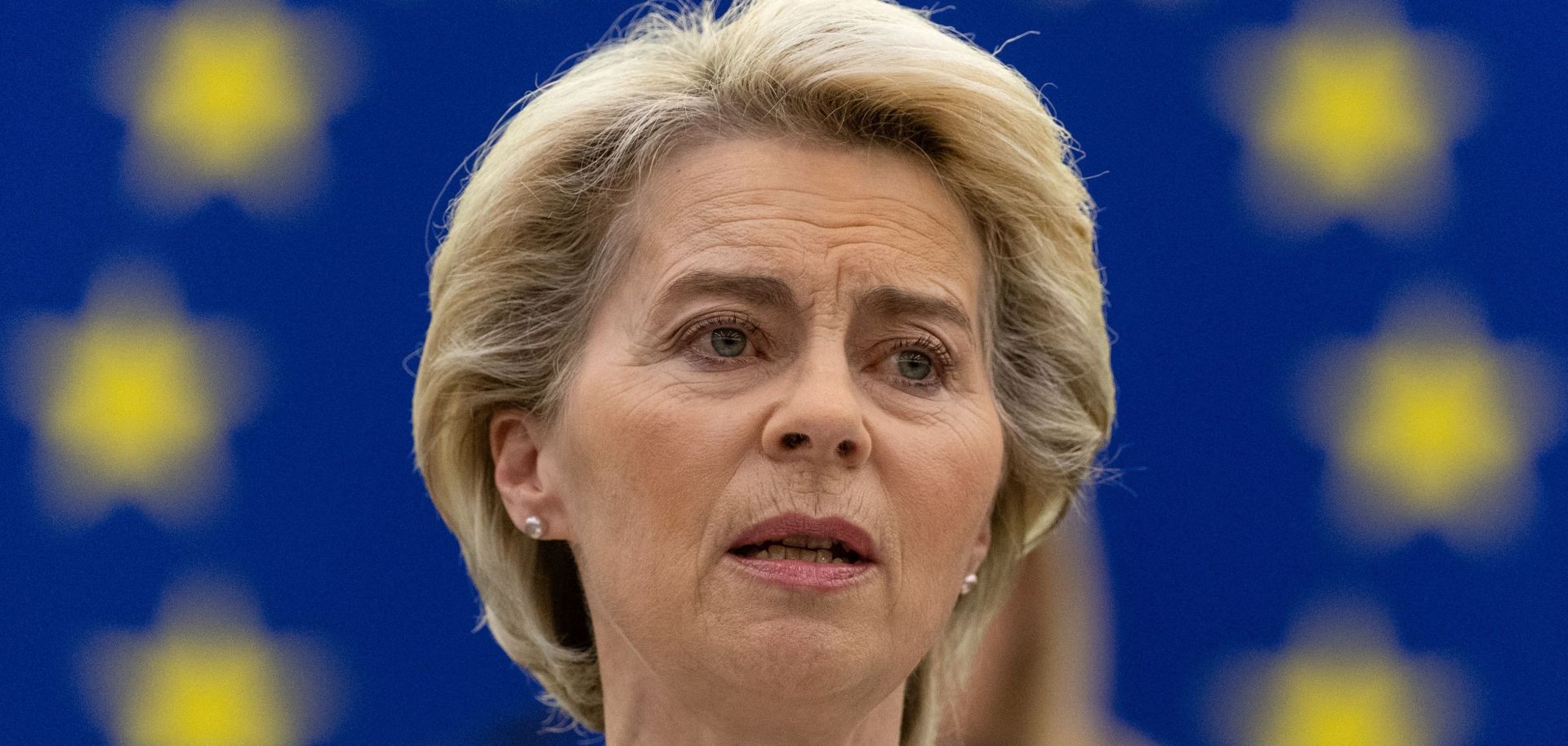
European Commission President Ursula von der Leyen discusses imposing new sanctions against Russia during a plenary session at the European Parliament in Strasbourg, France, on May 4, 2022.
If approved, the European Union's proposed embargo on Russian oil will ripple across global markets, especially if it helps enable more substantial U.S. sanctions targeting Moscow's energy sales to non-Western countries. On May 4, the European Commission proposed a sixth package of EU sanctions against Russia in response to Moscow's invasion of Ukraine. The new measures include:
- An EU-wide embargo on Russian petroleum, with the embargo of crude oil imports entering force in six months and the embargo on petroleum products imports entering force by the end of 2022.
- A ban within one month on the transport, including ship-to-ship transfers, of Russia-origin crude oil and petroleum products by any EU-flagged, -owned, -chartered or -operated vessel to third-party countries (i.e. non-EU member states).
- A ban within one month on EU entities and persons providing any services related to the transport of Russia-origin crude oil and petroleum products, including technical assistance, brokering services, insurance, and financing or financial services.
All of the European Union's 27 member states need to approve the proposal before the sanctions enter force. To secure unanimous support, Brussels may grant exemptions to countries that are most dependent on Russian oil, like Hungary and Slovakia. Countries including Greece, Malta and Cyprus have also expressed concerns about banning EU tankers from shipping Russian oil. Nonetheless, EU foreign policy chief Josep Borrell said the European Union aims to approve the sanctions during the bloc's next Foreign Affairs Council meetings, which are scheduled for May 10 and May 16. But according to Politico, the new measures could be approved even sooner — potentially as early as May 6.
What to Watch For
As EU member states discuss, approve and ultimately implement the new sanctions targeting Russia's oil sector, there are several key things to watch for in the coming months in order to gauge the embargo's overall impact:
Whether the EU grants exemptions to certain countries
If approved, the proposed embargo on Russian oil is slated to come into force for all EU member states' contracts (including long-term contracts) this year. The European Union, however, already appears willing to exempt certain member states from implementing the new sanctions. Just hours after European Commission President Ursula von der Leyen unveiled the sanctions package, Hungary's foreign minister said the country could not support a full EU ban on Russian oil. But it's unlikely that von der Leyen would have announced the package if she was not confident that all countries would get behind the proposal. There are reports Hungary and Slovakia will receive exemptions that will allow them to continue buying Russian oil under long-term contracts through the end of 2023. If Brussels does grant these exemptions, other countries will probably seek them as well, diluting the overall effectiveness of the bloc's embargo. On May 4, Bulgaria's deputy prime minister told a Bulgaria-based financial newspaper that Sofia would seek an exemption if the European Union exempts other countries from the new sanctions. According to Politico, the Czech Republic wants similar concessions to the ones reportedly being granted to Slovakia and Hungary.
How fast European markets adapt
The initial market response to the May 4 unveiling of the new EU sanctions package was fairly small, with the price of Brent crude oil only increasing by about 3-4%. This suggests much of the proposed ban on Russian oil was priced in and that markets are not as concerned about crude oil supplies for European refineries. While this may be the case, how quickly European refiners and supply chains can adapt to the new restrictions may ultimately decide how impactful the sanctions are on European consumers. The refineries most at risk of physical supply disruptions are the ones in Germany, Poland, the Czech Republic, Slovakia and Hungary that are situated along the two arteries of the Soviet-built Druzhba pipeline system. Each of these could import crude oil from sources other than Russia, though in some cases, it would require additional investment like expanding port facilities.
Nonetheless, the refinery in the Czech Republic is connected to a number of other pipelines that can import non-Russian oil. Germany, meanwhile, has recently reached an agreement with Poland to allow its two Druzhba-dependent refineries to use a Polish port to import crude oil. And TotalEnergies, which operates one of the two German refineries along the pipeline, is already planning to phase out the use of Russian crude oil at its Luena refinery in Germany. Hungary and Slovakia, which each have a Druzhba-dependent refinery, may receive exemptions from sanctions allowing them to phase out Russian oil over a longer period. But Hungarian oil and gas company MOL, which operates both refineries, has said it has sufficient capacity in the Adria oil pipeline connected to an oil import terminal in Croatia to supply the two refineries in Hungary and Slovakia. This underscores that Hungary's push for the exemption is more driven by its current government's political calculations, rather than purely economic considerations.
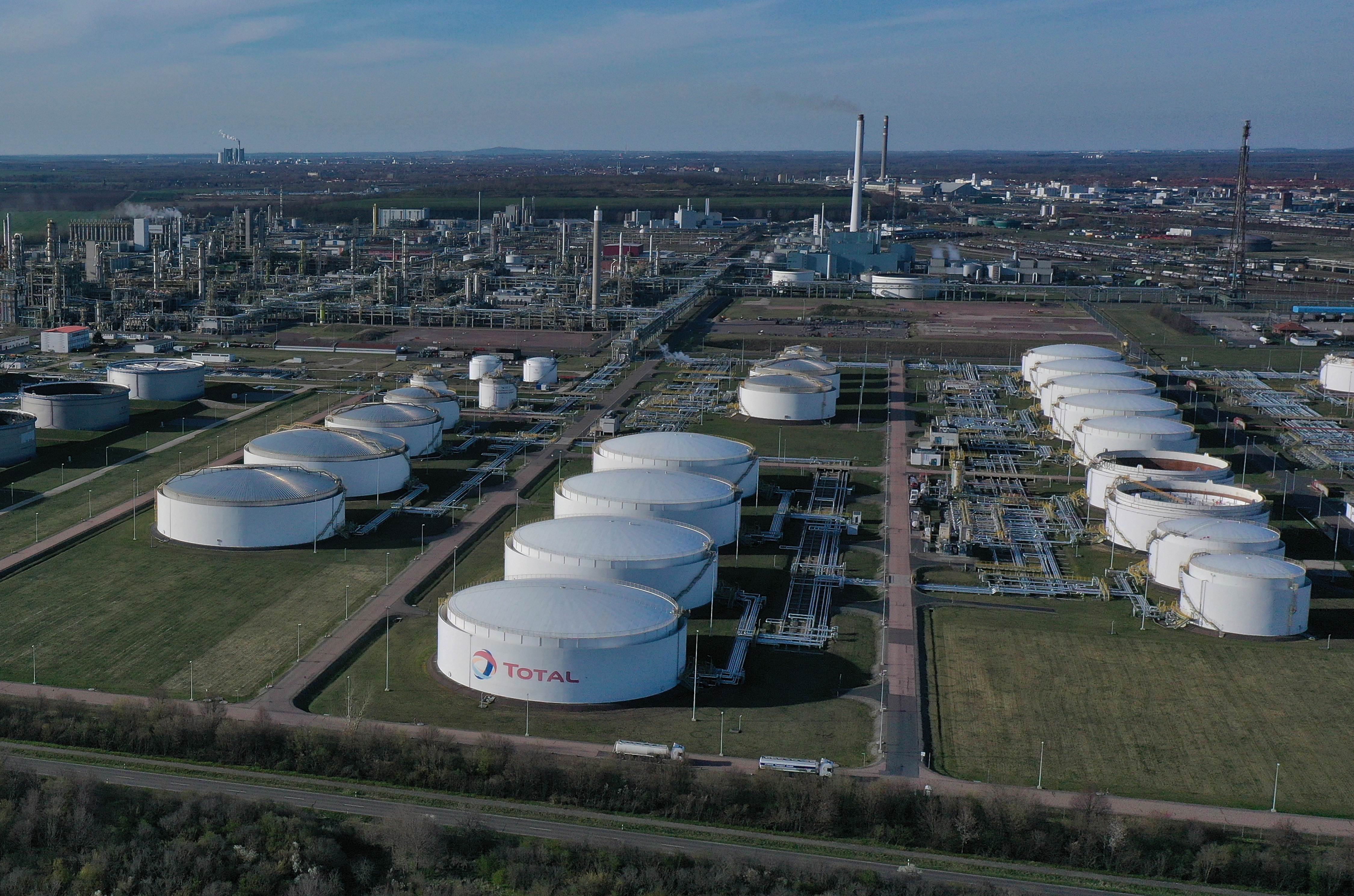
An aerial photo taken on April 12, 2022, shows the TotalEnergies Leuna oil refinery near Spergau, Germany. The refinery is connected to the Druzhba oil pipeline that transports oil from Russia to Germany. (Sean Gallup/Getty Images)
But despite what appears to be alternatives, each of these European refineries will be trying to replace Russia's flagship Urals crude oil sent through the Druzhba pipeline with other medium sour crude. This means that there will be more customers competing in a part of the global market that is already tight due to the self-sanctioning by companies deciding to reduce Russian oil purchases. Many of the largest streams of medium sour crude grades come from Middle Eastern countries like Saudi Arabia, Iraq, Kuwait and the United Arab Emirates — all of which will now be caught between high demand from Asia and increased demand from Europe.
The ban on petroleum product imports — principally Russian diesel — will also exacerbate Europe's ongoing diesel challenges, though the exact impact remains unclear. In April, Europe imported about 770,000 barrels per day of diesel from Russia, or about half of its diesel imports. It is unclear how the EU sanctions, however, will clarify what constitutes ''Russian'' petroleum products (if they do at all), as different intermediate petroleum products (such as naphtha) are often used in the process of making finished petroleum products; even finished petroleum products (including gasoline) are usually blended with different components as well. The fine print of the finalized EU sanctions package could clarify whether the embargo will also apply to products that were either created or blended with any Russian petroleum — which will, in turn, determine how much Russian petroleum products end up in European markets. According to a May 4 Reuters report, some traders are already trying to assess whether or not a diesel blend containing 49% Russian diesel constitutes a Russian petroleum product or not.
The impact of the EU's transport-related sanctions
Although the EU embargo on Russian petroleum is getting the most attention, the proposed ban on transporting Russian oil to non-EU countries may be just as significant due to the potential impact on Russian oil sales to non-Western countries like China and India, which have imposed few (if any) sanctions on Russia. Europe is one of the regions most important to the shipping industry. Many of the world's largest tanker companies are based in the European Union, such as Belgium-based Euronav, Greece-based Tsakos Energy and Greece-based Navios Maritime Holdings, and U.K.-based International Group of Protection & Indemnity Clubs, which collectively provide liability coverage for around 95% of ocean-bound tankers and will follow EU law and regulations. There is already a global shortage of oil tankers and many of them may be unwilling or unable to carry Russian crude due to the new sanctions if they are approved, limiting Russia's ability to export oil beyond the EU market.
Moreover, Russia's Baltic Primorsk and Ust-Luga oil export terminals and the Black Sea Novorossiysk oil export terminal that handle Russia's seaborne Urals crude grade exports are not equipped to handle very large crude carriers (VLCC) or ultra-large crude carriers (ULCC). Instead, most Russian crude oil shipments to Asia are first loaded on smaller tankers at these Russian ports. The smaller vessels transfer the oil to larger VLCCs or ULCCs that then go on to deliver the shipments at Asian ports. Those VLCCs or ULCCs, however, are typically sitting in EU waters and thus could soon be subject to sanctions. In addition, because it takes much longer to reach India (and especially China) from Russia compared with Europe, more tankers will need to be in use at once in order to maintain the same level of crude oil exports if going to Asia instead of Europe.
All of this will make it harder for Russia to find tankers that can export its crude if the EU sanctions are approved. And while India and China have their own fleets of tankers that can and have been used to skirt Iran or Venezuela sanctions, doing so on such a large scale will eat into their tanker capacity, which may deter Beijing and New Delhi from significantly ramping up their Russian oil imports. If the transport sanctions are effective in limiting Russia's ability to export oil currently destined for Europe to other markets, it will not only have a more significant financial impact on Russia, but a more significant impact on overall global oil supplies and, in turn, global oil prices.
The potential expansion of U.S. sanctions
The United States and European Union have been working closely together on their respective sanctions packages. Washington, however, has so far sought to avoid forcing EU states to cut off their imports of Russian oil by imposing secondary U.S. sanctions akin to those that have significantly curbed Iran's global oil exports. But if the European Union implements its proposed embargo, it would remove this roadblock by mitigating concerns about the second-order impact such sanctions would have on virtually all of the United States' NATO allies. This could, in turn, free Washington to more broadly target Russia's oil sales via secondary sanctions if the situation in Ukraine does not improve or if the number of civilian casualties in the war escalates significantly.
Such expansive U.S. sanctions, however, would still make it difficult for India, China and other countries to import Russian oil at high volumes, even at discounted prices — adding pressure on crude oil prices and, more importantly, gasoline prices in the United States. Given U.S. voters' particular sensitivity to rising gas prices, the White House is unlikely to impose broader sanctions on Russian oil ahead of the November midterm elections, though it may have more political space to do so after the vote.
Russia's response
Russia — which exported about two-thirds of its oil to Europe prior to the Ukraine invasion — will probably retaliate against the EU embargo, raising the potential for more economic disruptions in Europe. Moscow recently cut off Bulgaria and Poland's natural gas supplies and has threatened to do the same to other European customers that do not pay for gas using the ruble payment mechanism the Kremlin has set up. The European Union is planning to issue new legal guidance in the hopes of clarifying whether Russia's ruble payment mechanism violates EU sanctions ahead of gas payments due by more customers in the second half of May. If companies do not use the mechanism, the European Union oil embargo makes it even more likely that Russia will retaliate with gas cutoffs. Even if they do use the mechanism, Moscow may still consider cutting off the bloc's natural gas supplies.
Russia can also threaten to cut off other key raw materials and goods that the European Union depends on (such as nuclear power fuel rods, agriculture and fertilizer) or demand that purchasers of these exports use a similar ruble payment mechanism. On May 3, Russian President Vladimir Putin signed a broad decree allowing his government to cut off exports for products and raw materials to people and entities that are on a Russian sanctions list. The decree gives the Russian government 10 days to draft the list of entities that will be affected. It's possible that European firms, especially those announcing a plan to exit Russia investments like TotalEnergies and Shell, are placed on that list. Russia could also conduct cyberattacks against Western targets or retaliate against Western businesses or visitors still active in Russia through asset seizures or arbitrary detentions. The Kremlin's response to the European Union's proposed oil embargo has so far been largely rhetorical, but it is unlikely to stay that way for long.
